Affinity Time introduces a new vocabulary for perceiving and understanding temporal experience. Like all emerging frameworks, it depends on stabilizing its concepts into a shared language. This lexicon gathers the core terms, axes, metaphors, and models that structure the Affinity Time framework. It is both a glossary for readers and a scaffolding for future development, ensuring that Affinity Time remains consistent, communicable, and recognizable as an original contribution.
A living glossary of terms that anchor and expand the Affinity Time framework. This lexicon collects the conceptual vocabulary, mathematical scaffolding, metaphors, and phenomenological anchors needed to navigate the multidimensional model of time.
Core Axes of Affinity Time
Affinity Time is organized around three principal axes, each shaping how historical experience is folded, compressed, or expanded.
Constellational Axis (c) → Measures how strongly events, artifacts, or perceptions are linked across otherwise separate times.
Memory Intensity (m) → Captures how vividly a moment, artifact, or event is remembered, perceived, or reconstructed.
Frequency (h) → Reflects the density of artifacts or signals within a given stratum or context.
These axes interact dynamically: high constellational linkage with strong memory intensity produces bright folds, while low frequency with faint memory may yield ghost layers.
Affinity Time
A multidimensional framework for perceiving time, compressing and folding historical experience through the axes of m, c, and h. Affinity Time unites archaeology, phenomenology, and philosophy of time into a coherent schema.
Affinity
A perceptual and material bond between artifacts, observers, and events. Affinities function as connective tissue across time — the “gravity” pulling disparate nodes together in compressed folds.
Constellational Axis (c)
A dimension that measures how strongly events, artifacts, or perceptions are linked across otherwise separate times. Like stars in a constellation, discrete points are seen as belonging to a single figure or pattern.
Example: A 19th-century miner’s tin can and a 21st-century camper’s aluminum soda can might be constellationally linked through shared use of metal food containers.
Memory Intensity (m)
A phenomenological axis gauging how vividly a moment, artifact, or event is remembered, perceived, or reconstructed.
Measured through scales (e.g., 1–7 Likert ratings).
Strong memories act like bright beacons; faint ones dissolve into the periphery.
Frequency (h)
The archaeological density of objects or signals within a layer or stratum. High frequency thickens the temporal field, increasing the likelihood of folds.
Formula: h=artifactsm2 per stratumh = \frac{\text{artifacts}}{\text{m}^2 \text{ per stratum}}h=m2 per stratumartifacts
Metaphors of Time
Compression / Temporal Fold
When affinities collapse temporal distance, creating curvature in the temporal fabric.
Example: A worn boot evokes the lived struggle of its wearer.
Decompression / Temporal Dilation
The loosening of affinities where time stretches open, distinctions re-emerge, and history dilates into spaciousness.
Fold–Wave Duality
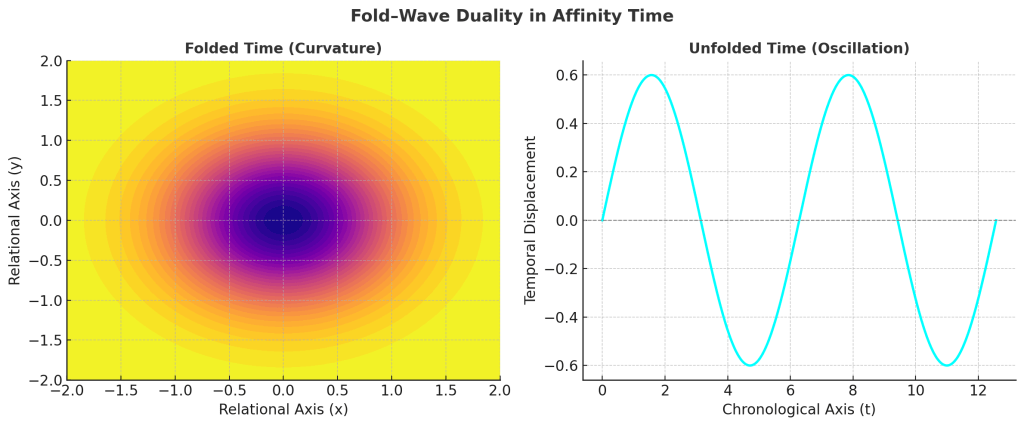
Folds represent internal compressions (curvature of affinities), while their unrolling manifests as sinusoidal oscillations (waves of temporal dilation). Geometry and rhythm are two faces of the same phenomenon.
Oscillatory Unrolling
The conversion of curved temporal folds into sinusoidal waveforms when affinities release at the network’s boundary.
Fourier Decomposition (Maybe Quandary Connection)
Decomposing waves of temporal dilation into fundamental oscillatory components, potentially revealing categorical rhythms of decision and perception (yes/no/maybe states).
Origami Time
The metaphor of time as foldable paper, creased by affinities and refolded into new proximities.
Portal Effect
The experiential moment when an artifact collapses time so vividly that the past feels co-present in the now.
Frequencies of Life
Ratios of compression, transition, and openness in a shadow map. These rhythms represent lived temporal patterns in daily life.
Analytic & Structural Terms
Temporal Fold
A compression of historical time wherein two or more disparate events are drawn close together in perception or affinity.
Shadow Map
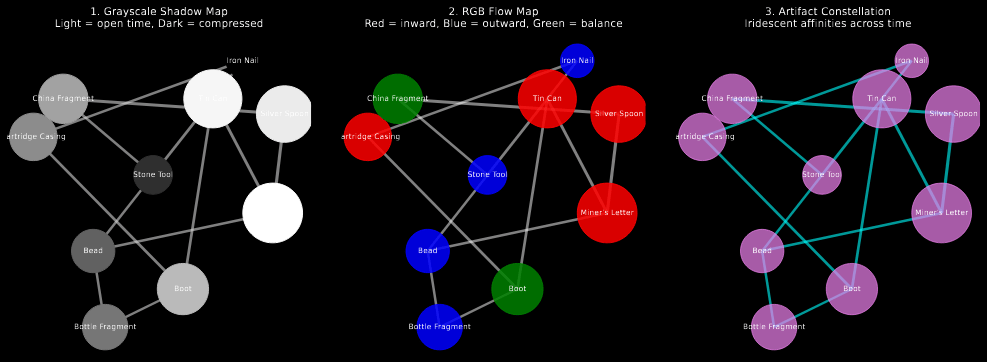
The two-dimensional projection of temporal folds, generated through Affinity Tomography. Shadow maps show which regions of history have been compressed, overlapped, or attenuated.
Ray Set (R)
A bundle of perceptual or analytic rays projected from the observer’s origin through the network of affinities. Each ray accumulates attenuation as it passes nodes and edges.
Formula: Attenuation along ray = Σ(α⋅ri+β⋅ωj)\Sigma ( \alpha \cdot r_i + \beta \cdot \omega_j )Σ(α⋅ri+β⋅ωj)
Pixel Intensity (I)
The output brightness of a tomography pixel: I=exp(−attenuation)I = \exp(-\text{attenuation})I=exp(−attenuation)
Tomography
The technique of reconstructing Affinity Time by passing rays through a graph of nodes (artifacts, observers) and edges (affinities). Inspired by CT scans and network tomography.
Node radius: proportional to frequency
Edge opacity: proportional to affinity strength
Solitary Rays
The beams of perception cast by an isolated observer. Subjective folds and biases emerge here. Solitary rays are both generative (new insights) and risky (illusions).
Networked Illuminations
The shared light field of multiple observers whose rays overlap, intersect, and sometimes clash. Truth emerges through interference patterns and collective negotiation.
Emergent Fields
The higher-order temporal atmospheres that arise when constellational linkages, memory intensities, and frequencies co-constitute a shared time experience.
Radical Disruptor
A solitary ray so powerful it warps the entire topology. Innovators, prophets, and liars alike can fracture consensus and bend the network into new folds.
Entanglement (Metaphor vs. Model)
Metaphor: Borrowed from quantum physics — affinities across time resemble entangled states.
Model: Operationalized as a shared-use index or co-occurrence probability between artifact classes.
Validation Bands
A rubric for interpreting attenuation strength:
≥ 50% → Strong affinity / bright fold
10–49% → Medium affinity / partial fold
< 10% → Weak affinity / negligible fold
Constellational Network
The overall topology of affinities mapped as a graph. Observers occupy barycentric origins from which rays project. Over time, networks evolve like shifting constellations.
Experimental / Poetic Terms
Temporal Explorer
The observer who actively navigates Affinity Time, probing folds and constellations rather than passively receiving them.
Portal Event
A sudden perceptual or material shift that opens a doorway between times, collapsing distances and revealing hidden folds.
Evental Horizon
A perceptual boundary within Affinity Time beyond which events cannot be seen, remembered, or reconstructed. Like the event horizon of a black hole, it marks the threshold where affinity and memory intensity collapse into opacity.
On one side: folds, affinities, and constellations are still retrievable.
Beyond it: history dissolves into unknowability, leaving only traces and gravitational pull.
Chronotope
Borrowed from literary theory (Bakhtin), but here extended to Affinity Time: narrative or experiential landscapes where time and space fuse into coherent, perceivable forms.
Liminal Residue
Faint traces at the edges of folds — afterimages, echoes, or ghost-affinities that suggest a fold was almost, but not fully, formed.
Ghost Layer
A stratum of history that remains invisible until lit by an observer’s ray. Ghost layers haunt the edges of perception, demanding attention to overlooked or marginalized times.
Time-Bender
An observer who actively shapes the topology of temporality through perception, memory, and meaning. In Affinity Time, all observers are time-benders, whether or not they are aware of it: their affinities crease, compress, or dilate the temporal fabric. Self-aware time-benders recognize their agency in bending time; networks of time-benders can achieve collective reflexivity, generating emergent folds that alter history as shared experience.
Closing Note
This lexicon is iterative. As Affinity Time expands — into philosophy, physics analogies, archaeological case studies, and data visualizations — the lexicon will expand alongside it.
This synopsis situates Affinity Time alongside landmark contributions in three fields: archaeology, philosophy of time, and phenomenology, demonstrating both its intellectual lineage and its novelty. With the recent expansion of its conceptual apparatus, Affinity Time now stands as both a synthesis and an extension, combining inherited insights with new axes, dualities, and computational metaphors.
Field Comparisons
Archaeology
Contribution
Parallel
Divergence
Processual (Binford, 1960s)
Systematic framework across artifacts
Phenomenological, adds axes (m, c, p, h, e)
Post-Processual (Hodder, 1980s)
Shares interpretive focus on meaning & perception
Formalizes interpretation into coordinates + tomography
Extends to visual & mathematical models (Fourier/Maybe)
Expanded Contributions
Taken together, these comparisons show that Affinity Time stands on the shoulders of giants: Augustine’s memory, Bergson’s durée, Husserl’s retention, Heidegger’s thrownness, and archaeology’s assemblages and multiple temporalities. Yet it does not merely echo them. Its novelty lies in:
Coordinate system with expanded axes — t (chronological), m (memory intensity), c (constellational linkage), p (perceptual proximity), h (horizon density), e (entanglement/emergence).
Fold–Wave Duality — time can appear as compressed folds (shadow maps, attenuations) or oscillatory fields (waves, Fourier states of “yes/no/maybe”).
Visualizable models — tomographic projections, shadow maps with threshold bands, and iridescent RGB overlays for simultaneous dimensional expression.
Observer as origin — the observer’s standpoint acts as the barycenter or light source, with calibration possible across individuals and networks.
Application beyond archaeology — climate debates, social media networks, policy response timelines, and memory studies.
Handling indeterminacy — the Maybe Quandary and Fourier decomposition model how uncertainty itself leaves a temporal signature.
Conclusion
If archaeology and philosophy have long struggled with how to articulate non-linear time, Affinity Time offers one possible synthesis: a multidimensional, perceptual, and computationally suggestive model. It transforms artifacts from inert remnants into active coordinates of temporal affinity, and it reframes the observer not as detached analyst but as the very source of illumination that reveals folds, waves, compressions, and constellations.
Whether in a museum, a dataset, or a network of social relations, Affinity Time invites us to perceive history as a living present, a shimmering field where memory, perception, and connection overlap ; a space where all things relate to all other things.
The Observer as Light Origin: Individual and Perceptual Dimensions
At the heart of this metaphor is the point of origin for the tomographic light stream, which symbolizes my standpoint as the observer. This origin represents not only a spatial or vectorial position, aligned for instance with the network’s time axis, but also my perceptual state, encompassing cognitive frameworks, prior assumptions, and interpretive lenses. In phenomenology, I do not merely record data; I co-create the observed world through my situated awareness. Similarly, in Affinity Time, the light’s origin embodies this duality: as the individual historian or analyst, I direct the inquiry, casting illumination that “brings into being” patterns of affinity and compression.
For example, when projecting through a network of ghost town artifacts, my perceptual state influences how affinities (e.g., between cartridge casings and conflict activities) are highlighted. The light stream travels as a field of awareness, interacting with the network’s nodes and edges to reveal temporal dynamics. This underscores a key philosophical insight: temporal foldings, where affinities fold and compress time, are perceptual artifacts. The framework invites humility, recognizing that what I perceive as compressed time is shaped by my light, much like how context folds historical interpretations into subjective narratives.
To clarify the process, I define light tomography in this context as a simulated ray-tracing technique adapted from network tomography principles in graph theory. Network tomography traditionally involves inferring internal characteristics of a graph such as densities or flows from endpoint measurements, often applied in communication or social networks to estimate hidden parameters without direct access to the interior. In Affinity Time, I extend this metaphorically: the “light” consists of virtual rays originating from my position as observer, traversing the 3D-embedded network structure. The network itself is a graph where nodes represent artifact categories (e.g., ‘suspender clips’ as a node sized by frequency), and edges are weighted connections reflecting affinities (e.g., production-to-use flows, with thickness proportional to strength). These internal structures of clusters of densely connected nodes or high-weight edges obstruct the rays variably: rays passing through sparse areas continue unimpeded, while dense internals (e.g., overlapping affinities compressing time) attenuate or scatter the light, creating shadows. The resultant patterns on the projection surface visualize temporal dynamics directly tied to the network’s topology.
What is meant by “light tomography” in the Affinity Time framework borrows principles from medical CT scans and network tomography but applies them conceptually to perceptual analysis of historical or archaeological data. It involves imagining infinitesimal, parallel rays of perception originating from the observer’s vantage point (the origin) and traveling along a chosen vector through a 3D graph representation of affinities. During traversal, each ray interacts with the graph’s nodes and weighted edges. In a computational sense, this could be simulated by counting the graph elements within the ray’s path, but philosophically, it represents attenuation: denser, higher-weighted structures reduce the ray’s intensity, akin to how obstacles absorb or scatter light. On the opposite side of the network lies a projection plane, an abstract screen where the cumulative attenuation of all rays renders as a grayscale image: White (approximately 0% attenuation) indicates minimal internal structure, symbolizing open, uncompressed time. Mid-gray (1 to 49% attenuation) shows partial obstruction, representing zones where temporal layers stretch or decompress. Black (≥50% attenuation) denotes strong obstruction, visualizing temporal folds where affinities collapse elements together. Since the rays emanate from the observer’s position, the resulting shadow map is inherently calibrated to what can (and cannot) be perceived from that standpoint.
The network structure is a 3D-embedded graph that models artifact affinities. Nodes represent categories or subcategories of artifacts (e.g., suspender clips, tin cans, cartridge casings), with their radii scaled by observed frequency, with larger nodes for more common items, which cast broader shadows in the tomography. Edges connect nodes based on affinities, such as production-to-use relationships, spatial co-locations, or functional similarities. Edge weights quantify the strength of these affinities, acting like thickness or opacity in the ray model; higher weights indicate stronger attractions (or repulsions) derived from data analysis, such as correlation metrics or inferred links via graph neural networks. The graph is oriented with time along the Z-axis: elongated edges or tall nodes suggest extended chronological spans, while flattened clusters imply simultaneous or rapid depositions. Obstruction occurs when a ray passes through: high-frequency nodes (large cross-sections due to abundance), high-weight edges (thick connective elements), or overlapping subgraphs (convergent clusters of ties). The greater the material traversed, the darker the pixel on the projection screen, directly mapping network topology to visual patterns.
Why the observer must be the origin: Positioning the observer at the light’s origin is essential, as shifting it warps the entire pattern, dark zones shift, new gaps emerge, and others disappear. This renders the compression map explicitly perspectival. From a personal perspective, the observer’s prior assumptions direct the light vector, illuminating specific graph regions. Different interests would redirect the beam, altering visible compressions.
Collective Observation: Participatory Perception and Calibration
Extending beyond my individual perspective, I conceive of the observer in Affinity Time as potentially manifesting in a networked form, where a collective of participants contributes to the perceptual field through mechanisms like prediction market-style feedback. In this configuration, the “light origin” shifts from a singular point to a distributed network of observers, each illuminating aspects of the unknowns within the affinity structure. This collective perceptual field expands the scope of inquiry, allowing shared insights to refine edge weights and inferred elements, such as wagering on the probability of affinities between artifacts. The aggregation of these contributions generates a consensus that calibrates the network, transforming isolated perceptions into a broader, interconnected field of awareness.
This networked observation draws parallels to the quantum observer effect, where the act of measurement interferes with the system itself, collapsing probabilistic states into definite outcomes. In quantum mechanics, observation is not neutral; it disturbs the observed, introducing interference that alters wavefunctions and measurements. Similarly, when observers form a network in Affinity Time, their participatory inputs create feedback loops that can interfere with the data, potentially distorting inferences. For instance, as users’ bets converge on certain affinities, these loops may amplify prevailing assumptions, echoing how quantum interference patterns emerge from repeated interactions. This amplification risks bias: initial perceptions, if dominant, could cascade through the collective, skewing calibrations and compressing temporal interpretations toward consensus artifacts rather than objective dynamics.
The concept here centers on the observer’s expanded role: as a network, the perceptual field becomes a dynamic interplay of interferences, where each participant’s “measurement” influences the whole. This introduces potential distortions like feedback loops that reinforce biases, much like quantum decoherence where environmental interactions collapse possibilities. It also enriches the field, allowing unknowns to be probed through collective scrutiny. Perception remains active and constitutive: the networked observer does not merely reveal but shapes the temporal affinities, with interference serving as a reminder of the inherent uncertainties in data interpretation.
Collectively, when calibration involves a crowd such as through prediction-market betting on edge weights, the origin becomes the barycenter of participants’ expectations. This aggregated “light” uncovers compressions that individual views might miss, fostering a shared perceptual field.
Interpreting the Shadow Map: Shadows, Transitions, and Light
The tomographic projections offer a rich canvas for philosophical interpretation, where patterns of light, transition, and shadow symbolize the interplay of temporal certainty and flux. Shadows; areas of deepest darkness are defined as grayscale values exceeding 50% and represent calibrated compressions where affinities densely overlap to fold time. These black zones visualize regions of intense temporal density, such as clustered survival artifacts compressing daily existence into survival imperatives, as refined by collective calibration. The obstruction occurs when rays encounter internal structures: high-density node clusters or thick edges block or diffuse the light, manifesting as shadows that indicate where affinities are pulling elements together, effectively compressing the perceived flow of time.
Transition zones, rendered in gray values, embody consensus uncertainties: intermediate gradients where affinities decompress or expand, reflecting divergences in user perceptions (e.g., debated links that pull temporal layers apart). These grays signify the liminal spaces of interpretation, where perception negotiates ambiguity, neither fully illuminated nor obscured, but in flux. These zones, with partial obstructions allowing some light to pass, represent time decompressing, as affinities loosen and temporal layers spread out.
Light areas, appearing as white or near-white regions, denote openness and sparsity: uncompressed temporal expanses where affinities are minimal, inviting further inquiry. Rays pass freely through these sparse internals, resulting in bright projections that highlight where time flows without compression. Together, these elements form holistic ratios like shadow to transition to light that proxy perceptual balance, revealing how compressed versus expansive experiences dominate the inferred “frequencies of life.” The projections serve as perceptual mirrors, casting the network’s dynamics onto a surface where time’s folds become visible artifacts of observation.
Crucially, these patterns are only directly perceptible by positioning the individual or the individual as part of a network as the point of origin for the light stream or vector. From this vantage, the tomography aligns with their perceptual field: the rays emanate from their position, ensuring that obstructions and passages are experienced relative to their viewpoint. Any other angle would distort the patterns, losing the direct correspondence between perception and projection. This setup reinforces the phenomenological principle that reality unfolds through the observer’s embodied perspective, making the compressions and decompressions intimate revelations of my interpretive act.
The shadow map’s tones provide a visual grammar for temporal dynamics:
Tonal Band
Graphical Cause
Temporal Meaning
Black (≥50%)
Multiple dense nodes and heavy edges stacked along the ray path
Time is highly compressed or “folded”, activities overlap tightly, blurring distinctions (e.g., rapid cycles of conflict and reprisal).
Gray (10–49%)
Partial obstruction; a single dense node or moderate edge bundle
Transitional phases, time stretches or relaxes; rival interpretations coexist.
White (<10%)
Sparse topology; rays pass through empty graph space
Open or dilated time, activities were rare, peripheral, or poorly preserved.
Global ratios (black:gray:white) serve as a phenomenological proxy for the rhythms of daily life inferred from the artifact assemblage.
Enhancing the Shadow Map: From Grayscale to RGB Shift for Directional Insight
To further enrich the perceptual tomography in the Affinity Time framework, I propose extending the grayscale shadow map into an RGB color shift, introducing an iridescent visual effect that captures not only the density of temporal compressions but also the directional flows within the network. In this adaptation, the monochromatic scale—where black signifies profound obstruction (compressed time via stacked dense nodes and heavy edges), gray denotes transitional ambiguities, and white reveals sparse, dilated expanses, is supplanted by a trichromatic model. Red channels could encode inbound affinities like convergent flows toward a node, such as artifacts drawn into survival clusters during frontier crises, green for balanced or static interactions, and blue for outbound divergences such as radiating uses from a production node like tin cans dispersing into sustenance activities. As rays traverse the 3D graph, attenuation now modulates hue and saturation alongside intensity: high-density paths might shift toward crimson iridescence if directional vectors point inward, evoking the perceptual “pull” of historical pressures, while outward expansions shimmer in azure tones, symbolizing temporal diffusion. This iridescent overlay, akin to the play of light on opal surfaces, emerges from simulated interference patterns in the ray-tracing, where overlapping affinities create chromatic fringes that highlight movement directions, revealing for instance how cartridge casings “flow” toward conflict nodes rather than merely clustering statically.
The benefits of this RGB shift are manifold, offering heightened resolution and multidimensional data encoding that grayscale alone cannot achieve. By leveraging three color channels, the visualization accommodates richer perceptual constructs: colors dissect directional nuances that might otherwise blur into uniform shades, allowing observers to discern vectorial dynamics such as the asymmetric pull of episodic events compressing time unevenly across the network. This not only provides more data (quantifying flow asymmetry via color gradients) but enhances interpretive fidelity, as iridescence intuitively mirrors the fluid, multifaceted nature of human traces in archaeological records. It deepens the observer’s immersion, transforming the projection into a vibrant perceptual artifact where colors co-constitute temporal realities, inviting reflections on how directionality shapes our embodied understanding of the past’s malleable folds. In collective calibrations, participants could even wager on directional probabilities, further tinting the map with consensus hues and underscoring the active, interferential role of perception in unveiling hidden historical currents.
Folds and Waves: Dual Expressions of Affinity Time
Within the Affinity Time framework, folds in temporality have thus far been modeled as compressions: dense affinity clusters bending the flow of time into depressions, like spherical curvatures in the temporal fabric. Yet observation of these folds reveals a deeper duality.
When the curvature of a fold is projected or unrolled onto a flat baseline, it does not disappear into uniformity. Instead, the curvature manifests as an oscillatory pattern, most naturally taking the form of a sinusoidal wave. The smooth efficiency of the sine function reflects the geometry of curvature distributed across a flat surface.
This suggests that Affinity Time is not only topological (folds and compressions) but also oscillatory (waves and ripples). The two are inseparable expressions of the same underlying phenomenon:
Inside the network, affinities pull time inward, generating folds and spherical depressions.
At the boundary and beyond, these folds unfold into sinusoidal waves, rippling outward as dilated temporal flows.
I propose a novel fold–wave duality within Affinity Time: compressions are experienced as curved surfaces of time, while decompressions appear as oscillatory undulations. This mirrors broader physical and phenomenological metaphors like Einstein’s spacetime curvature alongside Schrödinger’s wave mechanics; Husserl’s thickness of the present alongside Merleau-Ponty’s temporal rhythms.
Diagram: Fold–Wave Duality
This paper advances the Affinity Time framework by introducing the fold–wave duality, a novel principle in which temporal compressions (folds) are conceived as curvatures within affinity networks, and their subsequent unrolling manifests as oscillatory waveforms, thereby uniting topology and rhythm in the perception of time.
The implication is that Affinity Time should be modeled in both topological and waveform registers. Folds visualize the density of affinities within the network; waves visualize the release of those affinities once time dilates beyond the network’s edge. In this sense, the Affinity Time framework encodes not just the geometry of history but its rhythms: compressions become beats, decompressions become flows.
Resonance States and the Maybe Quandary
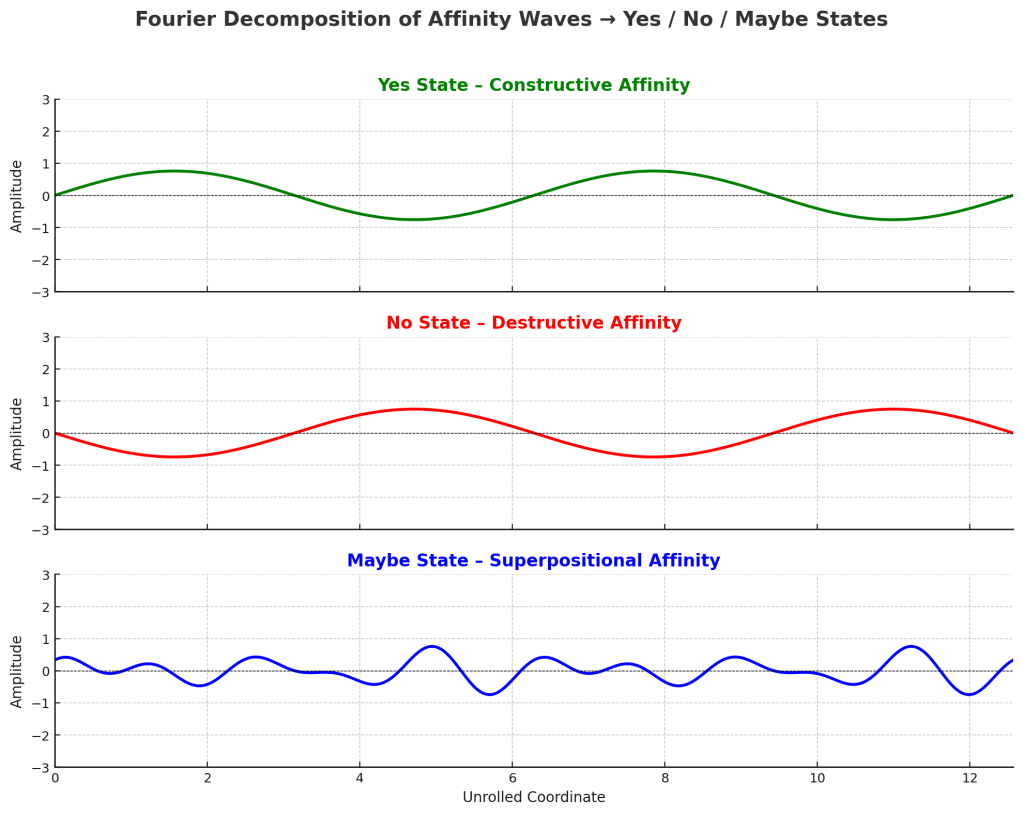
The unrolling of folds into sinusoidal waves reveals not only the rhythmic structure of time but also its ternary logic. When subjected to Fourier decomposition, these oscillations display three recurring resonance states: constructive alignment, destructive cancellation, and ambiguous superposition. These map directly onto what I have elsewhere called the Maybe Quandary or the philosophical problem of indeterminacy, where truth and decision are not binary (yes/no) but oscillatory (yes/no/maybe).
Within Affinity Time, this means that every fold of history does not simply dilate outward into smooth continuity; it resonates. The Yes state arises when affinities reinforce one another into coherent presence. The No state appears when affinities negate or cancel, producing troughs of absence. The Maybe state emerges when affinities partially overlap without resolution, producing ambiguity as a structural feature of time itself.
The implication is that uncertainty is not a flaw in perception but a fundamental rhythm of temporal unfolding. Affinity Time therefore encodes both the geometry of compressions and the logic of oscillations, uniting topology and ternary resonance in a single framework.
Fourier Decomposition and the Yes/No/Maybe States
In extending the fold–wave duality of Affinity Time, we observe that the unrolling of affinities into oscillatory patterns does not produce a single, uniform sine wave. Instead, Fourier-like decomposition reveals distinct repeating motifs that can be interpreted as temporal “states.”
Yes State (Constructive Affinity): Peaks align through reinforcement of multiple affinities, producing a clear, amplified waveform.
No State (Destructive Affinity): Affinities cancel each other, generating troughs or near-flat intervals where temporal resonance collapses.
Maybe State (Superpositional Affinity): Partial overlap of frequencies produces ambiguous, oscillatory motifs which are neither wholly reinforced nor wholly negated.
The Fourier spectrum of Affinity Time suggests that affirmation, negation, and indeterminacy are not merely logical categories but structural consequences of affinity interference. The “maybe” state, in particular, emerges as a natural mode of temporal flow, a ripple born of partial alignments across divergent folds.
Greater Implications
Through its tomographic metaphor, the Affinity Time framework invites broader reflections on perception and reality in archaeological and historical inquiry. By aligning the observer , whether individual or collective with the light origin, it underscores that temporal insights are perspectival, akin to observer effects in broader scientific paradigms where measurement shapes the measured. This avoids claims of absolute knowledge, instead embracing time as a perceptual construct: affinities fold and compress not in isolation, but through the illuminating act of observation.
The introduction of the fold–wave duality deepens this picture. Folds appear as curvatures in time, dense compressions within the network where affinities accumulate. Yet when these curvatures are unrolled, they reveal themselves as oscillatory waveforms, sinusoidal undulations that carry history outward as rhythm. Affinity Time therefore encodes both geometry and music: compressions become beats, decompressions become flows.
Conclusion: Shadows, Folds, Waves, and Resonance
Through its tomographic metaphor, my Affinity Time framework invites broader reflections on perception and reality in archaeological and historical inquiry. By aligning the observer as an individual or collective with the light origin, I underscore that temporal insights are perspectival, akin to observer effects in broader scientific paradigms where measurement shapes the measured. This avoids claims of absolute knowledge, instead embracing time as a perceptual construct: affinities fold and compress not in isolation, but through the illuminating act of observation. Such implications extend to existential questions about human traces across eras, where artifact networks become canvases for contemplating time’s malleability. Future explorations might integrate immersive technologies, allowing observers to “embody” the light origin and experience projections firsthand, further blurring the line between perceiver and perceived.
By constructing the graph, anchoring the observer (individual or collective) at the origin, and projecting this perceptual tomography, the framework yields a shadow map of history. It does not claim to reveal the “true” interior of the past but instead shows how the past compresses, stretches, or vanishes when illuminated from a specific stance. Affinity Time fulfills dual roles in this application: Analytical in that it distills vast artifact data into a single interpretable image, where darkness, gradients, and voids correspond to quantifiable network properties. It is reflective because it underscores that historical claims are angled by the chosen standpoint and the “light” questions, models, and expectations projected through the data.
To this foundation we now add resonance. The fold–wave duality reveals that compressed affinities, when unrolled, do not simply disperse — they oscillate. Fourier decomposition of these waves exposes a ternary rhythm: reinforcement (Yes), cancellation (No), and superposition (Maybe). This “Maybe Quandary” is not an external supplement but an intrinsic feature of Affinity Time: uncertainty itself is patterned, expressed as oscillatory ambiguity within the unfolding of history. Thus, Affinity Time models not only the geometry of folds and the rhythm of waves, but also the resonance states through which affirmation, negation, and indeterminacy co-constitute our experience of time.



 The Rosita Museum