
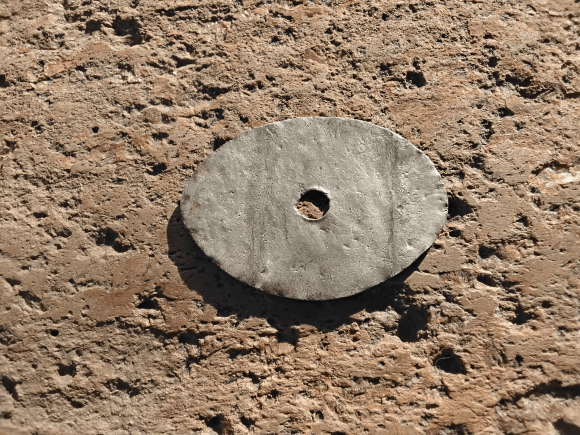
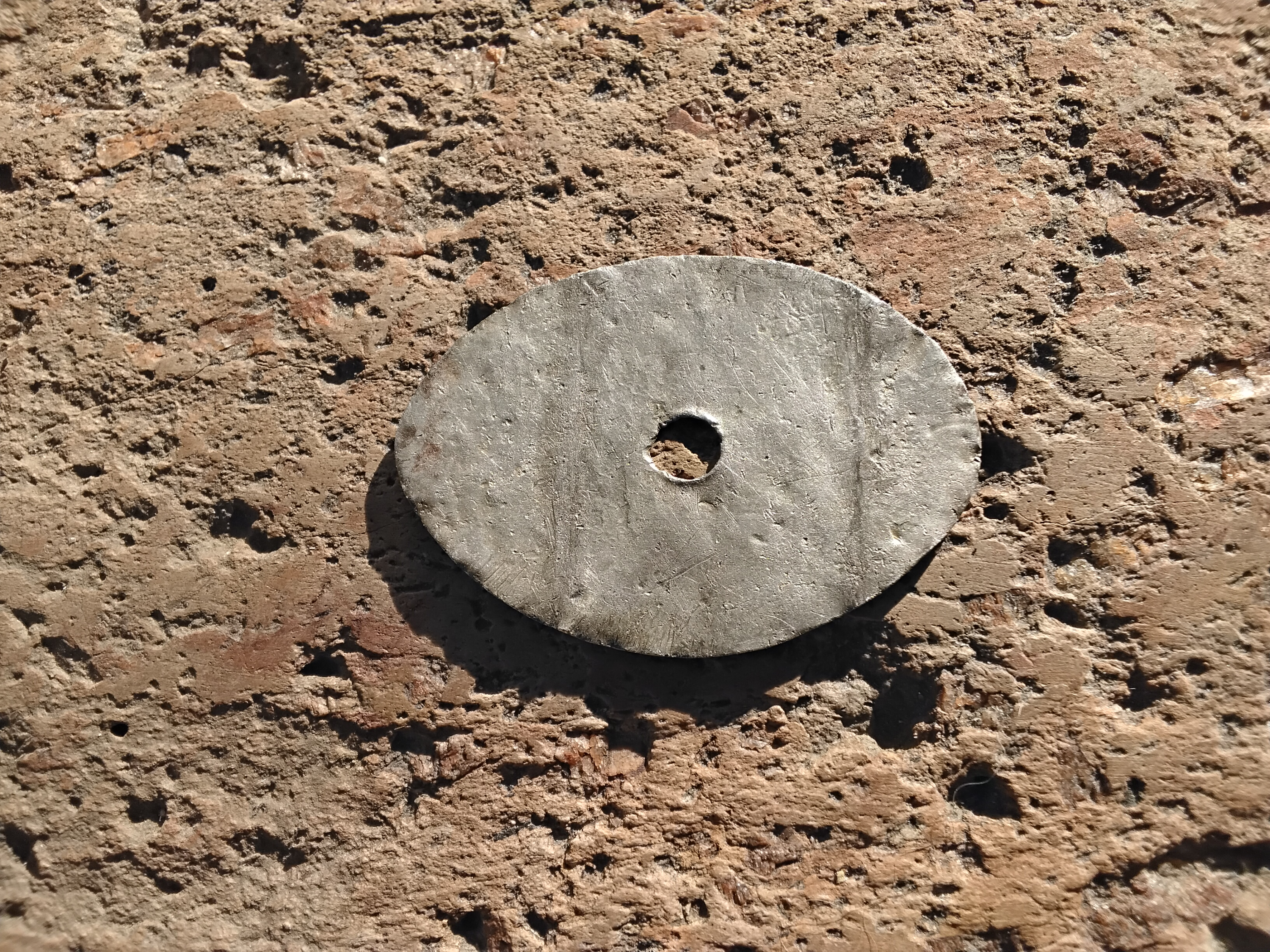
Long gun cheek inlay made from a Spanish silver coin, late 18th century or early 19th century
The silver coin is a Spanish two reales from the 18th or early 19th century with portions of the legend visible including part of “CAROLUS” and “DEI”. It would have been affixed to the stock of a long gun. This was popular as a decorative element during the late 18th and early 19th centuries on American muskets and rifles, predating the mining era of Rosita. There are several sets of tiny, handcarved initials, likely done with a very fine point or edge reading “IW” or “MI” depending on the artifact’s orientation. This piece was folded up in two places when found, indicating it was not lost directly from the gun, but was removed from the gun and modified before being lost or discarded. This artifact represents the late Spanish Colonial, Mexican, and or Fur Trade eras in Rosita.
Discovered and donated by Chris Ueberroth
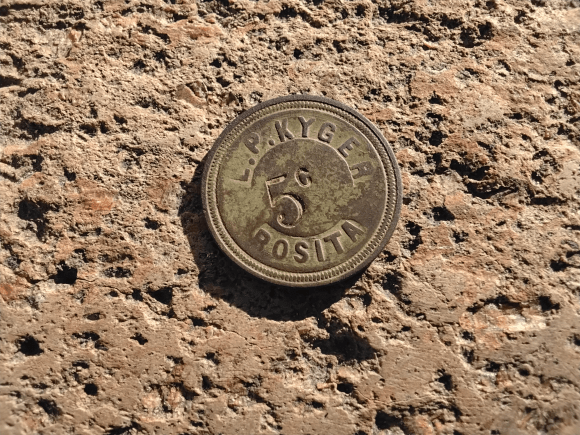
L.P. Kyger Trade Token from ‘the Snug’ Saloon
Lem Kyger owned and operated ‘the Snug’ saloon in Rosita, Colorado. These trade tokens were given as promotions or in lieu of change. This is the only known example of this token, and it would have been redeemable for a beer, soda, or cigar. This token dates to ca. 1880.
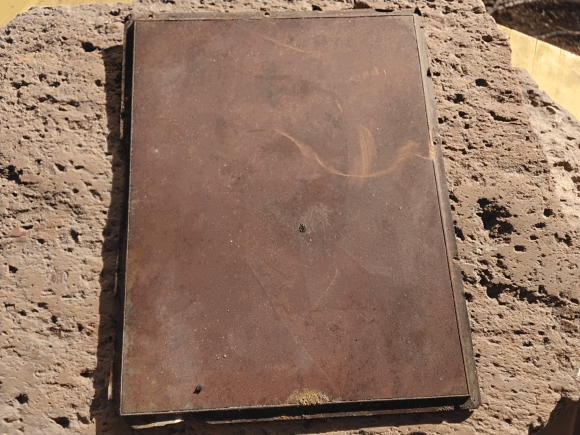
Carl Wulsten Copper Printing Plate
This copper printing plate was discovered in the back yard of a home site in Rosita. The image on the plate is of a middle aged Carl Wulsten. Carl Wulsten was the founder of the failed German Colfax Colony on the valley floor, and later became influential in the founding and development of Rosita.
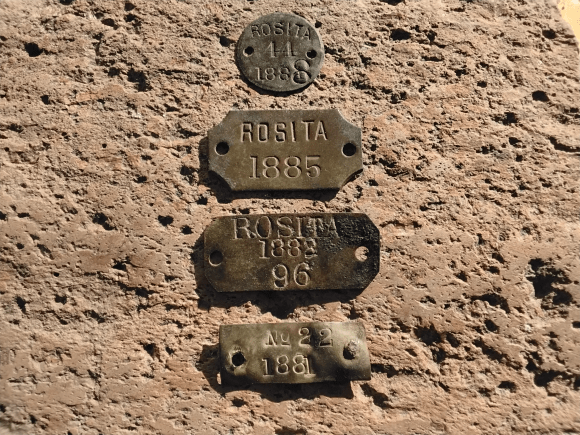
Dog Tax License Tags
In 1881 the Rosita Sierra Journal ran an advertisement advising that beginning that year all dogs in town must be registered and tagged, and that a “man with a shotgun” was hired to kill untagged dogs after a certain date. Packs of dogs roaming the town and behaving badly had become a problem. Rosita also experienced a personal milestone- the town had only 5 years before been on the frontier of the Wild West, and now a dog tax must be paid or the town would kill the dog. These specimens include a home made 1881, 1882 overstamped with the year 1883, 1884 overstamped with the year 1888, and 1885.
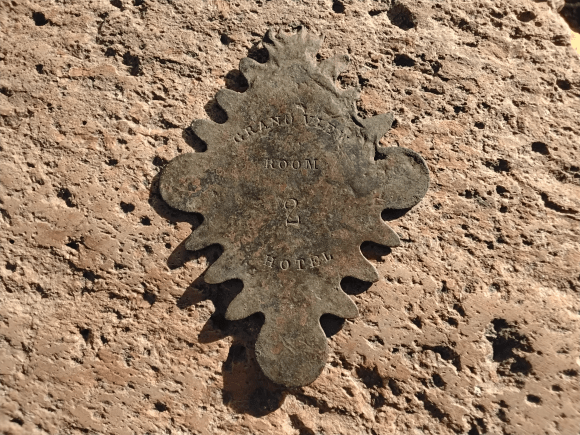
Grand View Hotel Key Fob
This brass keyfob is for room 2 at the Grand View Hotel. The Grand View Hotel was located on Tyndal Street, in the main business district next to Miller’s Store where the great fire of 1881 started. The Grand View Hotel burned down in that fire, and that incident is probably the cause of the melted metal seen on the upper part of this key fob. The eccentric shape was intended to prevent travelers from leaving town with their room key forgotten in their pocket.
Prehistoric Hafted Bifaces- knife and dart points
Three hafted bifaces from Rosita. The two bifaces on the left are from the same site. They are made from white chalcedony, heat treated petrified wood, and Trout Creek chert quarried from near Buena Vista. They are all likely of the Pelican Lake type and are around 2,000 to 4,000 years old. The two on the sides are dart points, used in conjunction with a dart thrower (atlatl). The larger middle specimen was used as a knife at the time it was lost, but would have been reduced in size over time from resharpening episodes, until finally being used as a dart tip.
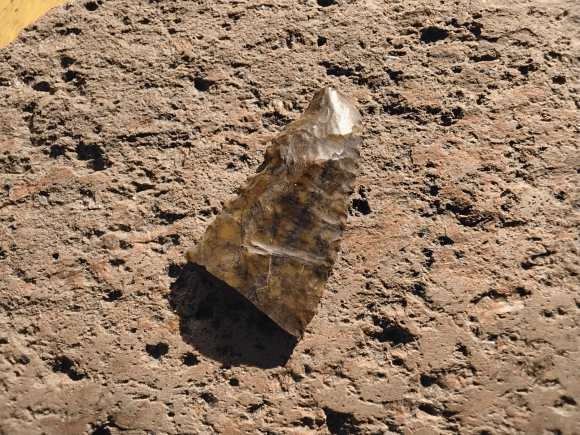
Paleo Indian blade or flake knife
This is the oldest man made artifact from Rosita in the collection of the museum. This is a blade or flake knife made by a very specific and distinctive flintknapping technique where a series of uniformly long and thin blades are produced from a polyhedral core. Similar technology is seen at the Friedkin and Gault sites in Texas in Clovis and pre Clovis levels. That would make this stone tool more than 13,000 years old.
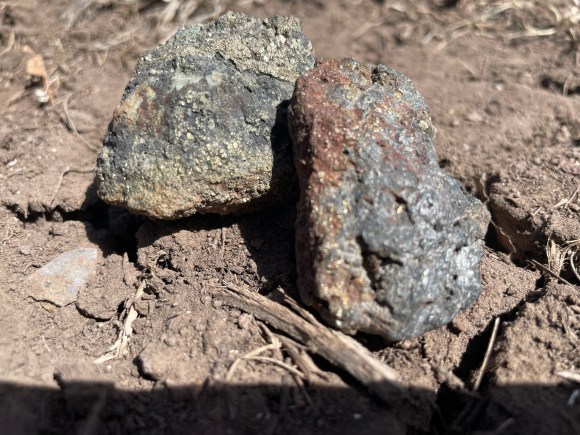
What does Rosita silver ore look like?
Rosita silver ore can take on many appearances. It can be mostly hidden by barite or calcite crystals. It is often combined with or found adjacent to varying amounts of lead, copper, pyrite, arsenopyrite, and iron oxide. Some of the more interesting specimens are digenite. Pictured are two specimens from Rosita.
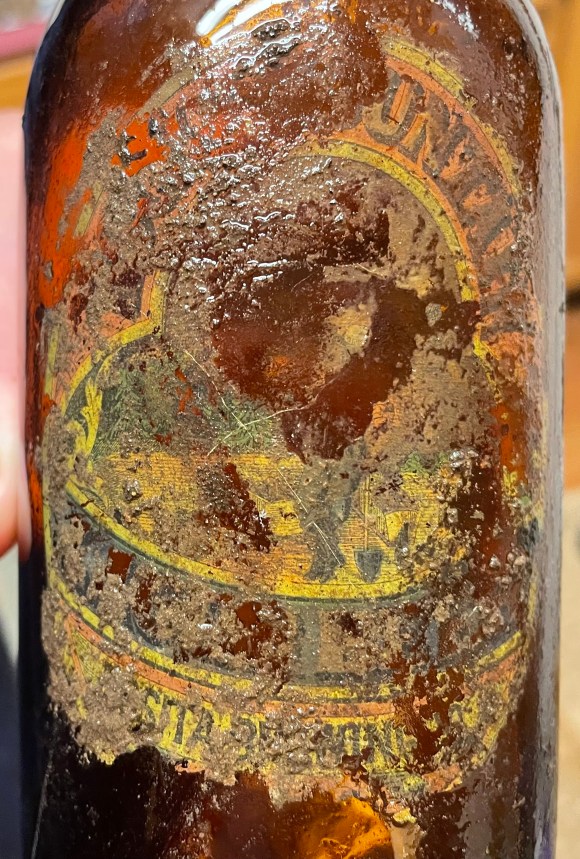
Rosita Brewing Company, Rocky Mountain Lager Beer, partial paper label on amber quart beer bottle, ca. 1881-1886.
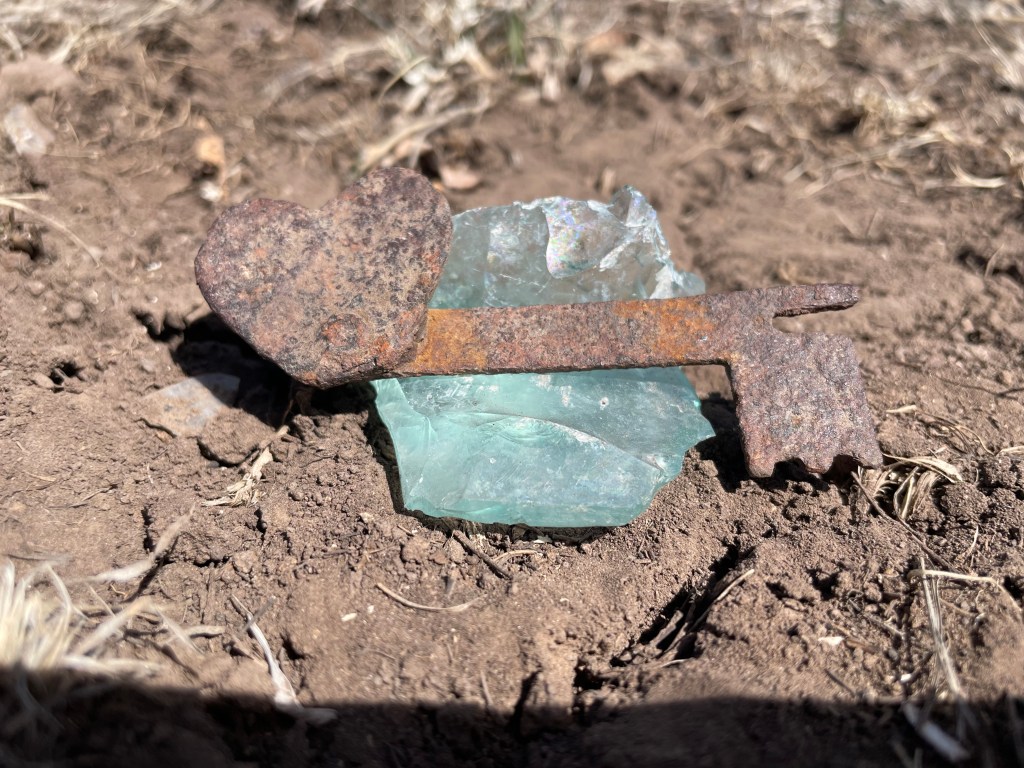
Primitive hand forged iron key, ca. 1875
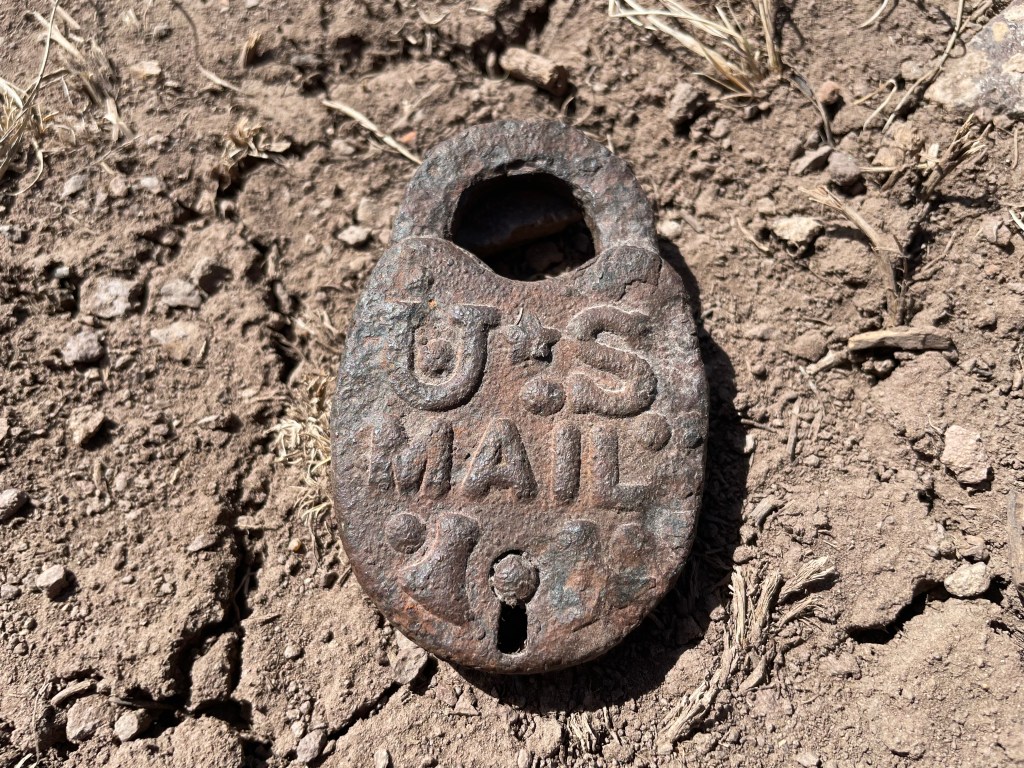
U.S. Mail iron padlock, stamped “1883” on the reverse of the bail
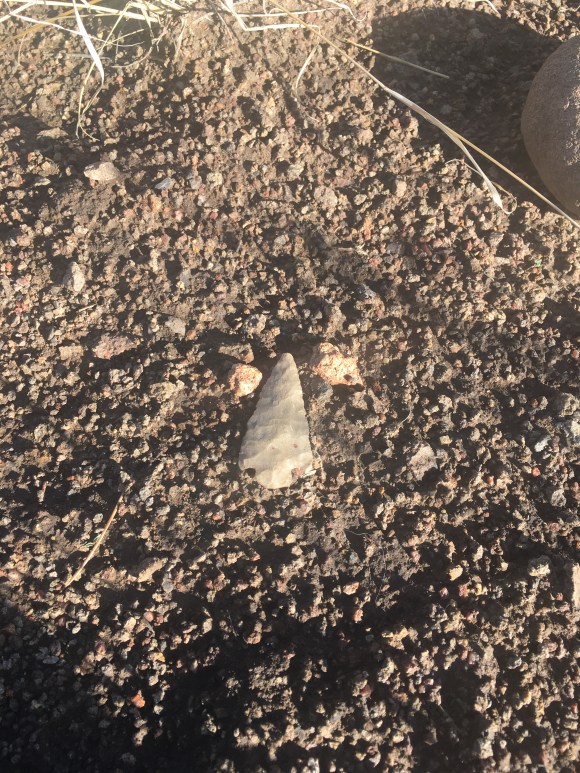
Prehistoric hafted biface in situ, ca. 1,000 years old
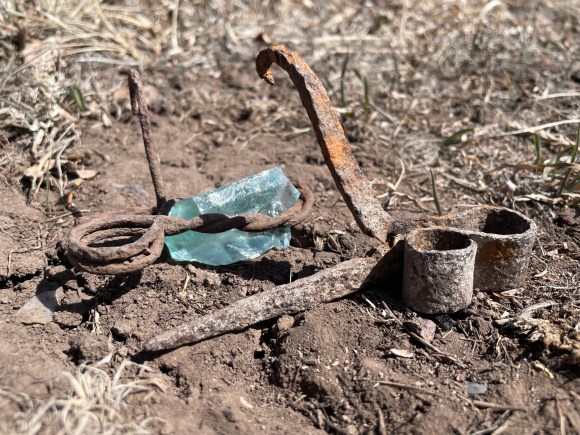
Two hand made miners’ candlestick holders, ca. 1870s
These miners’ candlestick holders are both hand made, one from a single strand of iron wire which has been doubled over and twisted, is designed to be attached to a hat or affixed to timbering in the mine, and holds one candlestick. The other specimen is constructed from a single strip of flat iron, and is also designed to be attached to a hat or affixed to timbering in the mine, and holds one or two candlesticks.
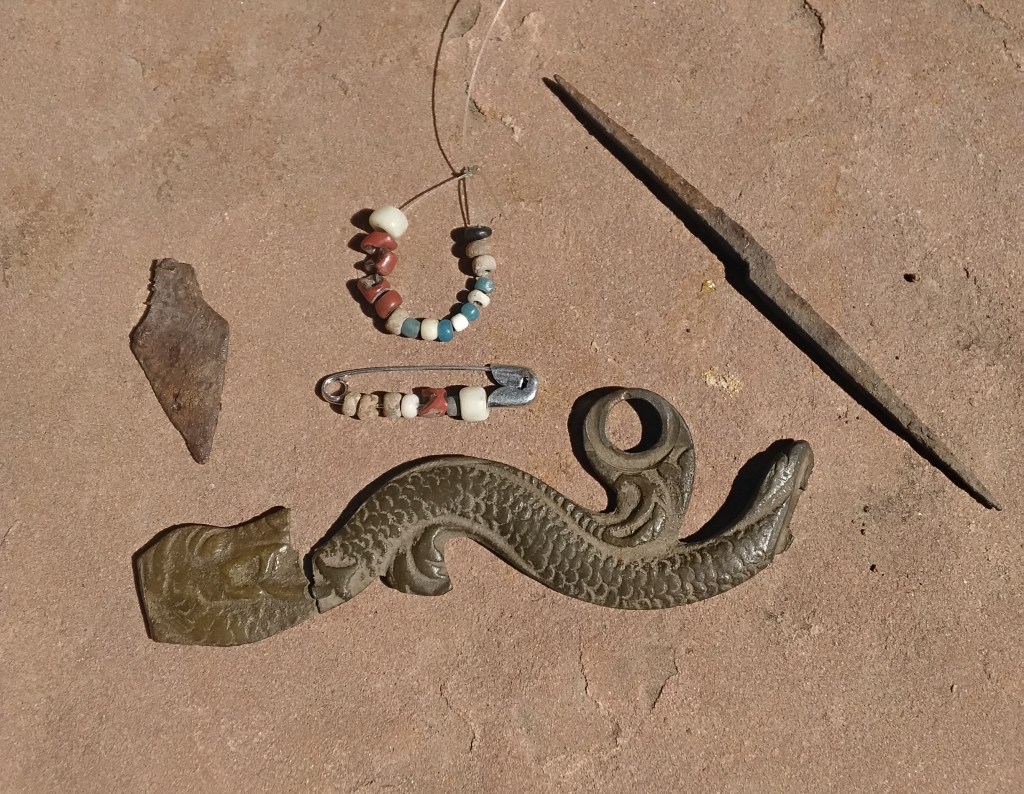
Ute or Jicarilla Apache camp, ca. 1850
These artifacts are typical of early to mid 19th century era trade goods and include glass seed beads, Hudson’s Bay Company ‘White Heart’ beads, an iron double ended awl, a hand made iron arrowhead, and a serpent side plate from a Northwest Trade Gun. The small seed beads with tiny holes dates this site to late in the Contact era when thread was available as a trade good.
iron arrowhead found and donated by chris ueberroth
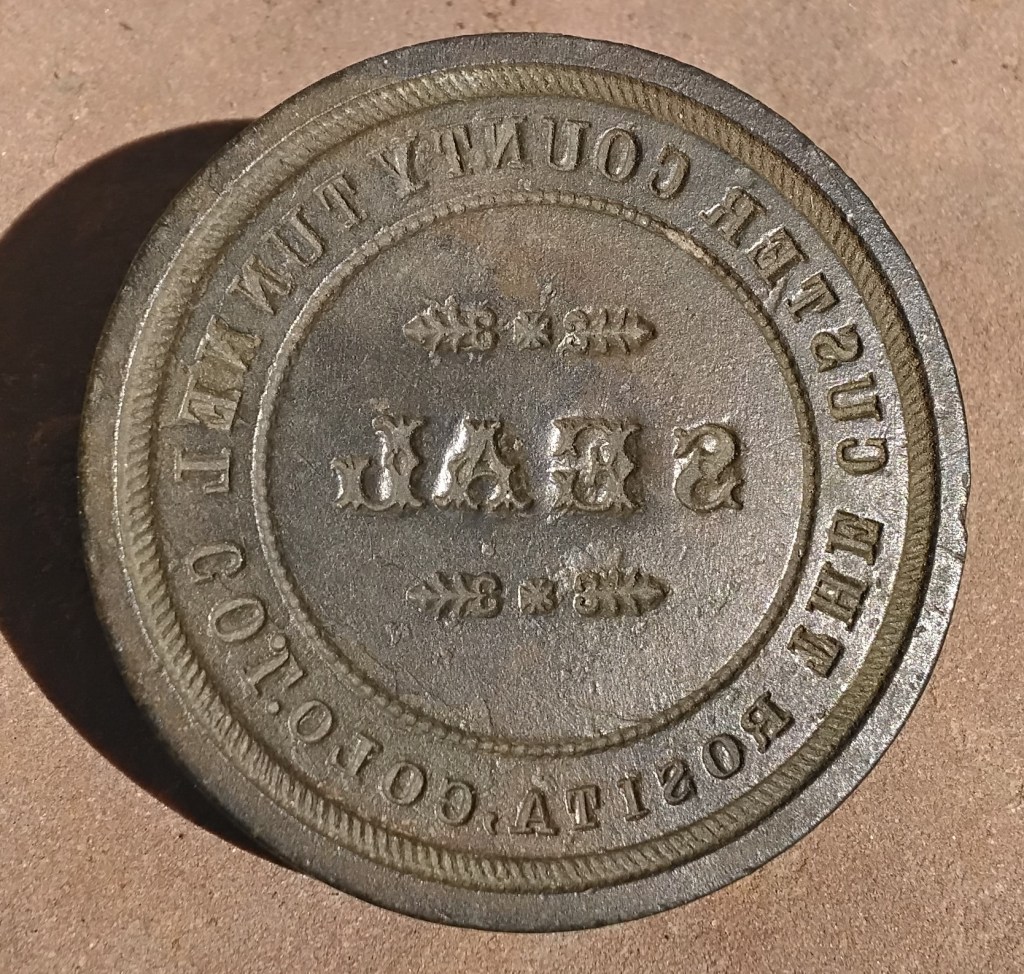
The Custer County Tunnel Company, Rosita, Colo, Corporate Seal Embosser, ca. 1880
This is the corporate seal embosser for the Custer County Tunnel Company. A tunnel is a horizontal mine shaft. This would have been used to emboss the gold seal on stock certificates and to stamp documents.

Late 18th Century- Mid 19th Century Toy Cannon
This miniature toy cannon is 2 3/8 inches long, made of cast brass, and is made to be a fully functioning toy capable of touching off a tiny black powder charge. Many of these pocket cannons date to the 18th century, and this one was likely very old when it was brought to Rosita during the silver mining era. The trunnions are broken off of this example.
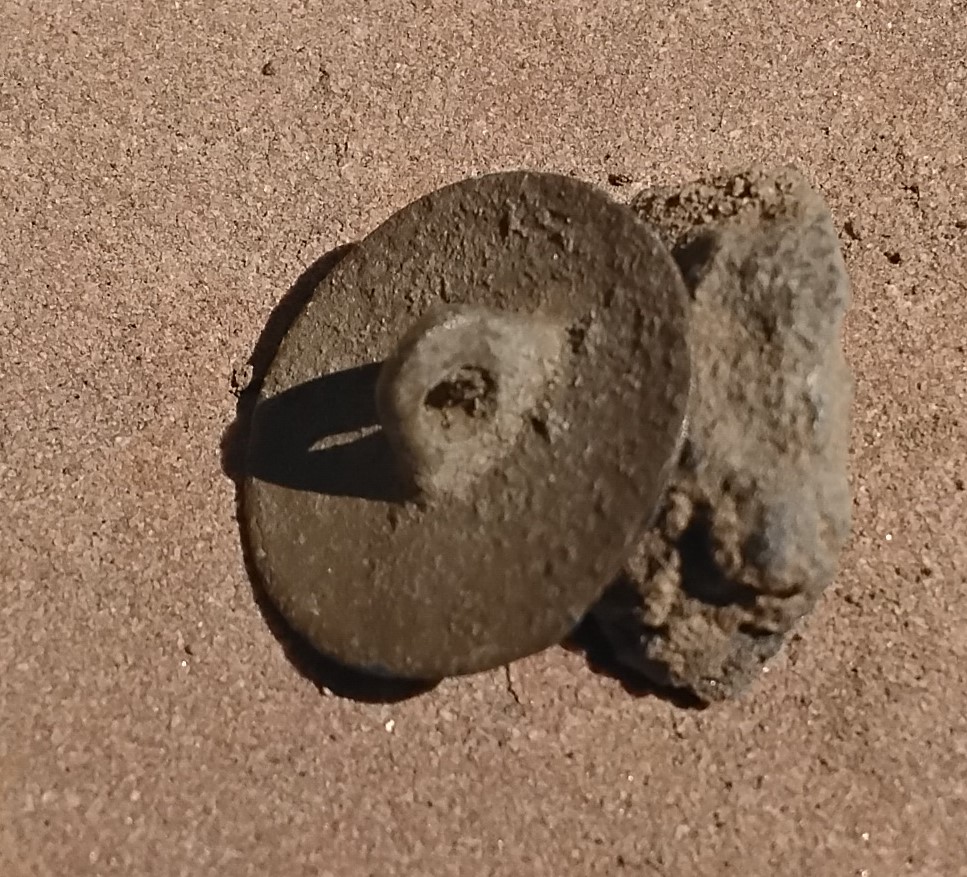
Early to Mid 18th Century Spanish Button
This small button is one piece cast brass with an integrally cast shank, with the hole drilled through the shank. This distinctive button manufacturing technology is very old. This button represents the Spanish Colonial period in Rosita. It was likely lost by an Indian who acquired it from the Spanish.
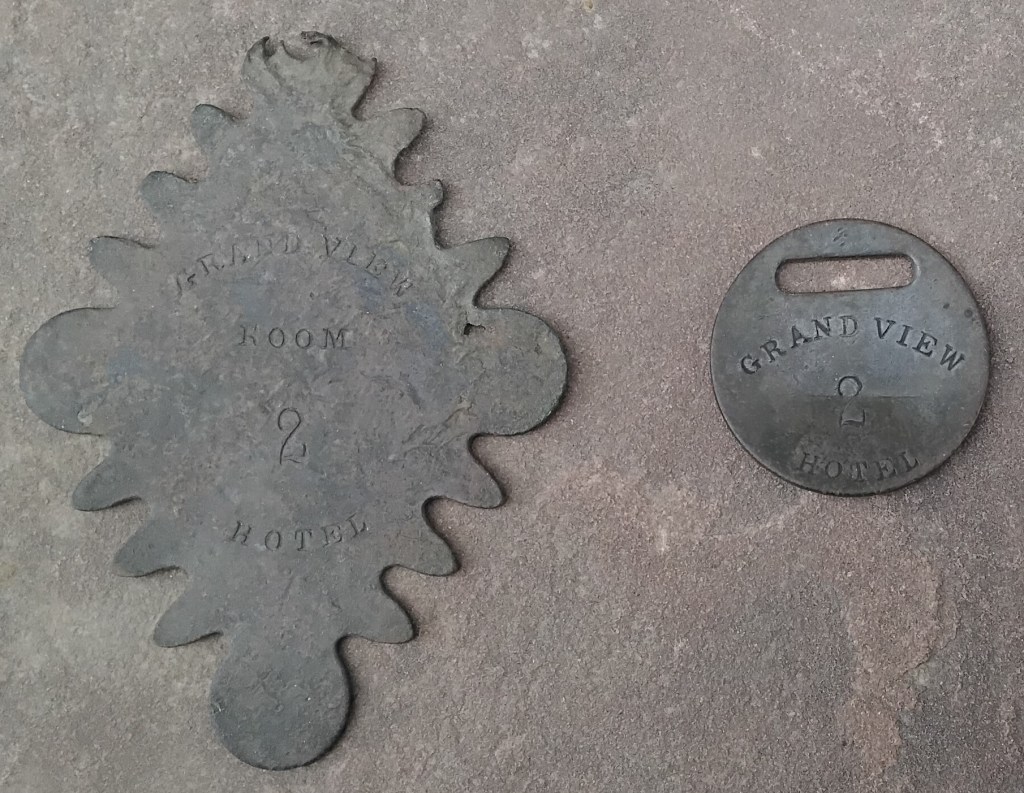
Grand View Hotel Key Fob and Baggage Tag- Room 2, Ca. 1875
The Grand View Hotel was located in the main business district on Tyndal Street, next door to Miller’s Store and across the street from the post office. The infamous Bank of Rosita was located inside the lobby of the hotel. The Bank of Rosita was operated by counterfeiters and crooks who later robbed the bank in the dead of night and fled town. The Grand View Hotel burned to the ground in the great fire of 1881. The pictured starburst shaped key fob was likely in that fire. The baggage tag was recovered in the town site some distance away.
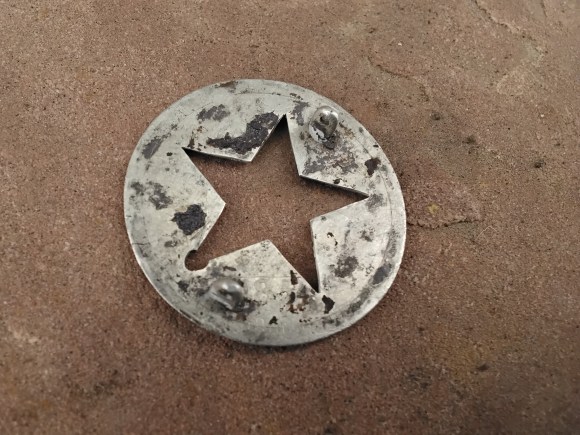
Concho made from 1854 Seated Liberty Quarter Dollar with Star Shaped Cutout ca. 1870s
This silver concho has a crude star hand cut from the interior, two applied silver loops for attachment to leather or cloth, and originally had a tin backing affixed which was likely painted, and so the star would have been colored when originally viewed. It is interesting that the coin has been stamped out to a diameter of 26 mm. This is the same diameter as a late 18th to early 19th century Spanish 2 reales coins. Spanish silver coins were legal tender in the US until 1857, and certainly circulated or used as silver for jewelry in the Southwest for longer. It is possible that the silversmith pressed US quarter dollars to the size of Spanish 2 reales coins to produce uniformity in goods like jewelry and conchos, while being able to use any silver coins in common use around at the time. It is unlikely that Spanish silver coins circulated in the Rosita economy, but likely that silversmiths in the West and Southwestern regions still used them interchangeably with US coinage for the production of silver goods.
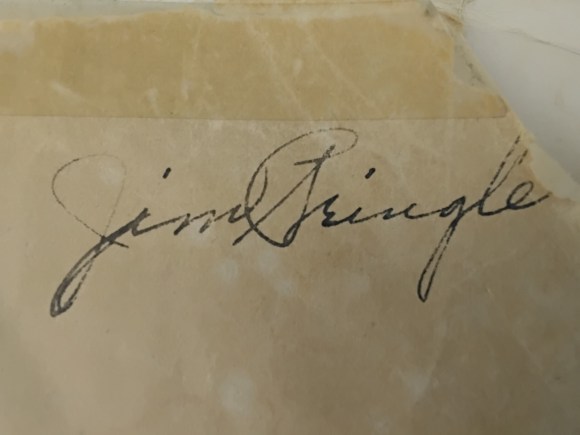
Autograph of Jim Pringle on Book of Local Mining Geology ca. 1896
James Pringle was a very early, well liked, and influential citizen of the Rosita mining camp. Pringle was Scottish, and in the early days of the camp would take a cabin door from the hinges and dance jigs to entertain the men so long as they would cook and clean up. Pringle Mountain on the North edge of Rosita is named after James Pringle.
gift of chris ueberroth
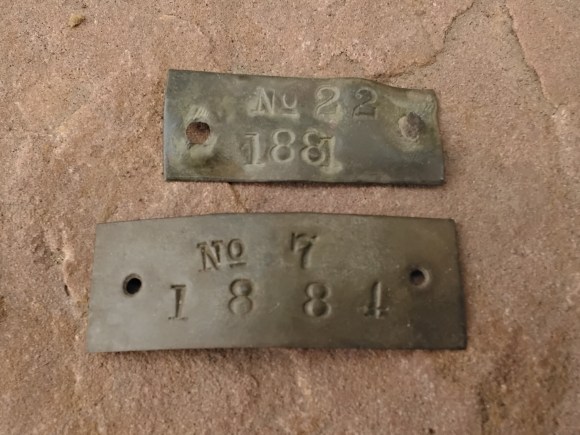
Two Specimens of the First Year of Issue Rosita Dog Tax License Tags, #7 and #22, 1881
Two specimens of the Rosita 1881 dog tax license tags. Each year of tag had a unique shape for identification of compliance from a distance. The newest specimen is larger than the first, and has the odd characteristic of the last “1” in the date being stamped with the “4” punch held on edge, or with a missing line. This is a mystery, but the tag is certainly an 1881. They are made on the same strap brass stock with silvered reverse side, they are hand stamped as opposed to being prestamped with the year of issue at the brass novelty works selling the tags, they are hand cut to order, they display the same letter and number punch set with identical sizes and fonts, in particular the underscored “o” in “No”. The 1884 tag which is viewable in another exhibit is round, the date is prestamped, and the integral holes for affixing to a collar are made at point of manufacture. The first year tags are very primitive in comparison. 1881 is also the only year that the word “Rosita” was not stamped into the tags.
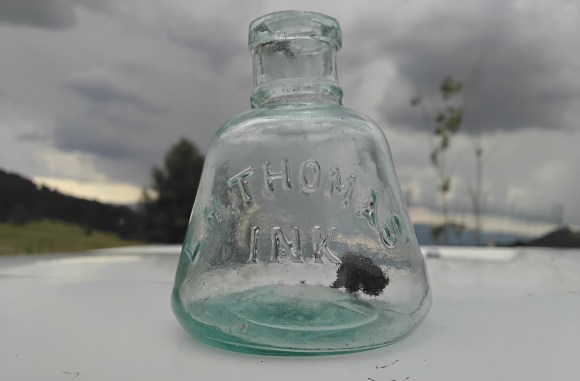
L.H. Thomas Ink Bottle with Applied Lip and Post Mold Base, Manufactured by Newark Star Glass Works, ca. 1880
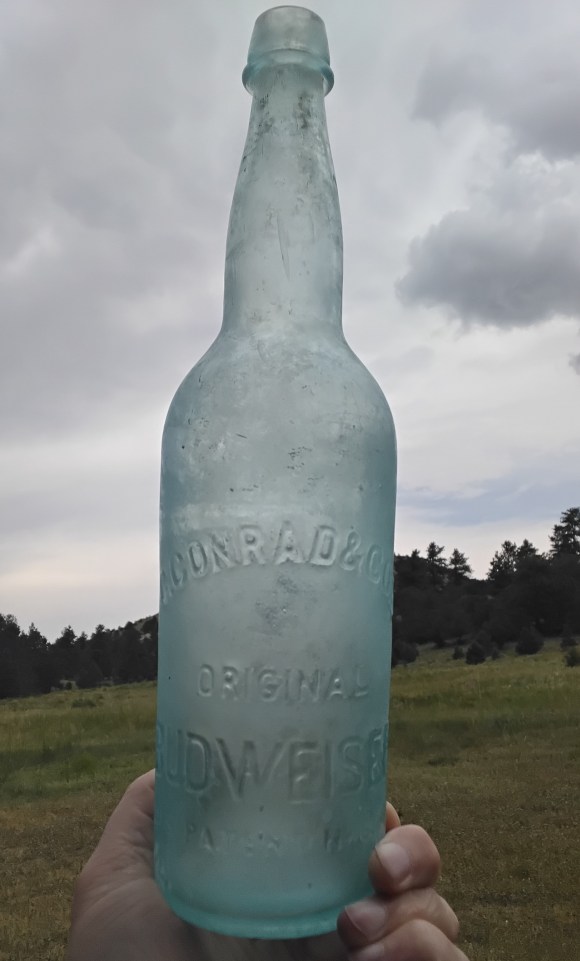
C. Conrad & Co’s Original Budweiser Quart Size Bottle in Aqua Glass, ca. 1880
The most common beer bottle found in the Rosita townsite are quart sized amber glass beer bottles manufactured in the Midwest and South. Almost all of them probably contained beer from the Rosita Brewing Company based on excavations in Rosita and recovered examples with partial labels intact. After acquiring the Budweiser recipe on a trip to Bavaria, Carl Conrad famously bankrupted the company by trying to over extend the business into the mountainous mining towns.
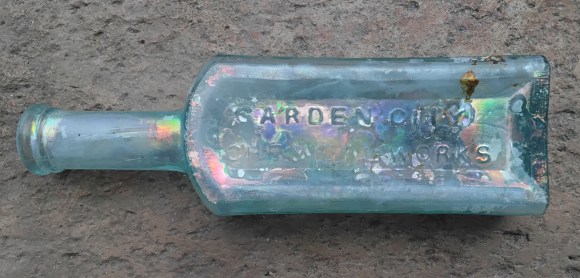
Garden City Chemical Works Bottle, with Applied Lip and Key Mold Base, ca. 1870
This small chemical bottle was discovered in the corner of a saloon cellar. There is no information online about a “Garden City Chemical Works” except a single antique source listing businesses lost in the great fire of Chicago in 1871. That date corresponds with the very early date of manufacture for this bottle. Is it possible that this small bottle came to the Wet Mountain Valley with the original German Colony from Chicago in 1870, before the owner came to Rosita?

Occupational Suspender End Adjuster , Firefighter. ca. 1875
These suspender ends adjusted the length of the suspender. There was one located on each side to the front of a person. They are a common find in Rosita and can have a number of decorative, whimsical, sporting, or neoclassical themes. This specimen is occupational and would have been worn by a firefighter, possibly as part of his fire company uniform. The central device features crossed hose nozzles, crossed megaphones, and a firefighter helmet.
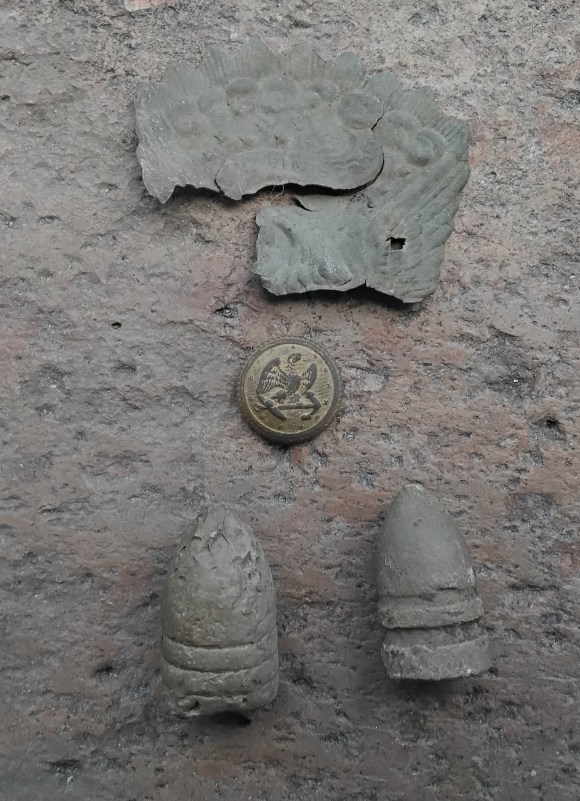
Civil War Era Artifacts, Hatpin, Button, and Bullets, Possible Camp of 1863 Expedition
While Civil War era uniform buttons are found in the mining camp as a remnant of veteran social life, civil war era ammunition for rifles is almost completely absent from the archeological record. The men who came West did so with a good quality modern rifle. This group of artifacts is from one locale in the vicinity of a historic spring, and includes a Federal Navy button, a .58 caliber Minie bullet, and a .52 caliber dimple based Sharps bullet. The fragmented piece at the top of the photo is a model 1858 Hardee Hat Pin or “Jefferson Davis” hat pin. It was worn on the side of a gigantic army top hat. Visible in the center of the artifact is the federal eagle neck and head, with an outstretched wing to the side, holding a banner reading “E PLURIBUS UNUM”, and with clouds and a sunburst at the top. These artifacts indicate 1860s era use of the area, and possibly locate the campsite of an expedition from Pueblo which traveled through the Rosita area in 1863.
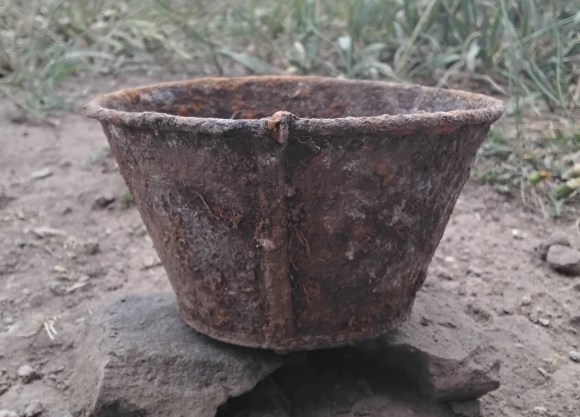
Tin Ware Cup with Lead Soldered Rolled Seams, ca. 1875
Tin Ware was a common good in the Rosita mining camp, with many different implements being made from this inexpensive, easy to manufacture, and durable material. This drinking cup has no handle, is about three inches tall, and was likely locally made by a tin smith.
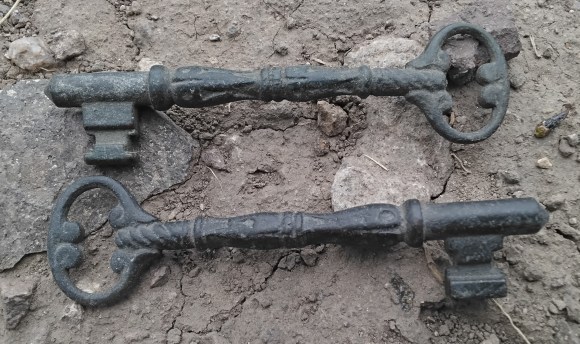
Set of Decorative Skeleton Keys, ca. 1875

Suspender Ends, Suspender Adjustment Devices, ca. 1865-1880.
Suspenders were the primary method of keeping pants up in the mining camp of Rosita, and these brass or tin suspender ends allowed for adjustment of the length of the suspender. They are found in a wide variety of themes and styles, sometimes reflecting an interest or profession of the wearer. This group includes cherubs, a sporting motif with a rabbit and crossed rifles, and a patriotic American flag themed shield, which likely represents the era of the 1876 American centennial.
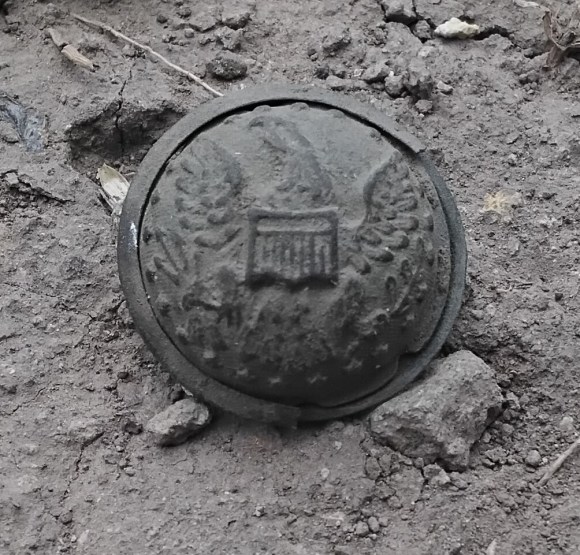
US Staff Officer Coat Button with Horstmann Bro & Allien N.Y. Backmark in Raised Mark Depressed Channel Style, ca. 1852-1865
This button could have been older Civil War era surplus being worn on a military uniform during the Rosita boom years, or may have been worn by a veteran of the Civil War living in Rosita, and lost during one of the many veteran oriented social functions of the times, such as a Grand Army of the Republic (GAR) parade through the business district.
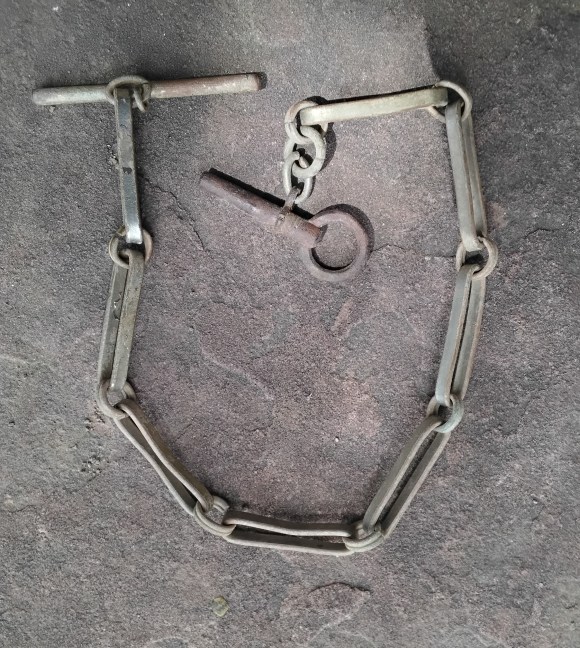
Silver Plated Brass Watch Chain with Iron Watch Winding Key Attached, ca. 1870s
This watch chain would have been worn with the T bar worn through a button hole on a jack or vest, and with various fobs, watch keys, and the pocket watch itself attached to the chain. This is a relatively inexpensive and modest example.
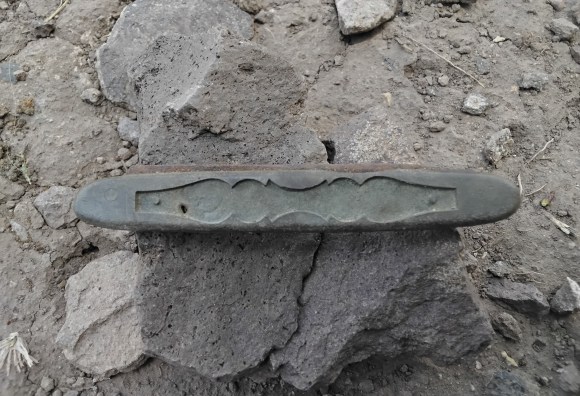
Pen Knife with Decorative Brass Scales and Missing Inlay, ca. 1870s
It is easy to imagine mother of pearl or abalone shell inlays in the brass scales of this sturdy and fancy pen knife.

Lined Crockery Marbles, ca. 1850s-1860s
These hand painted lined crockery marbles were manufactured well before the time of the Rosita mining camp, and may very well have originally belonged to the parents of the children who played with them and lost them in Rosita during the 1870s. The designs are typical with lines, concentric circles, flowers, and leaf track motifs.
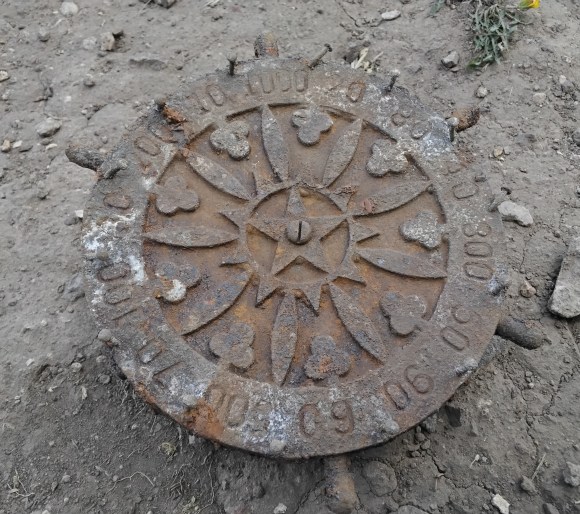
Cast Iron Table or Counter Top Game of Chance Wheel, ca 1875
This cast iron spinning wheel for a table or countertop game of chance resembles Roulette, and only measures 5 3/4 inches in diameter, not including the little nubs for grasping and spinning the wheel. It would have been attached to a movable cast iron base and sitting at an angle tilted towards the observer. The base is missing from this specimen. This was certainly originally in a saloon in Rosita, but was recovered from the bottom of a trash deposit dating from the 1870s.
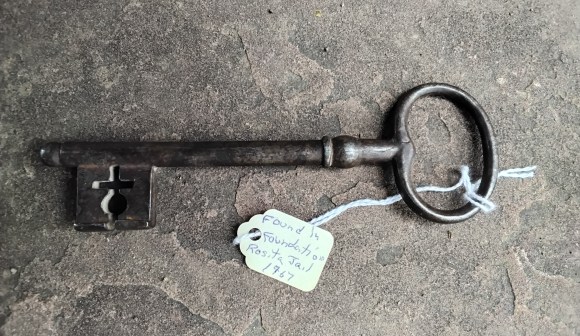
Large Iron Key, 5 1/4″, ca. 1870s
This large iron key was discovered in the remains of the jail in Rosita in 1967 by a local resident. The jail house door is still in existence and does not bear a lock or keyhole, so this key is probably to a large padlock which secured a chain over the jail door.
Gift of chris ueberroth

1870 Indian Head Cent
Goods were expensive in the mining camp of Rosita. There was no nearby railroad for most of the years of the camp, and goods had to be hauled by mules and wagons up Hardscrabble Pass. We know from old receipts from Rosita businesses and the artifacts recovered that nickels generally served as the smallest denomination of pocket change in the camp. Cent coins likely represent losses by children.
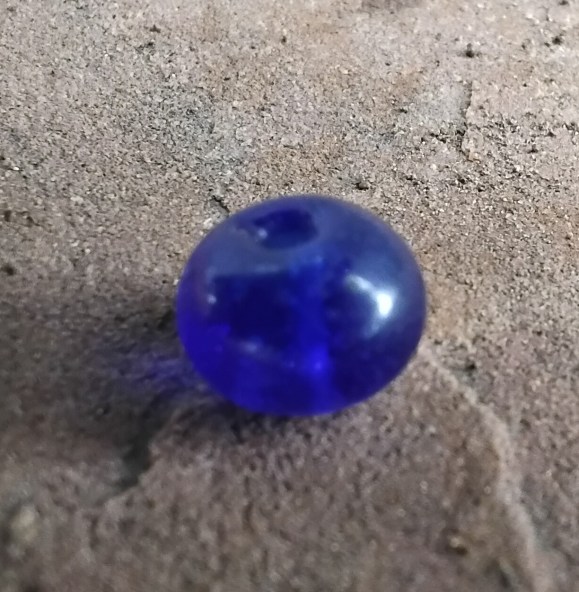
Blue Wound Glass Trade Bead, ca. 1800- 1850
This blue wound glass bead style was shipped and traded all over the world. Other examples are found in the archaeological collections at Fort Vancouver, and another was recovered from a historic period Ute camp in nearby Saguache County, Colorado as part of the ‘”‘Colorado Wickiup Project’ – a survey of standing Ute wickiups on Colorado public lands. The pictured example was recovered in Rosita, and represents the Ute presence in the area during the 19th century.

Ostby and Barton Gold Filled Wedding Band, ca. late 19th century
This gold filled or electroplated band was manufactured by Ostby and Barton of Providence, Rhode Island. It is made from a core of copper covered with a thin application of gold. The copper visible on the band is not a product of wear, but was an intentional art design by the jeweler. Englehart Ostby, one of the founders of the firm was a passenger on the Titanic when that ship sank to the bottom of the ocean.
 The Rosita Museum