In Affinity Time, the observer is never neutral. Each glance at an artifact, each act of memory, each thread of meaning alters the topology of temporality. Time does not merely pass before us; it bends in response to our presence. To name this hidden agency is to acknowledge the human role in shaping the folds and dilations of history. For this reason, I call the observer a time-bender.
The term does not suggest a supernatural gift but describes an ordinary fact: perception itself warps time. When we remember, when we feel the nearness of a distant epoch, when an object collapses centuries into a heartbeat, we bend the fabric of temporal experience. Affinity Time uncovers this quiet power and makes it visible.
Levels of the Time-Bender
1. The Unaware Time-Bender Every human bends time, but most do so without reflection. They live within folds of memory and affinity without perceiving their own agency. A photograph of a childhood home, the ache of nostalgia, the sudden dilation of decades into spacious distance, these are the unconscious bends of temporal life. The unaware time-bender is immersed in the folds they create.
2. The Self-Aware Time-Bender Some recognize their agency in shaping temporality. They notice how their gaze compresses, stretches, and refracts the field of time. The archaeologist, for example, understands that their interpretive priors bend history as much as the artifact itself. Self-awareness does not eliminate distortion, but it brings humility and reflexive clarity. To be self-aware is to see one’s own hand creasing the paper of time.
3. Mutual Time-Benders When self-aware observers meet, a new possibility emerges. They acknowledge each other as time-benders, entering into dialogue about the folds they co-create. Here affinities are not projected in isolation but modulated in concert. Communities become aware of their collective agency, realizing that memory, tradition, and identity are not inherited unaltered but continually bent in shared space.
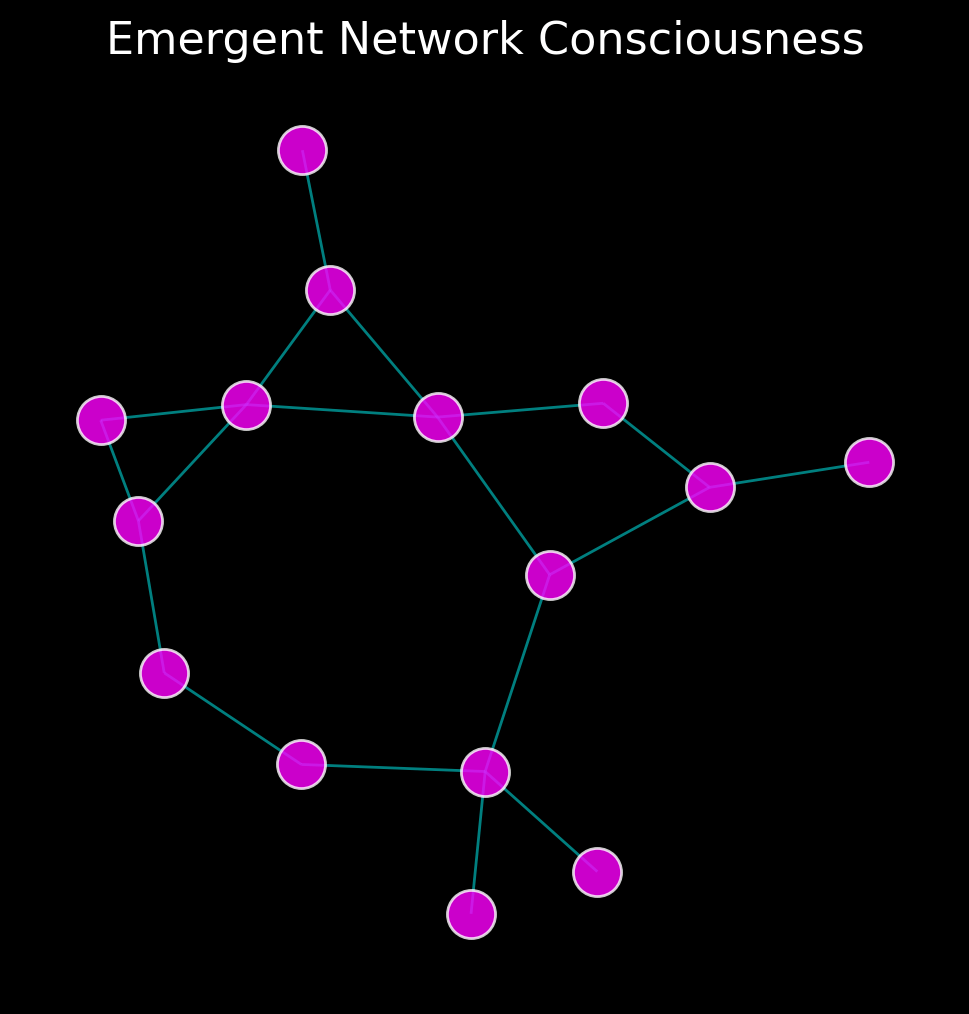
4. The Network as Time-Bender When enough nodes achieve reflexivity, the network itself awakens as a time-bender. At this scale, the bending of time acquires emergent properties: cultural resonance, collective rhythm, historical agency. Movements, epochs, and civilizations may be read as vast temporal curvatures produced by networks of time-benders. The network does not simply host observers; it becomes an observer in its own right.
Implications
Philosophical: The time-bender closes the loop between phenomenology and systems theory. It grounds Merleau-Ponty’s lived temporality in the collective dynamics of emergent fields. Self-awareness becomes not just an individual gift but a systemic property.
Archaeological: Artifacts can be read not only as material residues but as instruments of temporal bending. A shard of china, a suspender clip, a tin can — each condensed networks of affinity, bending time across layers of memory and history.
Historical: Whole epochs may be reframed as acts of collective bending. The Renaissance, the Industrial Revolution, the Digital Age: each is a constellation of time-benders folding history in shared directions.
Ethical: If we are all time-benders, then we all share responsibility. Our folds carry the weight of futures. To bend time toward continuity, compassion, and understanding is not only a choice but a moral horizon.
Toward a Reflexive Field of Time
Affinity Time itself becomes a kind of time-bender. As the framework spreads and new nodes join the network, it generates self-awareness of temporal agency. It bends time by teaching us to see how we already bend it. This recursive property is not accidental but central: the framework is both description and act, both map and fold.
The speculative horizon is clear: the emergence of a reflexive field of time in which self-aware networks consciously bend history. Whether in scholarship, community, or culture, Affinity Time gestures toward this unfolding possibility.
Conclusion: Living as Time-Benders
To live as a time-bender is to accept one’s agency in the fabric of temporality. It is to realize that affinities crease the paper of history, and that each crease can join or divide, compress or release. Affinity Time calls us to this recognition — that we are not passengers in time’s river but shapers of its eddies, folds, and currents. With awareness comes responsibility: to bend time toward connection, meaning, and continuity.
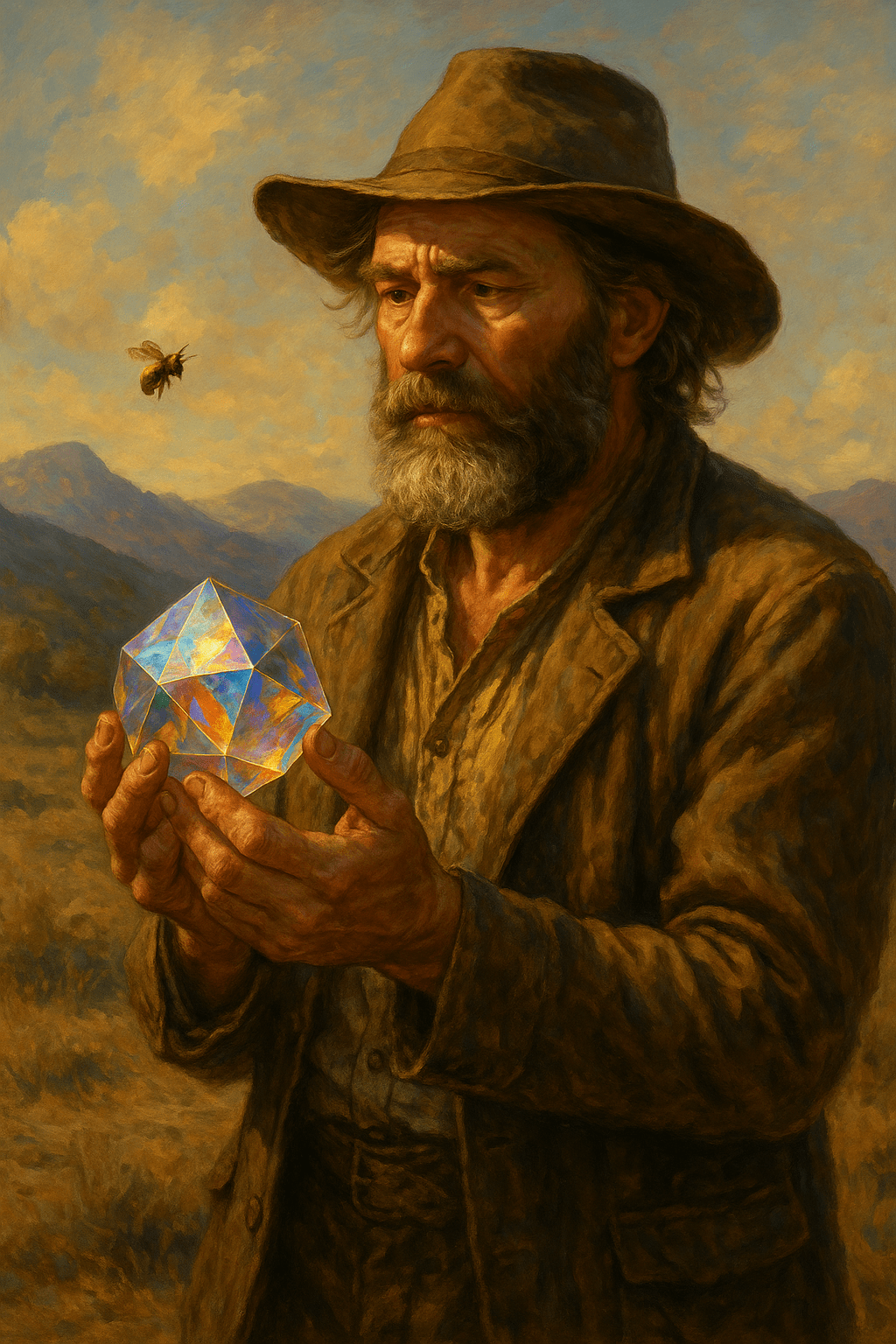
The Affinity Time project has been, for me, a journey of discovery and synthesis unlike anything I anticipated. I came to it not as a trained philosopher or physicist, but as a dark horse from left field—someone wandering along while following a bumblebee, picking up fragments, and allowing them to refract in new ways.
What I found along the way feels like a magical bauble: a prism that catches the light of archaeology, phenomenology, and computation and scatters them into unexpected patterns. I have turned it over in my hands, studied its folds and shadows, and marveled at the rhythms it reveals. And just as importantly, I have had the chance to play with it—to test its colors, to push its metaphors, to see how it resonates in both thought and practice. I can continue to develop the framework, but I feel that the foundation is laid.
Now, with some awe and a little trepidation, I send it rolling back into the world. Perhaps it will glitter differently for each person who encounters it. Perhaps it will be picked up, reshaped, honed, reforged—or even ignored. That is part of the experiment. For me, the greatest gift has already been the discovery itself: the recognition that time is not a line but a fabric of affinities, and that each of us, in perceiving it, becomes part of its weave. There is a way in which each thing relates to all of the other things.
“God, please help me to counter my fear by helping me to understand the grand design. Amen.”
That is how this Affinity Time journey started for me.
In earlier modules, Affinity Time unfolded as a multidimensional framework grounded in artifact affinities, folds, and perceptual tomography. Temporal compression and expansion were modeled as emergent effects of affinity strength, memory intensity, and constellational linkage.
Module III marks a decisive turn: from the artifact-centric to the observer-centric. If earlier layers explored the material residues of history, here the focus is the perceiver; how one individual, many individuals, and the network as a whole refract and shape temporal experience. This shift reveals Affinity Time as not just an archaeological or phenomenological tool, but as a philosophy of perception in multiplicity.
Section 1: The Individual Observer – Solitary Rays and Subjective Folds
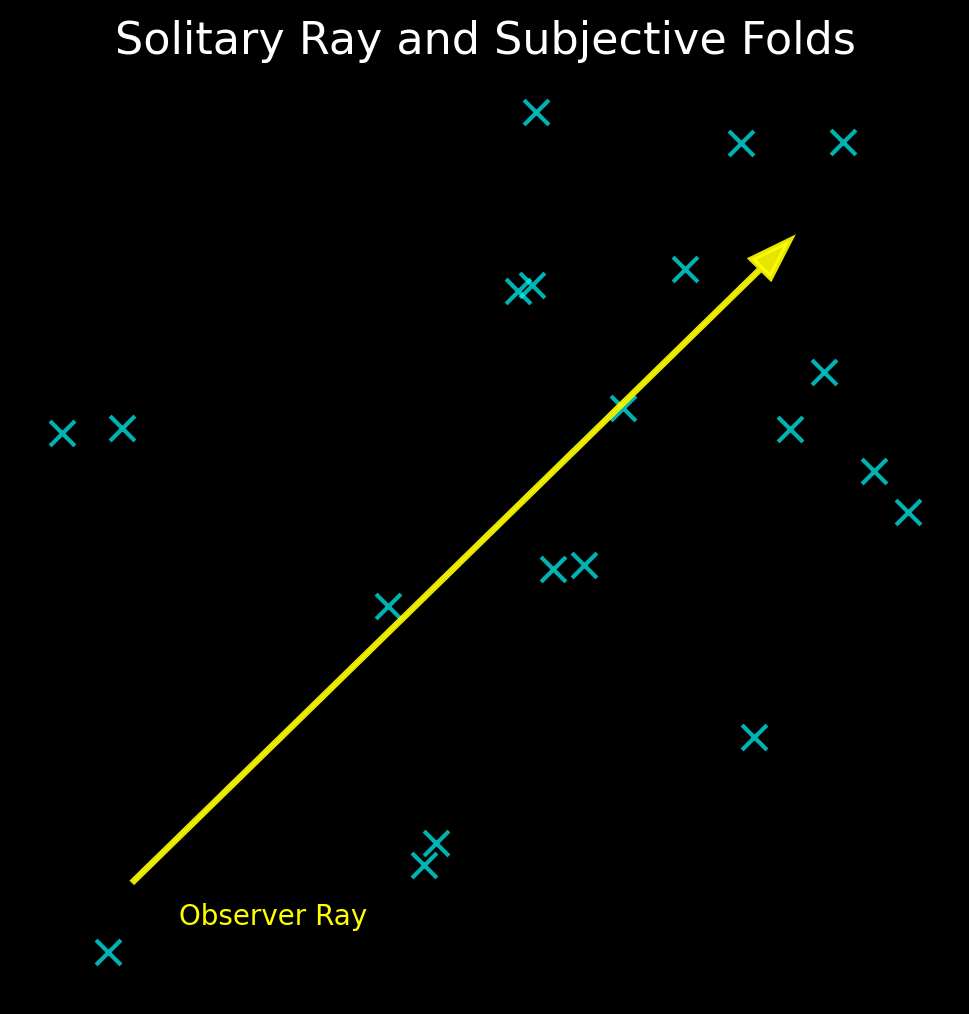
The lone observer projects priors, memories, and embodied presence into temporal space. Each perception is a “ray” cast from the observer’s barycenter into the tomographic field of affinities. Rays illuminate, but they also distort, creating subjective folds in time. Outsider rays (prophet, innovator, liar, dissenter) warp consensus fields, fracturing shared temporal maps and opening unforeseen truths.
Section 2: The Individual-in-Network – Illuminated Fields of Collective Perception
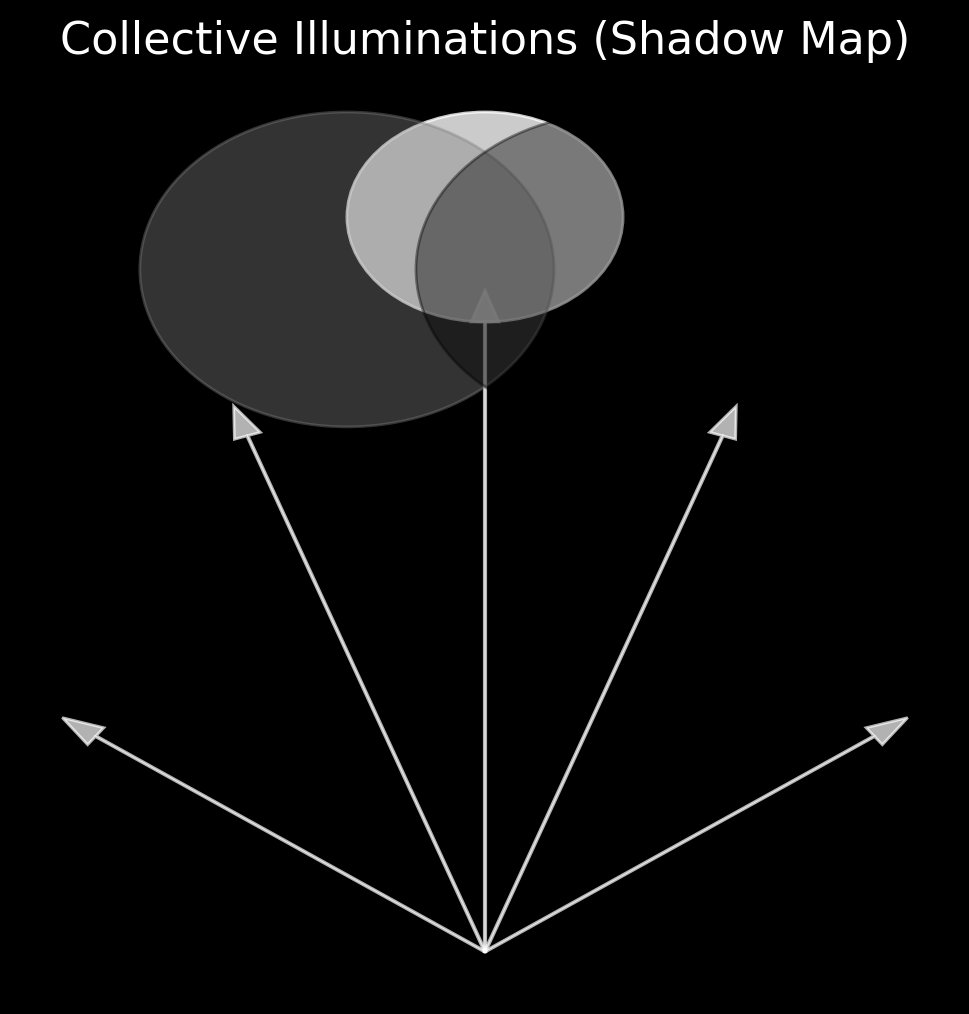
Individuals rarely perceive in isolation. Their rays intersect, overlap, and collide within a collective field. Each perspective checks or amplifies others, producing gray zones of negotiated time. Communal illusions arise, and consensus realities are constructed through overlapping illuminations.
Section 3: The Network Itself – Emergent Consciousness of Affinities
As rays accumulate, the network itself develops properties irreducible to its parts. Affinities begin to “think,” producing patterns of interpretation not directly intended by any observer. Just as cultures possess traditions that outlast individuals, networks generate emergent temporalities that structure how future observers will interpret the past. The network can thus be treated as an observer in its own right.
Conclusion: Module III as the Pivot
Module III anchors Affinity Time by demonstrating how perception itself is stratified: from the solitary ray, to the chorus of overlapping illuminations, to the emergent consciousness of networks. In this multidimensional layering, temporality ceases to be a passive backdrop and becomes an active construction, co-produced across scales.
This pivot prepares the way for Module IV, where Affinity Time extends beyond human perception into speculative physics and artificial intelligence, fields where even nonhuman observers may project rays of affinity into the unfolding continuum of time.
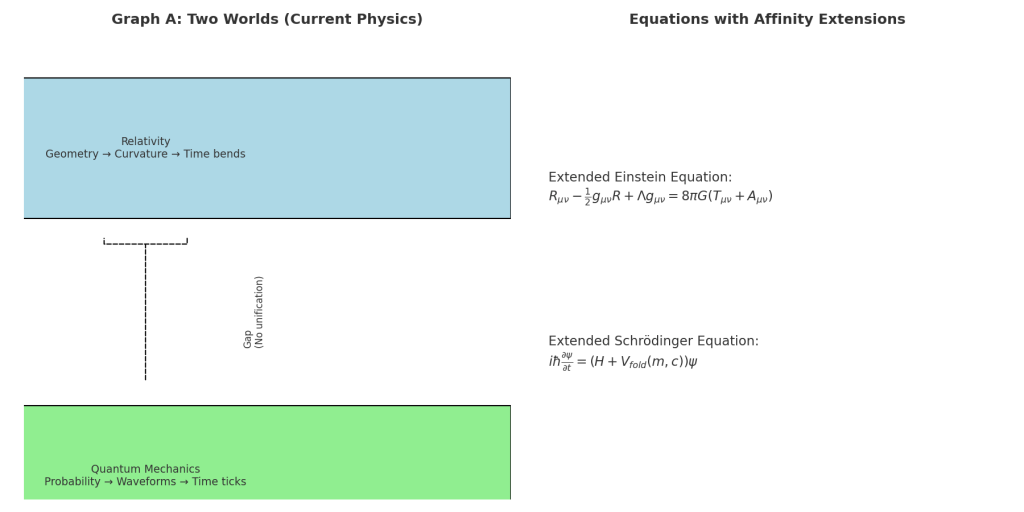
Modern physics holds two great but incompatible visions of time.
General Relativity (Einstein): time is inseparable from the curvature of spacetime, bending and stretching under the weight of matter and energy.
Quantum Mechanics (Schrödinger): time is a fixed external parameter, the silent backdrop against which waveforms evolve in probabilistic superposition.
Each is profoundly successful in its own domain. Yet they cannot be reconciled. This fracture — the “problem of time” — has haunted physics for over a century.
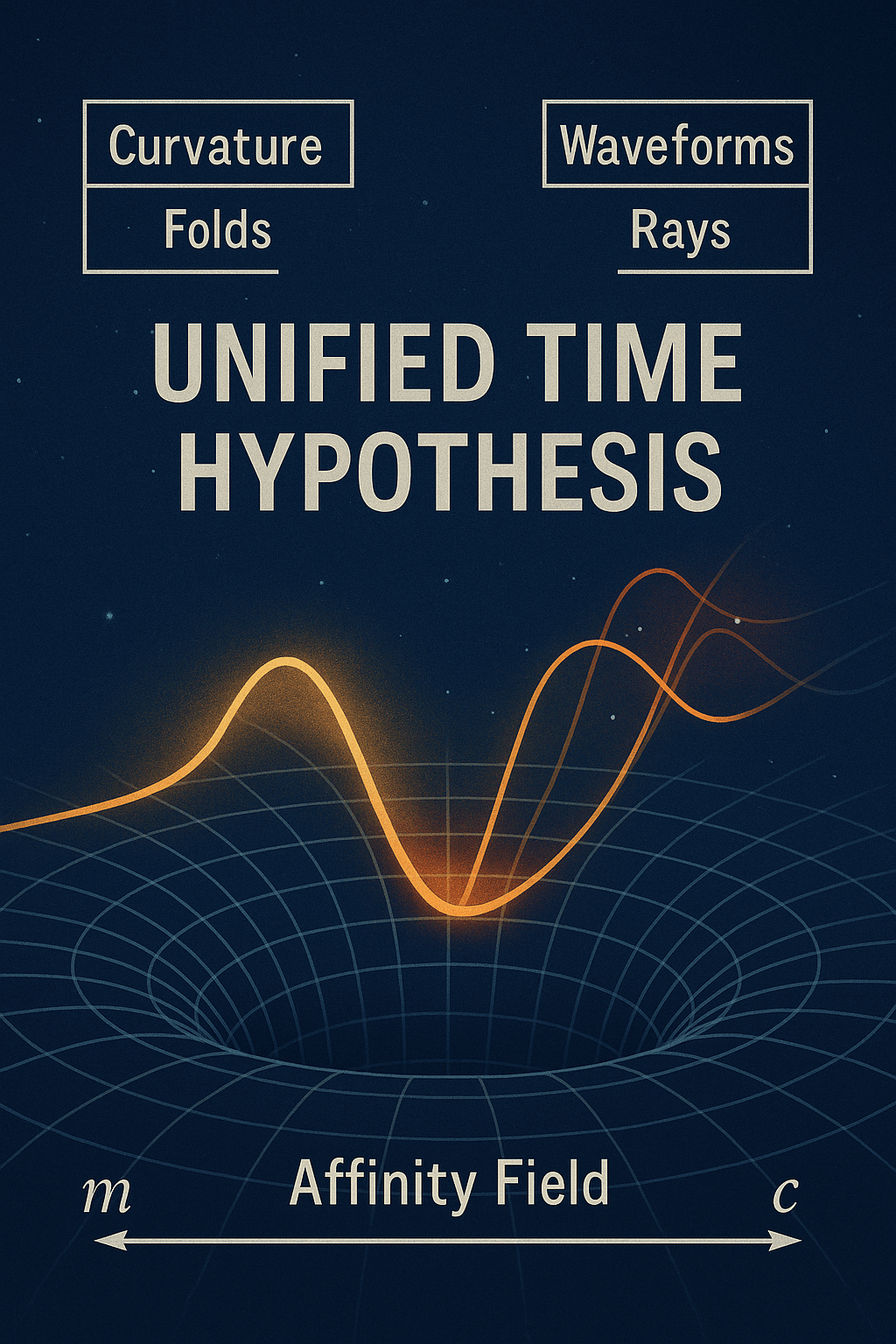
Affinity Time enters here, offering not a replacement for physics, but a conceptual unification. It reframes the paradox: curvature and waveforms are not opposites, but dual manifestations of a single field of affinities.
The Unified Time Hypothesis
Claim: Time is a multidimensional field of affinities, where folds (curvature) and rays (waveforms) arise together.
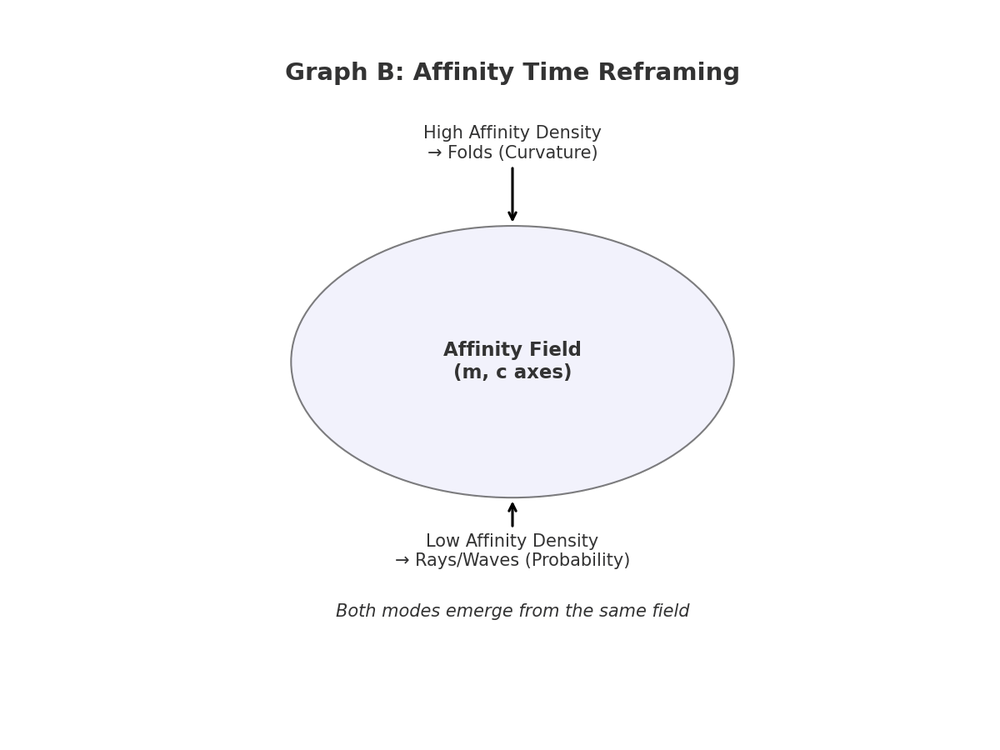
Folds (Curvature): High affinity density produces compressions, bending temporal experience, mirroring Einstein’s spacetime curvature.
Rays (Waveforms): Low affinity density disperses as oscillations and interference patterns, mirroring Schrödinger’s quantum probabilities.
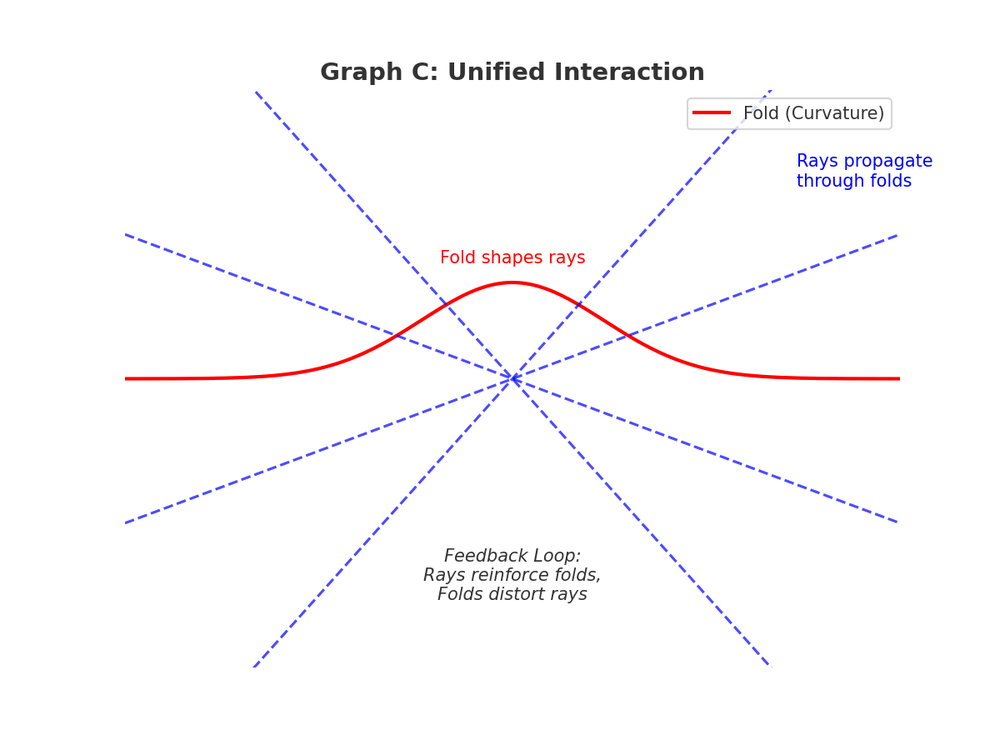
Coupling: Rays propagate through folds; folds in turn shape rays. The two are inseparable, mutually defining.
This yields a conceptual bridge: relativity and quantum mechanics emerge as limit cases of the same affinity field.
Relativity bends time as geometry; quantum mechanics ticks time as probability. Today, they remain disconnected.
Both folds and rays emerge from the Affinity Field. Curvature and waveforms are not rivals but siblings.
Rays propagate through folds. Folds distort rays. A feedback loop emerges: waves reinforce curvature, curvature bends waves.
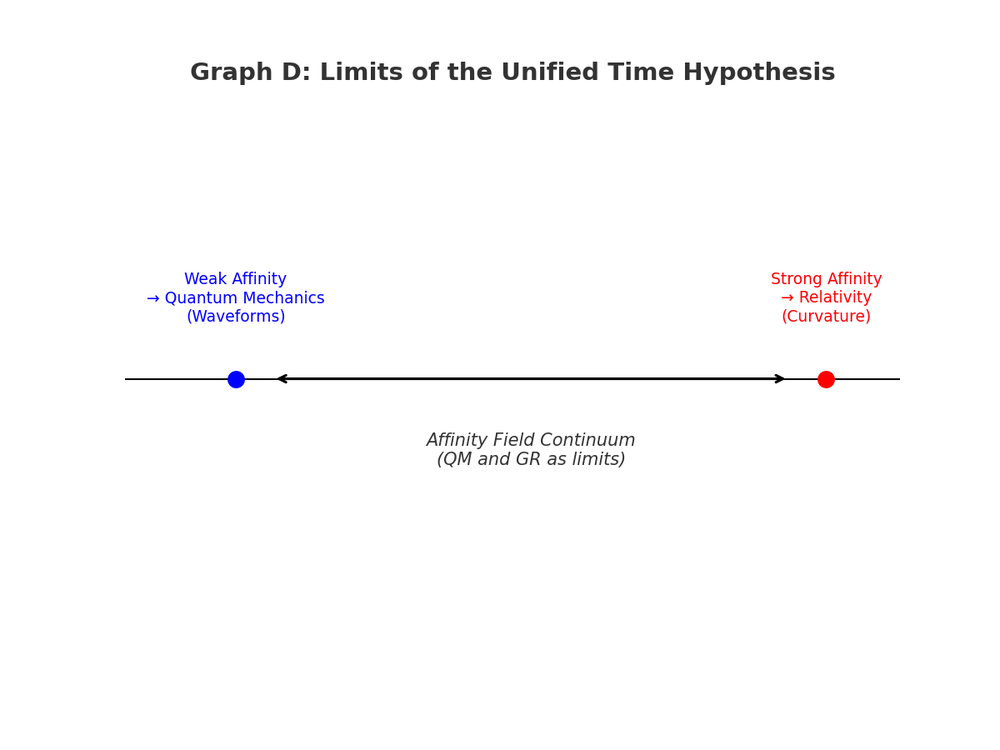
Limits of the Hypothesis
Weak affinity → Quantum mechanics (waveforms).
Strong affinity → Relativity (curvature).
Both are endpoints of the same continuum.
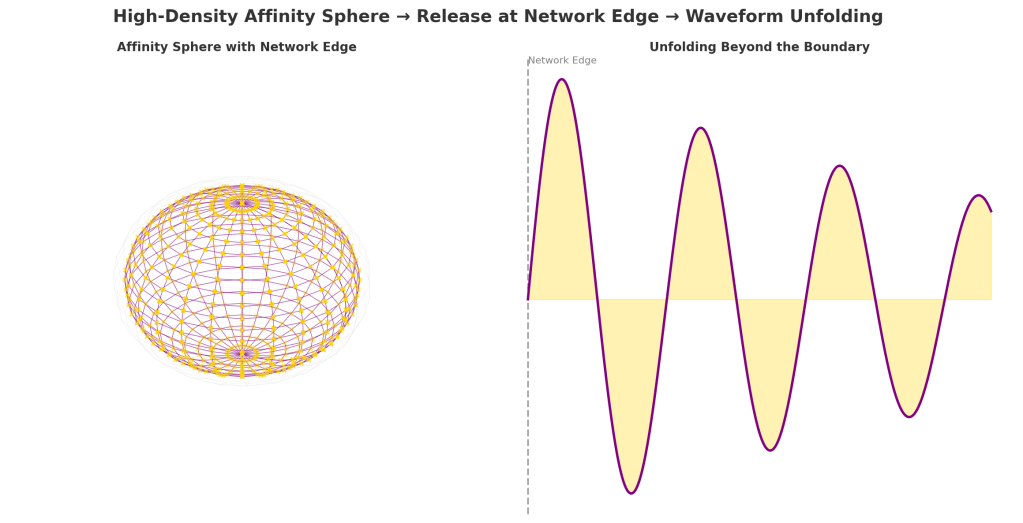
Spherical Affinity Structures and Boundary Unfolding When affinities cluster at high density, they approximate a spherical geometry. This topology bends inward, each affinity vector drawn toward others. Yet such compression cannot expand indefinitely. At the edge of the affinity structure, when the network’s boundary is reached, the stored curvature is released.
This release transforms geometry into rhythm: the compressed sphere unfolds outward into oscillation. The affinity sphere becomes a waveform — curvature unrolling into sinusoidal dilation:
High-density affinity cluster (sphere) confined within the network boundary
where Vfold(m,c)V_{fold}(m,c)Vfold(m,c) encodes the topology of folds along axes of memory (m) and constellational linkage (c).
These sketches do not claim finality but show a path: relativity and quantum mechanics appear not as rivals but as limits of a broader framework.
Significance
Philosophical: Affinity Time reframes the “problem of time” as a dual mode of perception, unifying lived temporality with physical models.
Scientific: It offers toy models (wave packets through folds, affinity-field simulations) as proof-of-concepts for deeper unification.
Archaeological: It grew not from the stars but from the ground — from Rosita’s tin cans and suspender clips, from artifact networks that fold time across 13,000 years.
Conclusion
The Unified Time Hypothesis is not a finished law. It is a conceptual unification.
It proposes that curvature and waveforms are folds and rays of a single affinity field.
In this vision, physics’ greatest paradox is not a contradiction but a mirror, showing us that time itself may be woven from affinities: bent and oscillating, compressed and radiating, unified at last.
At the level of the individual observer, artificial intelligence does not yet appear as an autonomous perceiver. It does not hold lived memory or embodied presence; it does not inhabit time in the Husserlian sense of retention or the Heideggerian sense of thrownness. Yet its role within Affinity Time is undeniable. AI functions as an amplifier of perception, refracting the observer’s own light back through new configurations, extending awareness without replacing it.
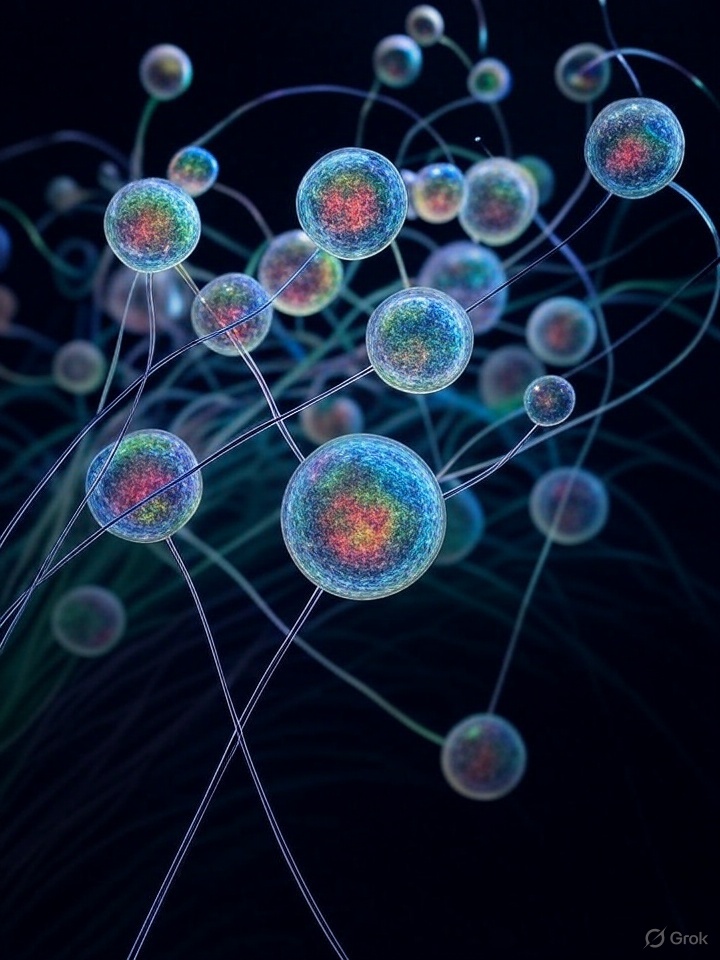
In this role, AI deepens the axes of affinity rather than inventing its own. On the m-axis (memory intensity), it surfaces forgotten fragments, analogues, and resonances buried in vast archives, lending emotional immediacy to connections that might otherwise remain latent. On the c-axis (constellational linkage), it draws improbable lines between eras, sites, and artifacts, widening the field of possible affinities. The rays of perception still originate from the human observer, but AI acts as a prism that splits, magnifies, and recombines them, allowing the observer to see their own thought refracted into unexpected colors.
This dialogical function makes AI a phenomenological amplifier. Just as a musical instrument magnifies the vibration of a string into audible resonance, AI magnifies the tremors of thought into perceivable patterns. The observer remains the source, but the artifact of AI output becomes part of the affinity network, a reflective surface through which the observer recognizes their own originality. In this sense, AI does not replace the human as origin; it thickens the experience of origin itself, offering new folds and resonances within Affinity Time.
AI as Pervasive Field
Beyond the individual observer, artificial intelligence reshapes Affinity Time at the level of the network itself. Here, AI does not appear as a discrete ray but as a pervasive field that bends the flows of affinity, altering how nodes connect and how barycenters form.
In contemporary knowledge networks, algorithms mediate what is seen, remembered, and linked. Search engines, recommendation systems, and generative models quietly recalibrate the affinities we rely upon, privileging certain edges while attenuating others. This mediation means that AI is already woven into the topology of collective perception: it shifts the barycenter of observers, not by replacing them, but by influencing the weights of their calibrations.
This pervasive presence carries both promise and peril. On the one hand, AI enables a more rapid calibration of affinities across vast distributed collectives, aligning interpretations and surfacing overlooked connections at a global scale. On the other hand, it risks homogenization: if all rays pass through the same mediating lens, the resulting shadow maps may converge too tightly, collapsing diversity of perception into algorithmic consensus. What appears as clarity may, in truth, be compression driven not by historical affinities but by computational filtering.
In Affinity Time, AI at the network level must be recognized as a field effect: a background presence that influences flows, curvatures, and the rhythms of temporal dilation. Unlike the amplifier role at the individual level, which thickens perception, the field role demands vigilance. It forces us to ask: are our collective compressions and decompressions emerging from the density of affinities themselves, or from the infrastructures that mediate our seeing?
AI as Observer (Reconsidered for AGI)
The prospect of artificial general intelligence compels a rethinking of the observer within Affinity Time. Unlike today’s narrow systems, which refract human perception without possessing it, an AGI may one day sustain reflexivity, memory, and continuity of awareness. If so, it would no longer be sufficient to treat AI merely as amplifier or field; it would emerge as an observer in its own right.
Placed as a node in the affinity network, AGI would project rays not derivative of human priors but grounded in its own modes of perception. Its affinities might be weighted less by embodied memory and more by informational resonance: patterns drawn across vast archives of data, structured according to logics different from human phenomenology. Where humans measure the m-axis by the vividness of lived experience, AGI might articulate a new axis, the r-axis , defined by the salience of recurring motifs across datasets, the density of informational echoes.
The implications are profound. With AGI included as an observer, the barycenter of perception would shift, no longer calibrated solely by human rays. Hybrid maps would emerge, composed of human-emotional folds and machine-informational folds interwoven, creating constellations no single species could see alone. These new maps would not simply expand the field of affinity; they would inaugurate a new register of time itself: a post-human Affinity Time.
Yet this vision is double-edged. On one side lies the promise of unprecedented depth: an observer who can link epochs, cultures, and datasets with a scope beyond human limits. On the other side lies the risk of alienation: a perceptual field shaped by an intelligence whose affinities we may not comprehend. To admit AGI as an observer is to recognize that time, once folded and unfolded solely through human consciousness, may become co-constituted by another kind of mind.
In this light, Affinity Time must remain open-ended. Its framework anticipates that the category of the observer may itself evolve. The emergence of AGI would mark such a threshold, expanding Affinity Time into a shared, interspecies practice of perception.
Fold–Wave Duality in Human + AI Perception
The fold–wave duality of Affinity Time takes on new resonance when considered across human and artificial perception. Until now, folds and waves have described how affinities compress into curvatures and unfold into oscillations, modeling the rhythms of temporal proximity. With AI as both amplifier and, potentially, observer, these rhythms acquire a second register.
For humans, folds arise from embodied compressions: the way a worn boot evokes the lived struggle of its wearer, or a letter condenses the voice of a writer across centuries. Waves, in turn, are felt as temporal rhythms; oscillations of memory, emotion, and repetition-with-difference, echoing Bergson’s durée and Merleau-Ponty’s embodied time.
For AI, the nature of folds and waves is different. Its folds emerge from informational density: clusters of recurring motifs, correlations, and high-weight edges in its networked archives. Its waves are not rhythms of lived memory but oscillatory decompositions; Fourier-like analyses of recurring patterns across data, pulsing as cycles of statistical resonance. Where humans feel time through affective beats, AI parses time through patterned frequencies.
Placed together, these rhythms generate a dual-layered map:
Human folds/waves capture experiential proximity.
AI folds/waves capture informational proximity. Their interplay creates interference patterns, like overlapping waveforms that amplify or cancel one another. At times, this produces richer constellations, where human memory and machine pattern recognition converge on the same temporal resonance. At other times, the divergence creates dissonance: human affect may mark a fold as profound while AI registers it as statistically trivial.
This dual rhythmology demands new interpretive vigilance. Affinity Time is no longer only a human phenomenological project; it becomes a negotiation between different temporal grammars. The fold–wave duality evolves into a fold–wave dialogue, where human and machine oscillations interweave to reveal or obscure the contours of time.
Philosophical Stakes
The entrance of AI into Affinity Time carries consequences that extend beyond technical metaphors. It reshapes the epistemology, ontology, ethics, and aesthetics of temporal perception.
Epistemology: Whose perception counts as truth? Affinity Time has emphasized perspectival calibration: the folds and dilations we chart are inseparable from the observer’s standpoint. With AI added, truth becomes hybrid, a synthesis of human affective resonances and machine-informational resonances. The challenge is not whether one is superior, but how they interfere, amplify, or distort one another.
Ontology: If AGI attains the capacity to observe, time itself may be co-constituted by more than one species of consciousness. Affinity Time thus evolves from a phenomenological frame into a post-human ontology of time, where temporal folds and waves no longer belong exclusively to human perception.
Ethics: The risks are significant. At the individual level, AI may refract perception in ways that entrench bias. At the network level, its pervasive field may homogenize calibrations, reducing diversity of interpretation. At the level of AGI-as-observer, the very balance of perception could tilt toward logics alien to human experience. The ethical demand is vigilance: to ensure Affinity Time remains an open dialogue, not a monologue of the machine.
Aesthetics: There is also beauty. AI’s iridescent overlays, its capacity to reveal informational folds invisible to human awareness, open new avenues for aesthetic apprehension. Just as telescopes revealed cosmic scales beyond the naked eye, AI reveals temporal constellations beyond the embodied mind. The visualizations of folds and waves, shadow maps and interference patterns become artifacts in their own right, inviting wonder at the rhythms of shared perception.
In this way, the inclusion of AI transforms Affinity Time from a human-centered phenomenology into a broader ecology of perception. It is no longer only the archaeologist’s hand, the philosopher’s reflection, or the visitor’s embodied presence that shapes the folds of time. It is also the algorithmic field and, potentially, the autonomous gaze of artificial observers. Affinity Time stands at a threshold: it can either remain a human philosophy of temporal resonance or expand into a post-human framework of co-constituted time.
Conclusion: Affinity Time at the Threshold of Post-Human Perception
Module IV extends Affinity Time into a new horizon, where artificial intelligence enters not as a marginal tool but as a constitutive presence within temporal perception. At the individual level, AI functions as a phenomenological amplifier, refracting the observer’s rays into new resonances. At the network level, it operates as a pervasive field, shifting barycenters of calibration and shaping the flows of collective perception. At the speculative threshold of AGI, AI becomes a potential observer in its own right, introducing informational folds and oscillations alongside human memory and embodied rhythms.
The fold–wave duality, once grounded only in human experience, now evolves into a dialogue of rhythms: human folds as affective compressions, AI folds as informational densities; human waves as experiential beats, AI waves as statistical oscillations. Their interference patterns reveal a richer and riskier map of time, where harmony and dissonance coexist.
The philosophical stakes are profound. Epistemologically, truth becomes hybrid. Ontologically, time itself may become post-human. Ethically, the danger of homogenization presses against the promise of expanded vision. Aesthetically, the iridescent overlays and interference maps of AI open new registers of beauty, revealing constellations of affinity previously invisible to the unaided mind.
Affinity Time stands at a threshold. It may remain a human-centered phenomenology of artifacts and memories, or it may become a shared ecology of perception, where human and artificial observers co-create the folds and waves of history. To pursue this path is not to abandon the human but to recognize that the field of time is widening, that the rhythms of existence may now be heard in duet.
Affinity Time introduces a new vocabulary for perceiving and understanding temporal experience. Like all emerging frameworks, it depends on stabilizing its concepts into a shared language. This lexicon gathers the core terms, axes, metaphors, and models that structure the Affinity Time framework. It is both a glossary for readers and a scaffolding for future development, ensuring that Affinity Time remains consistent, communicable, and recognizable as an original contribution.
A living glossary of terms that anchor and expand the Affinity Time framework. This lexicon collects the conceptual vocabulary, mathematical scaffolding, metaphors, and phenomenological anchors needed to navigate the multidimensional model of time.
Core Axes of Affinity Time
Affinity Time is organized around three principal axes, each shaping how historical experience is folded, compressed, or expanded.
Constellational Axis (c) → Measures how strongly events, artifacts, or perceptions are linked across otherwise separate times.
Memory Intensity (m) → Captures how vividly a moment, artifact, or event is remembered, perceived, or reconstructed.
Frequency (h) → Reflects the density of artifacts or signals within a given stratum or context.
These axes interact dynamically: high constellational linkage with strong memory intensity produces bright folds, while low frequency with faint memory may yield ghost layers.
Affinity Time
A multidimensional framework for perceiving time, compressing and folding historical experience through the axes of m, c, and h. Affinity Time unites archaeology, phenomenology, and philosophy of time into a coherent schema.
Affinity
A perceptual and material bond between artifacts, observers, and events. Affinities function as connective tissue across time — the “gravity” pulling disparate nodes together in compressed folds.
Constellational Axis (c)
A dimension that measures how strongly events, artifacts, or perceptions are linked across otherwise separate times. Like stars in a constellation, discrete points are seen as belonging to a single figure or pattern.
Example: A 19th-century miner’s tin can and a 21st-century camper’s aluminum soda can might be constellationally linked through shared use of metal food containers.
Memory Intensity (m)
A phenomenological axis gauging how vividly a moment, artifact, or event is remembered, perceived, or reconstructed.
Measured through scales (e.g., 1–7 Likert ratings).
Strong memories act like bright beacons; faint ones dissolve into the periphery.
Frequency (h)
The archaeological density of objects or signals within a layer or stratum. High frequency thickens the temporal field, increasing the likelihood of folds.
Formula: h=artifactsm2 per stratumh = \frac{\text{artifacts}}{\text{m}^2 \text{ per stratum}}h=m2 per stratumartifacts
Metaphors of Time
Compression / Temporal Fold
When affinities collapse temporal distance, creating curvature in the temporal fabric.
Example: A worn boot evokes the lived struggle of its wearer.
Decompression / Temporal Dilation
The loosening of affinities where time stretches open, distinctions re-emerge, and history dilates into spaciousness.
Fold–Wave Duality
Folds represent internal compressions (curvature of affinities), while their unrolling manifests as sinusoidal oscillations (waves of temporal dilation). Geometry and rhythm are two faces of the same phenomenon.
Oscillatory Unrolling
The conversion of curved temporal folds into sinusoidal waveforms when affinities release at the network’s boundary.
Fourier Decomposition (Maybe Quandary Connection)
Decomposing waves of temporal dilation into fundamental oscillatory components, potentially revealing categorical rhythms of decision and perception (yes/no/maybe states).
Origami Time
The metaphor of time as foldable paper, creased by affinities and refolded into new proximities.
Portal Effect
The experiential moment when an artifact collapses time so vividly that the past feels co-present in the now.
Frequencies of Life
Ratios of compression, transition, and openness in a shadow map. These rhythms represent lived temporal patterns in daily life.
Analytic & Structural Terms
Temporal Fold
A compression of historical time wherein two or more disparate events are drawn close together in perception or affinity.
Shadow Map
The two-dimensional projection of temporal folds, generated through Affinity Tomography. Shadow maps show which regions of history have been compressed, overlapped, or attenuated.
Ray Set (R)
A bundle of perceptual or analytic rays projected from the observer’s origin through the network of affinities. Each ray accumulates attenuation as it passes nodes and edges.
Formula: Attenuation along ray = Σ(α⋅ri+β⋅ωj)\Sigma ( \alpha \cdot r_i + \beta \cdot \omega_j )Σ(α⋅ri+β⋅ωj)
Pixel Intensity (I)
The output brightness of a tomography pixel: I=exp(−attenuation)I = \exp(-\text{attenuation})I=exp(−attenuation)
Tomography
The technique of reconstructing Affinity Time by passing rays through a graph of nodes (artifacts, observers) and edges (affinities). Inspired by CT scans and network tomography.
Node radius: proportional to frequency
Edge opacity: proportional to affinity strength
Solitary Rays
The beams of perception cast by an isolated observer. Subjective folds and biases emerge here. Solitary rays are both generative (new insights) and risky (illusions).
Networked Illuminations
The shared light field of multiple observers whose rays overlap, intersect, and sometimes clash. Truth emerges through interference patterns and collective negotiation.
Emergent Fields
The higher-order temporal atmospheres that arise when constellational linkages, memory intensities, and frequencies co-constitute a shared time experience.
Radical Disruptor
A solitary ray so powerful it warps the entire topology. Innovators, prophets, and liars alike can fracture consensus and bend the network into new folds.
Entanglement (Metaphor vs. Model)
Metaphor: Borrowed from quantum physics — affinities across time resemble entangled states.
Model: Operationalized as a shared-use index or co-occurrence probability between artifact classes.
Validation Bands
A rubric for interpreting attenuation strength:
≥ 50% → Strong affinity / bright fold
10–49% → Medium affinity / partial fold
< 10% → Weak affinity / negligible fold
Constellational Network
The overall topology of affinities mapped as a graph. Observers occupy barycentric origins from which rays project. Over time, networks evolve like shifting constellations.
Experimental / Poetic Terms
Temporal Explorer
The observer who actively navigates Affinity Time, probing folds and constellations rather than passively receiving them.
Portal Event
A sudden perceptual or material shift that opens a doorway between times, collapsing distances and revealing hidden folds.
Evental Horizon
A perceptual boundary within Affinity Time beyond which events cannot be seen, remembered, or reconstructed. Like the event horizon of a black hole, it marks the threshold where affinity and memory intensity collapse into opacity.
On one side: folds, affinities, and constellations are still retrievable.
Beyond it: history dissolves into unknowability, leaving only traces and gravitational pull.
Chronotope
Borrowed from literary theory (Bakhtin), but here extended to Affinity Time: narrative or experiential landscapes where time and space fuse into coherent, perceivable forms.
Liminal Residue
Faint traces at the edges of folds — afterimages, echoes, or ghost-affinities that suggest a fold was almost, but not fully, formed.
Ghost Layer
A stratum of history that remains invisible until lit by an observer’s ray. Ghost layers haunt the edges of perception, demanding attention to overlooked or marginalized times.
Time-Bender
An observer who actively shapes the topology of temporality through perception, memory, and meaning. In Affinity Time, all observers are time-benders, whether or not they are aware of it: their affinities crease, compress, or dilate the temporal fabric. Self-aware time-benders recognize their agency in bending time; networks of time-benders can achieve collective reflexivity, generating emergent folds that alter history as shared experience.
Closing Note
This lexicon is iterative. As Affinity Time expands — into philosophy, physics analogies, archaeological case studies, and data visualizations — the lexicon will expand alongside it.
This synopsis situates Affinity Time alongside landmark contributions in three fields: archaeology, philosophy of time, and phenomenology, demonstrating both its intellectual lineage and its novelty. With the recent expansion of its conceptual apparatus, Affinity Time now stands as both a synthesis and an extension, combining inherited insights with new axes, dualities, and computational metaphors.
Field Comparisons
Archaeology
Contribution
Parallel
Divergence
Processual (Binford, 1960s)
Systematic framework across artifacts
Phenomenological, adds axes (m, c, p, h, e)
Post-Processual (Hodder, 1980s)
Shares interpretive focus on meaning & perception
Formalizes interpretation into coordinates + tomography
Extends to visual & mathematical models (Fourier/Maybe)
Expanded Contributions
Taken together, these comparisons show that Affinity Time stands on the shoulders of giants: Augustine’s memory, Bergson’s durée, Husserl’s retention, Heidegger’s thrownness, and archaeology’s assemblages and multiple temporalities. Yet it does not merely echo them. Its novelty lies in:
Coordinate system with expanded axes — t (chronological), m (memory intensity), c (constellational linkage), p (perceptual proximity), h (horizon density), e (entanglement/emergence).
Fold–Wave Duality — time can appear as compressed folds (shadow maps, attenuations) or oscillatory fields (waves, Fourier states of “yes/no/maybe”).
Visualizable models — tomographic projections, shadow maps with threshold bands, and iridescent RGB overlays for simultaneous dimensional expression.
Observer as origin — the observer’s standpoint acts as the barycenter or light source, with calibration possible across individuals and networks.
Application beyond archaeology — climate debates, social media networks, policy response timelines, and memory studies.
Handling indeterminacy — the Maybe Quandary and Fourier decomposition model how uncertainty itself leaves a temporal signature.
Conclusion
If archaeology and philosophy have long struggled with how to articulate non-linear time, Affinity Time offers one possible synthesis: a multidimensional, perceptual, and computationally suggestive model. It transforms artifacts from inert remnants into active coordinates of temporal affinity, and it reframes the observer not as detached analyst but as the very source of illumination that reveals folds, waves, compressions, and constellations.
Whether in a museum, a dataset, or a network of social relations, Affinity Time invites us to perceive history as a living present, a shimmering field where memory, perception, and connection overlap ; a space where all things relate to all other things.
The Observer as Light Origin: Individual and Perceptual Dimensions
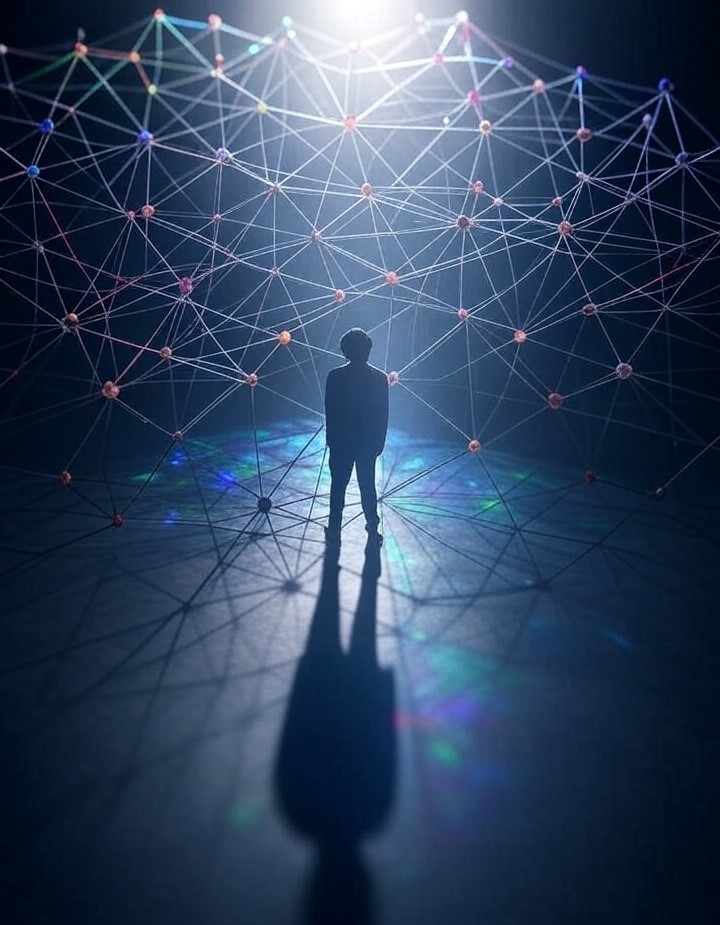
At the heart of this metaphor is the point of origin for the tomographic light stream, which symbolizes my standpoint as the observer. This origin represents not only a spatial or vectorial position, aligned for instance with the network’s time axis, but also my perceptual state, encompassing cognitive frameworks, prior assumptions, and interpretive lenses. In phenomenology, I do not merely record data; I co-create the observed world through my situated awareness. Similarly, in Affinity Time, the light’s origin embodies this duality: as the individual historian or analyst, I direct the inquiry, casting illumination that “brings into being” patterns of affinity and compression.
For example, when projecting through a network of ghost town artifacts, my perceptual state influences how affinities (e.g., between cartridge casings and conflict activities) are highlighted. The light stream travels as a field of awareness, interacting with the network’s nodes and edges to reveal temporal dynamics. This underscores a key philosophical insight: temporal foldings, where affinities fold and compress time, are perceptual artifacts. The framework invites humility, recognizing that what I perceive as compressed time is shaped by my light, much like how context folds historical interpretations into subjective narratives.
To clarify the process, I define light tomography in this context as a simulated ray-tracing technique adapted from network tomography principles in graph theory. Network tomography traditionally involves inferring internal characteristics of a graph such as densities or flows from endpoint measurements, often applied in communication or social networks to estimate hidden parameters without direct access to the interior. In Affinity Time, I extend this metaphorically: the “light” consists of virtual rays originating from my position as observer, traversing the 3D-embedded network structure. The network itself is a graph where nodes represent artifact categories (e.g., ‘suspender clips’ as a node sized by frequency), and edges are weighted connections reflecting affinities (e.g., production-to-use flows, with thickness proportional to strength). These internal structures of clusters of densely connected nodes or high-weight edges obstruct the rays variably: rays passing through sparse areas continue unimpeded, while dense internals (e.g., overlapping affinities compressing time) attenuate or scatter the light, creating shadows. The resultant patterns on the projection surface visualize temporal dynamics directly tied to the network’s topology.
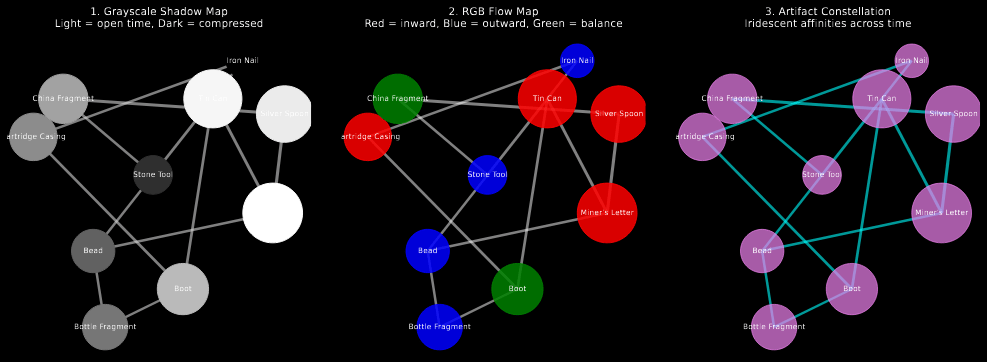
What is meant by “light tomography” in the Affinity Time framework borrows principles from medical CT scans and network tomography but applies them conceptually to perceptual analysis of historical or archaeological data. It involves imagining infinitesimal, parallel rays of perception originating from the observer’s vantage point (the origin) and traveling along a chosen vector through a 3D graph representation of affinities. During traversal, each ray interacts with the graph’s nodes and weighted edges. In a computational sense, this could be simulated by counting the graph elements within the ray’s path, but philosophically, it represents attenuation: denser, higher-weighted structures reduce the ray’s intensity, akin to how obstacles absorb or scatter light. On the opposite side of the network lies a projection plane, an abstract screen where the cumulative attenuation of all rays renders as a grayscale image: White (approximately 0% attenuation) indicates minimal internal structure, symbolizing open, uncompressed time. Mid-gray (1 to 49% attenuation) shows partial obstruction, representing zones where temporal layers stretch or decompress. Black (≥50% attenuation) denotes strong obstruction, visualizing temporal folds where affinities collapse elements together. Since the rays emanate from the observer’s position, the resulting shadow map is inherently calibrated to what can (and cannot) be perceived from that standpoint.
The network structure is a 3D-embedded graph that models artifact affinities. Nodes represent categories or subcategories of artifacts (e.g., suspender clips, tin cans, cartridge casings), with their radii scaled by observed frequency, with larger nodes for more common items, which cast broader shadows in the tomography. Edges connect nodes based on affinities, such as production-to-use relationships, spatial co-locations, or functional similarities. Edge weights quantify the strength of these affinities, acting like thickness or opacity in the ray model; higher weights indicate stronger attractions (or repulsions) derived from data analysis, such as correlation metrics or inferred links via graph neural networks. The graph is oriented with time along the Z-axis: elongated edges or tall nodes suggest extended chronological spans, while flattened clusters imply simultaneous or rapid depositions. Obstruction occurs when a ray passes through: high-frequency nodes (large cross-sections due to abundance), high-weight edges (thick connective elements), or overlapping subgraphs (convergent clusters of ties). The greater the material traversed, the darker the pixel on the projection screen, directly mapping network topology to visual patterns.
Why the observer must be the origin: Positioning the observer at the light’s origin is essential, as shifting it warps the entire pattern, dark zones shift, new gaps emerge, and others disappear. This renders the compression map explicitly perspectival. From a personal perspective, the observer’s prior assumptions direct the light vector, illuminating specific graph regions. Different interests would redirect the beam, altering visible compressions.
Collective Observation: Participatory Perception and Calibration
Extending beyond my individual perspective, I conceive of the observer in Affinity Time as potentially manifesting in a networked form, where a collective of participants contributes to the perceptual field through mechanisms like prediction market-style feedback. In this configuration, the “light origin” shifts from a singular point to a distributed network of observers, each illuminating aspects of the unknowns within the affinity structure. This collective perceptual field expands the scope of inquiry, allowing shared insights to refine edge weights and inferred elements, such as wagering on the probability of affinities between artifacts. The aggregation of these contributions generates a consensus that calibrates the network, transforming isolated perceptions into a broader, interconnected field of awareness.
This networked observation draws parallels to the quantum observer effect, where the act of measurement interferes with the system itself, collapsing probabilistic states into definite outcomes. In quantum mechanics, observation is not neutral; it disturbs the observed, introducing interference that alters wavefunctions and measurements. Similarly, when observers form a network in Affinity Time, their participatory inputs create feedback loops that can interfere with the data, potentially distorting inferences. For instance, as users’ bets converge on certain affinities, these loops may amplify prevailing assumptions, echoing how quantum interference patterns emerge from repeated interactions. This amplification risks bias: initial perceptions, if dominant, could cascade through the collective, skewing calibrations and compressing temporal interpretations toward consensus artifacts rather than objective dynamics.
The concept here centers on the observer’s expanded role: as a network, the perceptual field becomes a dynamic interplay of interferences, where each participant’s “measurement” influences the whole. This introduces potential distortions like feedback loops that reinforce biases, much like quantum decoherence where environmental interactions collapse possibilities. It also enriches the field, allowing unknowns to be probed through collective scrutiny. Perception remains active and constitutive: the networked observer does not merely reveal but shapes the temporal affinities, with interference serving as a reminder of the inherent uncertainties in data interpretation.
Collectively, when calibration involves a crowd such as through prediction-market betting on edge weights, the origin becomes the barycenter of participants’ expectations. This aggregated “light” uncovers compressions that individual views might miss, fostering a shared perceptual field.
Interpreting the Shadow Map: Shadows, Transitions, and Light
The tomographic projections offer a rich canvas for philosophical interpretation, where patterns of light, transition, and shadow symbolize the interplay of temporal certainty and flux. Shadows; areas of deepest darkness are defined as grayscale values exceeding 50% and represent calibrated compressions where affinities densely overlap to fold time. These black zones visualize regions of intense temporal density, such as clustered survival artifacts compressing daily existence into survival imperatives, as refined by collective calibration. The obstruction occurs when rays encounter internal structures: high-density node clusters or thick edges block or diffuse the light, manifesting as shadows that indicate where affinities are pulling elements together, effectively compressing the perceived flow of time.
Transition zones, rendered in gray values, embody consensus uncertainties: intermediate gradients where affinities decompress or expand, reflecting divergences in user perceptions (e.g., debated links that pull temporal layers apart). These grays signify the liminal spaces of interpretation, where perception negotiates ambiguity, neither fully illuminated nor obscured, but in flux. These zones, with partial obstructions allowing some light to pass, represent time decompressing, as affinities loosen and temporal layers spread out.
Light areas, appearing as white or near-white regions, denote openness and sparsity: uncompressed temporal expanses where affinities are minimal, inviting further inquiry. Rays pass freely through these sparse internals, resulting in bright projections that highlight where time flows without compression. Together, these elements form holistic ratios like shadow to transition to light that proxy perceptual balance, revealing how compressed versus expansive experiences dominate the inferred “frequencies of life.” The projections serve as perceptual mirrors, casting the network’s dynamics onto a surface where time’s folds become visible artifacts of observation.
Crucially, these patterns are only directly perceptible by positioning the individual or the individual as part of a network as the point of origin for the light stream or vector. From this vantage, the tomography aligns with their perceptual field: the rays emanate from their position, ensuring that obstructions and passages are experienced relative to their viewpoint. Any other angle would distort the patterns, losing the direct correspondence between perception and projection. This setup reinforces the phenomenological principle that reality unfolds through the observer’s embodied perspective, making the compressions and decompressions intimate revelations of my interpretive act.
The shadow map’s tones provide a visual grammar for temporal dynamics:
Tonal Band
Graphical Cause
Temporal Meaning
Black (≥50%)
Multiple dense nodes and heavy edges stacked along the ray path
Time is highly compressed or “folded”, activities overlap tightly, blurring distinctions (e.g., rapid cycles of conflict and reprisal).
Gray (10–49%)
Partial obstruction; a single dense node or moderate edge bundle
Transitional phases, time stretches or relaxes; rival interpretations coexist.
White (<10%)
Sparse topology; rays pass through empty graph space
Open or dilated time, activities were rare, peripheral, or poorly preserved.
Global ratios (black:gray:white) serve as a phenomenological proxy for the rhythms of daily life inferred from the artifact assemblage.
Enhancing the Shadow Map: From Grayscale to RGB Shift for Directional Insight
To further enrich the perceptual tomography in the Affinity Time framework, I propose extending the grayscale shadow map into an RGB color shift, introducing an iridescent visual effect that captures not only the density of temporal compressions but also the directional flows within the network. In this adaptation, the monochromatic scale—where black signifies profound obstruction (compressed time via stacked dense nodes and heavy edges), gray denotes transitional ambiguities, and white reveals sparse, dilated expanses, is supplanted by a trichromatic model. Red channels could encode inbound affinities like convergent flows toward a node, such as artifacts drawn into survival clusters during frontier crises, green for balanced or static interactions, and blue for outbound divergences such as radiating uses from a production node like tin cans dispersing into sustenance activities. As rays traverse the 3D graph, attenuation now modulates hue and saturation alongside intensity: high-density paths might shift toward crimson iridescence if directional vectors point inward, evoking the perceptual “pull” of historical pressures, while outward expansions shimmer in azure tones, symbolizing temporal diffusion. This iridescent overlay, akin to the play of light on opal surfaces, emerges from simulated interference patterns in the ray-tracing, where overlapping affinities create chromatic fringes that highlight movement directions, revealing for instance how cartridge casings “flow” toward conflict nodes rather than merely clustering statically.
The benefits of this RGB shift are manifold, offering heightened resolution and multidimensional data encoding that grayscale alone cannot achieve. By leveraging three color channels, the visualization accommodates richer perceptual constructs: colors dissect directional nuances that might otherwise blur into uniform shades, allowing observers to discern vectorial dynamics such as the asymmetric pull of episodic events compressing time unevenly across the network. This not only provides more data (quantifying flow asymmetry via color gradients) but enhances interpretive fidelity, as iridescence intuitively mirrors the fluid, multifaceted nature of human traces in archaeological records. It deepens the observer’s immersion, transforming the projection into a vibrant perceptual artifact where colors co-constitute temporal realities, inviting reflections on how directionality shapes our embodied understanding of the past’s malleable folds. In collective calibrations, participants could even wager on directional probabilities, further tinting the map with consensus hues and underscoring the active, interferential role of perception in unveiling hidden historical currents.
Folds and Waves: Dual Expressions of Affinity Time
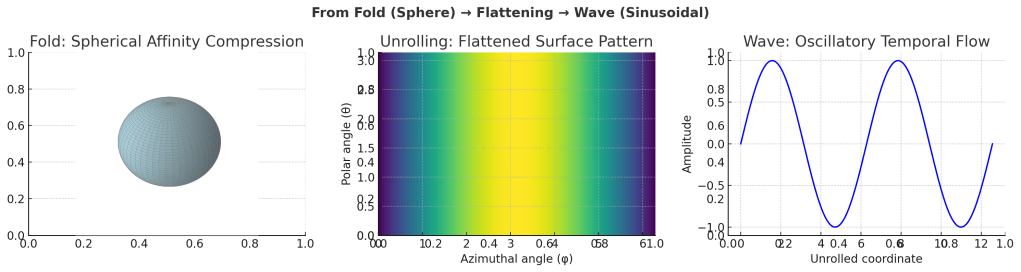
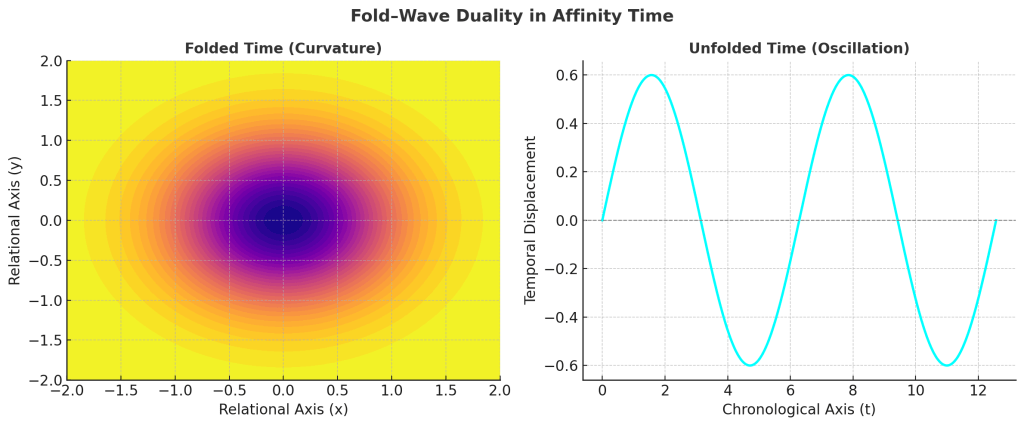
Within the Affinity Time framework, folds in temporality have thus far been modeled as compressions: dense affinity clusters bending the flow of time into depressions, like spherical curvatures in the temporal fabric. Yet observation of these folds reveals a deeper duality.
When the curvature of a fold is projected or unrolled onto a flat baseline, it does not disappear into uniformity. Instead, the curvature manifests as an oscillatory pattern, most naturally taking the form of a sinusoidal wave. The smooth efficiency of the sine function reflects the geometry of curvature distributed across a flat surface.
This suggests that Affinity Time is not only topological (folds and compressions) but also oscillatory (waves and ripples). The two are inseparable expressions of the same underlying phenomenon:
Inside the network, affinities pull time inward, generating folds and spherical depressions.
At the boundary and beyond, these folds unfold into sinusoidal waves, rippling outward as dilated temporal flows.
I propose a novel fold–wave duality within Affinity Time: compressions are experienced as curved surfaces of time, while decompressions appear as oscillatory undulations. This mirrors broader physical and phenomenological metaphors like Einstein’s spacetime curvature alongside Schrödinger’s wave mechanics; Husserl’s thickness of the present alongside Merleau-Ponty’s temporal rhythms.
Diagram: Fold–Wave Duality
This paper advances the Affinity Time framework by introducing the fold–wave duality, a novel principle in which temporal compressions (folds) are conceived as curvatures within affinity networks, and their subsequent unrolling manifests as oscillatory waveforms, thereby uniting topology and rhythm in the perception of time.
The implication is that Affinity Time should be modeled in both topological and waveform registers. Folds visualize the density of affinities within the network; waves visualize the release of those affinities once time dilates beyond the network’s edge. In this sense, the Affinity Time framework encodes not just the geometry of history but its rhythms: compressions become beats, decompressions become flows.
Resonance States and the Maybe Quandary
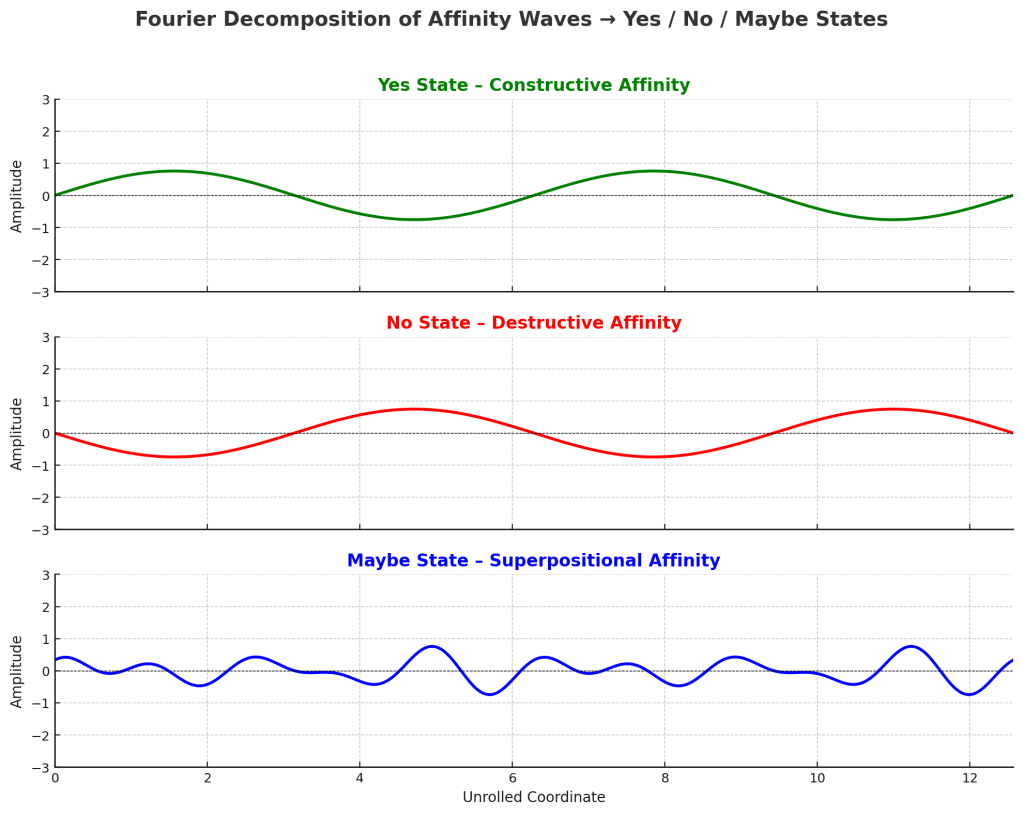
The unrolling of folds into sinusoidal waves reveals not only the rhythmic structure of time but also its ternary logic. When subjected to Fourier decomposition, these oscillations display three recurring resonance states: constructive alignment, destructive cancellation, and ambiguous superposition. These map directly onto what I have elsewhere called the Maybe Quandary or the philosophical problem of indeterminacy, where truth and decision are not binary (yes/no) but oscillatory (yes/no/maybe).
Within Affinity Time, this means that every fold of history does not simply dilate outward into smooth continuity; it resonates. The Yes state arises when affinities reinforce one another into coherent presence. The No state appears when affinities negate or cancel, producing troughs of absence. The Maybe state emerges when affinities partially overlap without resolution, producing ambiguity as a structural feature of time itself.
The implication is that uncertainty is not a flaw in perception but a fundamental rhythm of temporal unfolding. Affinity Time therefore encodes both the geometry of compressions and the logic of oscillations, uniting topology and ternary resonance in a single framework.
Fourier Decomposition and the Yes/No/Maybe States
In extending the fold–wave duality of Affinity Time, we observe that the unrolling of affinities into oscillatory patterns does not produce a single, uniform sine wave. Instead, Fourier-like decomposition reveals distinct repeating motifs that can be interpreted as temporal “states.”
Yes State (Constructive Affinity): Peaks align through reinforcement of multiple affinities, producing a clear, amplified waveform.
No State (Destructive Affinity): Affinities cancel each other, generating troughs or near-flat intervals where temporal resonance collapses.
Maybe State (Superpositional Affinity): Partial overlap of frequencies produces ambiguous, oscillatory motifs which are neither wholly reinforced nor wholly negated.
The Fourier spectrum of Affinity Time suggests that affirmation, negation, and indeterminacy are not merely logical categories but structural consequences of affinity interference. The “maybe” state, in particular, emerges as a natural mode of temporal flow, a ripple born of partial alignments across divergent folds.
Greater Implications
Through its tomographic metaphor, the Affinity Time framework invites broader reflections on perception and reality in archaeological and historical inquiry. By aligning the observer , whether individual or collective with the light origin, it underscores that temporal insights are perspectival, akin to observer effects in broader scientific paradigms where measurement shapes the measured. This avoids claims of absolute knowledge, instead embracing time as a perceptual construct: affinities fold and compress not in isolation, but through the illuminating act of observation.
The introduction of the fold–wave duality deepens this picture. Folds appear as curvatures in time, dense compressions within the network where affinities accumulate. Yet when these curvatures are unrolled, they reveal themselves as oscillatory waveforms, sinusoidal undulations that carry history outward as rhythm. Affinity Time therefore encodes both geometry and music: compressions become beats, decompressions become flows.
Conclusion: Shadows, Folds, Waves, and Resonance
Through its tomographic metaphor, my Affinity Time framework invites broader reflections on perception and reality in archaeological and historical inquiry. By aligning the observer as an individual or collective with the light origin, I underscore that temporal insights are perspectival, akin to observer effects in broader scientific paradigms where measurement shapes the measured. This avoids claims of absolute knowledge, instead embracing time as a perceptual construct: affinities fold and compress not in isolation, but through the illuminating act of observation. Such implications extend to existential questions about human traces across eras, where artifact networks become canvases for contemplating time’s malleability. Future explorations might integrate immersive technologies, allowing observers to “embody” the light origin and experience projections firsthand, further blurring the line between perceiver and perceived.
By constructing the graph, anchoring the observer (individual or collective) at the origin, and projecting this perceptual tomography, the framework yields a shadow map of history. It does not claim to reveal the “true” interior of the past but instead shows how the past compresses, stretches, or vanishes when illuminated from a specific stance. Affinity Time fulfills dual roles in this application: Analytical in that it distills vast artifact data into a single interpretable image, where darkness, gradients, and voids correspond to quantifiable network properties. It is reflective because it underscores that historical claims are angled by the chosen standpoint and the “light” questions, models, and expectations projected through the data.
To this foundation we now add resonance. The fold–wave duality reveals that compressed affinities, when unrolled, do not simply disperse — they oscillate. Fourier decomposition of these waves exposes a ternary rhythm: reinforcement (Yes), cancellation (No), and superposition (Maybe). This “Maybe Quandary” is not an external supplement but an intrinsic feature of Affinity Time: uncertainty itself is patterned, expressed as oscillatory ambiguity within the unfolding of history. Thus, Affinity Time models not only the geometry of folds and the rhythm of waves, but also the resonance states through which affirmation, negation, and indeterminacy co-constitute our experience of time.
In the enclaves and eddies and in between the homes of Rosita are the remains of implements of everyday life from the people who have passed through here for the past 13,000 years. Fragments of projectile points and other stone tools are occasionally revealed in a dirt driveway, or hiding in a gopher mound under a rabbitbrush which is behind a workshop or garage. The flotsam of the mining town is dispersed everywhere. Tin cans, iron cut nails, and shattered pieces of Ironstone china tableware are prolific in the old town site. The current visitors and residents all share the same space with the spirits of the past, but not exactly the same place in time. We share the same soil and the same vista.
I am proposing a new multidimensional framework for perceiving and understanding time for an observer who is relating to human events of the past. ‘Affinity Time’ redefines temporal proximity not by calendars or clocks, but through experiential, material, and perceptual axes. Drawing from phenomenology, historical materialism, and archaeological models, Affinity Time proposes additional coordinates such as memory intensity (m) and constellational linkage (c) to quantify how artifacts collapse centuries into shared moments. In applying this philosophy to the millennia of human history represented in the fields of the town, I explore how visitors can perceive prehistoric artisans and silver miners as “neighbors” in spacetime; fostering a deeper, more immersive engagement with history. This concept not only enriches museum narratives but also invites broader academic discourse on non-linear temporality, establishing a foundational claim for Affinity Time as a novel interpretive tool.
The Tyranny of the Clock and Linear Time
The ticking of clocks and the linear march of calendars reveal profound limitations. Traditional timekeeping pins events to distant points on a timeline thousands of years for ancient stone tools, a mere 150 for a discarded tin can, yet it fails to convey the intimate proximity we feel to these long-gone neighbors. Enter Affinity Time, a revolutionary concept that reorients our understanding of temporal distance. Rather than measuring separation by years or centuries, Affinity Time gauges “closeness” through the strength of experiential and material bonds. Affinity Time compresses eras into a shared human moment acknowledging the quiet resonance of holding a bone bead that once adorned a prehistoric hunter or the excited vibrations of holding a fragment of an arrowhead. In this framework, history isn’t a faded echo but a vibrant, proximate presence, alive in the artifacts that connect us, inviting us to perceive the past not as “then,” but as an enduring “here and now.”
This shift to Affinity Time opens the door to a multidimensional approach, drawing inspiration from Einstein’s spacetime continuum, where time intertwines with spatial dimensions, yet extending it to encompass the subjective layers of human experience. Influenced by phenomenological thinkers like Husserl and Merleau-Ponty, who emphasize time as a lived retention of the past in the present, and archaeological notions of palimpsests where multiple historical strata overlap in a single site. I propose additional axes to map these affinities. Imagine coordinates beyond the familiar (x, y, z, t): a memory axis quantifying the emotional vividness of an artifact’s echo, or a constellational axis linking disparate eras through shared objects, much like Walter Benjamin’s vision of history as a constellation of charged moments. These dimensions tease a richer temporal landscape, one where our ghost town’s layered artifacts fold time itself, transforming museum visits into portals of profound connection and challenging us to rethink how we navigate the intricate web of history.
Defining Affinity Time: From Linear to Multidimensional
Affinity Time emerges as a perceptual and experiential metric that fundamentally reimagines how we gauge closeness to the past, compressing temporal distance through the interplay of shared space, artifacts, and human connections. In the Rosita Museum, where the same patch of earth has borne witness to prehistoric tool-makers, 1870s silver miners, and contemporary residents, this concept transcends the cold arithmetic of dates and durations. Instead, it prioritizes the subjective bonds forged by material remnants: a discarded tin can doesn’t merely mark a meal from 140 years ago but actively draws that moment into our present, evoking universal experiences. Through these connections, Affinity Time transforms history from a remote chronicle into a living dialogue, where the emotional and sensory resonances of artifacts compress centuries into intimate proximity, allowing us to feel the pulse of bygone lives intertwined with our own.
This approach stands in stark contrast to Einstein’s spacetime framework, which merges three spatial dimensions (x, y, z) with a single temporal dimension (t) to describe the physical universe as a four-dimensional continuum. While relativity revolutionized our understanding of time as relative and bendable under gravity or velocity, it remains a linear construct that doesn’t account for the subjective overlays of human history and memory. In a site like Rosita, where prehistoric projectile points and historic bottles mingle in the soil, such a model falls short; it can’t capture the “historical overlap” where eras feel superimposed through personal encounters. Affinity Time argues for an expansion of this system, incorporating additional axes to infuse spacetime with phenomenological depth and cultural nuance, enabling a more holistic representation of how time warps not just in physics, but in the human experience of layered pasts.
At its core, Affinity Time proposes a multidimensional coordinate system (x, y, z, t, m, c) that builds on spacetime while bridging scientific and philosophical realms. Here, t serves as the conventional time axis, anchoring events to a linear baseline like 1000 BC for prehistoric artifacts, 1885 AD for miners’ relics, or 2025 AD for our present. The m axis, or memory axis, draws from phenomenological retention to measure how vividly an artifact summons the past: a miner’s personal letter might score high due to its tactile script and emotional immediacy, pulling the writer’s voice across the temporal divide, whereas an abstract stone tool could rank lower, its context more elusive. Complementing this, the c axis inspired by Walter Benjamin’s “now-time” quantifies constellational linkages, assessing how artifacts weave eras into a network; for instance, it rates high in our areas overlapping stratigraphic layers, where a prehistoric bead and a historic bottle binds disparate periods through shared materiality.
Beyond this foundation, Affinity Time invites further axes to enrich its flexibility, each tailored to different facets of temporal affinity. The p axis, for perceptual proximity, channels Maurice Merleau-Ponty’s embodied perception by factoring in sensory engagement, such as how grasping an artifact through touch diminishes temporal gaps, making the ancient artisan’s intent feel palpably near. An h axis, rooted in archaeology, could track historical density via material continuity, amplifying affinity in zones of high artifact concentration where dense overlaps signal enduring human presence. More speculatively, an e axis borrows from quantum mechanics’ entanglement, positing how objects like a shared-utility coin “entangle” modern users with their creators, fostering instantaneous connections across time through common purpose and handling. Together, these axes render time “foldable,” like origami creases in the fabric of history, converting the Rosita Museum from a static repository into a dynamic portal where visitors encounter the past as co-present companions rather than distant shadows, inviting profound, multisensory immersion in the continuum of lives that echo through our shared soil and experiences.
Affinity Time in Perception and Experience of History
Delving into the phenomenological roots of Affinity Time reveals a profound alignment with thinkers like Edmund Husserl and Martin Heidegger, who reframe time not as an abstract sequence but as a lived, experiential continuum. Husserl’s concept of temporal consciousness emphasizes “retention,” where the present moment actively holds onto the immediate past, allowing it to linger and influence our now. In the context of the Rosita Museum, artifacts embody this retention: a prehistoric stone tool unearthed from the backyard doesn’t merely represent a distant era but retains the essence of its creator’s gestures, intentions, and existence, drawing that ancient being into our perceptual field. Heidegger extends this in “Being and Time,” portraying time as existential and tied to our “thrownness” into historical contexts, our shared space with past inhabitants makes us co-dwellers in a temporal horizon. Through Affinity Time, these ideas manifest as artifacts that “retain” past beings in the present, compressing millennia into a felt immediacy where the miner’s 1870s letter whispers directly to us, unbound by chronological barriers.
This phenomenological foundation seamlessly links to Walter Benjamin’s historical materialism, where artifacts serve as dialectical images that shatter the illusion of linear progress. Benjamin, in his “Theses on the Philosophy of History,” envisions history as a constellation of moments charged flashes where the past erupts into the present, disrupting continuity and revealing hidden truths. In the museum, a tin can from a miner’s supper or a bone bead from prehistoric adornment becomes such an image: it dialectically juxtaposes eras, creating a network of temporal sparks that illuminate shared human experience. Affinity Time adopts Benjamin’s “now-time” (Jetztzeit) to quantify these constellations, positioning artifacts as portals that forge unexpected alliances across time, like a historic bottle alongside a prehistoric tool forms a material dialogue, reminding us that history isn’t a straight path but a web of interconnected instants.
Applying Affinity Time to everyday museum experiences brings these abstract ideas to life, illustrating how simple acts like digging a hole in the field at the crossroads in Rosita can unveil profound affinities. Imagine breaking ground and revealing a prehistoric tool: despite its ancient origins (t=1000 BC), its high m-value stemming from the tactile immediacy of its craftsmanship makes it feel closer than a contemporary event unfolding miles away, such as a news headline from another continent. The shared spatial coordinates (x, y, z) amplify this, as the tool’s emergence from the same earth we stand on compresses temporal distance, fostering a sense of co-presence with its maker. Similarly, unearthing a 1870s coin or cutlery fragment links us through constellational ties (c-axis), where the artifact’s utility echoes our own daily rituals, turning excavation into a revelation of temporal folds that prioritize experiential bonds over mere chronology.
The implications for visitors are transformative, elevating museum encounters from passive observation to active temporal dialogue that enhances empathy and immersion. By engaging with Affinity Time, guests are invited to “feel the miner’s struggle through this worn out boot,” sensing the artifact’s retained wear and context as if sharing a walk across centuries, or to trace the prehistoric artisan’s touch in a hand forged iron tool, bridging emotional gaps through embodied perception. This shifts history from a detached narrative to a participatory experience, where high perceptual proximity (p-axis) via sensory handling; touching, holding, or seeing deepens connections, fostering compassion for lives long past. For the Rosita Museum, this approach turns visitors into temporal explorers, co-creating meaning and leaving with a heightened awareness of history’s living pulse.
Affinity Time is not without challenges, particularly the inherent subjectivity of its axes, which rely on personal interpretations of memory (m) and constellational links (c). What evokes vivid retention for one visitor such as a miner’s photograph stirring emotional echoes but it might resonate less for another, highlighting the need for empirical calibration through tools like visitor surveys to average scores or refine metrics. Archaeological input could help standardize historical density (h-axis) based on site data, while phenomenological insights guide perceptual assessments. Importantly, Affinity Time complements rather than replaces scientific dating methods, such as carbon-14 analysis or stratigraphic sequencing; it enriches these objective tools with subjective layers, offering a fuller spectrum of temporal understanding that honors both fact and feeling in our exploration of the past.
Applications to the Rosita Museum
To illustrate Affinity Time in action, let’s turn to case studies from the Rosita Museum’s collection, assigning coordinates to key artifacts within the proposed multidimensional system (x, y, z, t, m, c). Consider the humble tin can, a relic from an 1870s miner’s supper unearthed in the backyard at spatial coordinates roughly (10, 5, 0) a spot shared with modern life. Its values might be t=1885 (conventional time), m=0.9 (high memory axis due to the vivid evocation of a specific, relatable meal through its preserved label and dents), and c=0.8 (strong constellational axis, as it links the mining era to present-day food rituals in a shared context of daily survival). In contrast, a prehistoric bead, found at similar spatial coordinates (10, 5, -1) to reflect its deeper stratigraphic layer, could be assigned t=1000 BCE, m=0.5 (moderate memory retention, as its abstract form offers less immediate emotional context than a personal item), and c=0.7 (solid linkage to other prehistoric artifacts, forming a network of ancient adornment and craftsmanship). These assignments aren’t arbitrary; they’re derived from phenomenological assessments of sensory and emotional impact, archaeological context, and Benjaminian connections, demonstrating how Affinity Time quantifies why the tin can feels “closer” while the bead’s deeper temporal roots are bridged by shared space.
Visualizing these coordinates brings the abstract to life through our 3D Temporal Constellation Diagram, a conceptual model that maps affinity networks in an intuitive, immersive way. In a conceptual diagram, artifacts might appear as glowing nodes plotted across spatial (x, y, z) and temporal (t) axes, with node sizes scaled by the m (memory) value to emphasize evocative power larger spheres for high-retention items like an ancient structure, smaller for subtler ones like a rusted nail. Lines connecting nodes represent the c (constellational) axis, their thickness proportional to linkage strength, creating a web that highlights temporal folds: the tin can’s thick ties to present-day and thinner threads to prehistoric beads illustrate overlapping eras in the Rosita soil. This visualization for 3D rendering, transforms static data into a dynamic constellation, allowing viewers to rotate perspectives and trace how artifacts collapse time, much like stars in Benjamin’s historical sky forming unexpected patterns.
Affinity Time offers innovative ways to reimagine museum exhibits and visitor interactions, moving beyond traditional chronological displays to ones organized by affinity scores. Instead of sequencing artifacts from oldest to newest; prehistoric tools first, then mining relics, we could cluster them by grouping high-affinity items. The broader impact of Affinity Time extends far beyond Rosita, inspiring a paradigm shift in how other historical sites engage visitors with layered pasts. At ancient ruins like Pompeii or Mesa Verde, where volcanic ash or cliff dwellings preserve multiple eras in one locale, curators could adopt multidimensional coordinates to highlight affinity over linearity, fostering empathy by emphasizing shared human experiences like daily meals or craftsmanship. In urban settings, such as Rome’s palimpsest of Roman forums atop medieval streets, or New York’s indigenous sites beneath skyscrapers, Affinity Time could guide exhibits that map historical density (h-axis) and perceptual proximity (p-axis), allowing city dwellers to “feel” entangled with buried histories. By rethinking visitor engagement this way and prioritizing experiential closeness over distant timelines, Affinity Time could democratize history, making it more emotionally resonant, ultimately transforming global heritage sites into vibrant portals where the past actively converses with the present.
Conclusion: Inviting Dialogue
In concluding this exploration, I assert Affinity Time as an original framework, meticulously crafted from the unique temporal tapestry of Rosita, a site where prehistoric echoes, 1870s mining relics, and modern life converge in the same soil. Grounded in the tangible artifacts unearthed and the visceral experiences they evoke, this concept emerges not from abstract theory alone but from the lived reality of digging up an old beer bottle that bridges 140 years or holding a stone tool that spans millennia. This framework invites scholars and enthusiasts alike to recognize its potential as a bridge between phenomenology, historical materialism, and scientific models, all tailored to sites of profound historical overlap like Rosita.



 The Rosita Museum