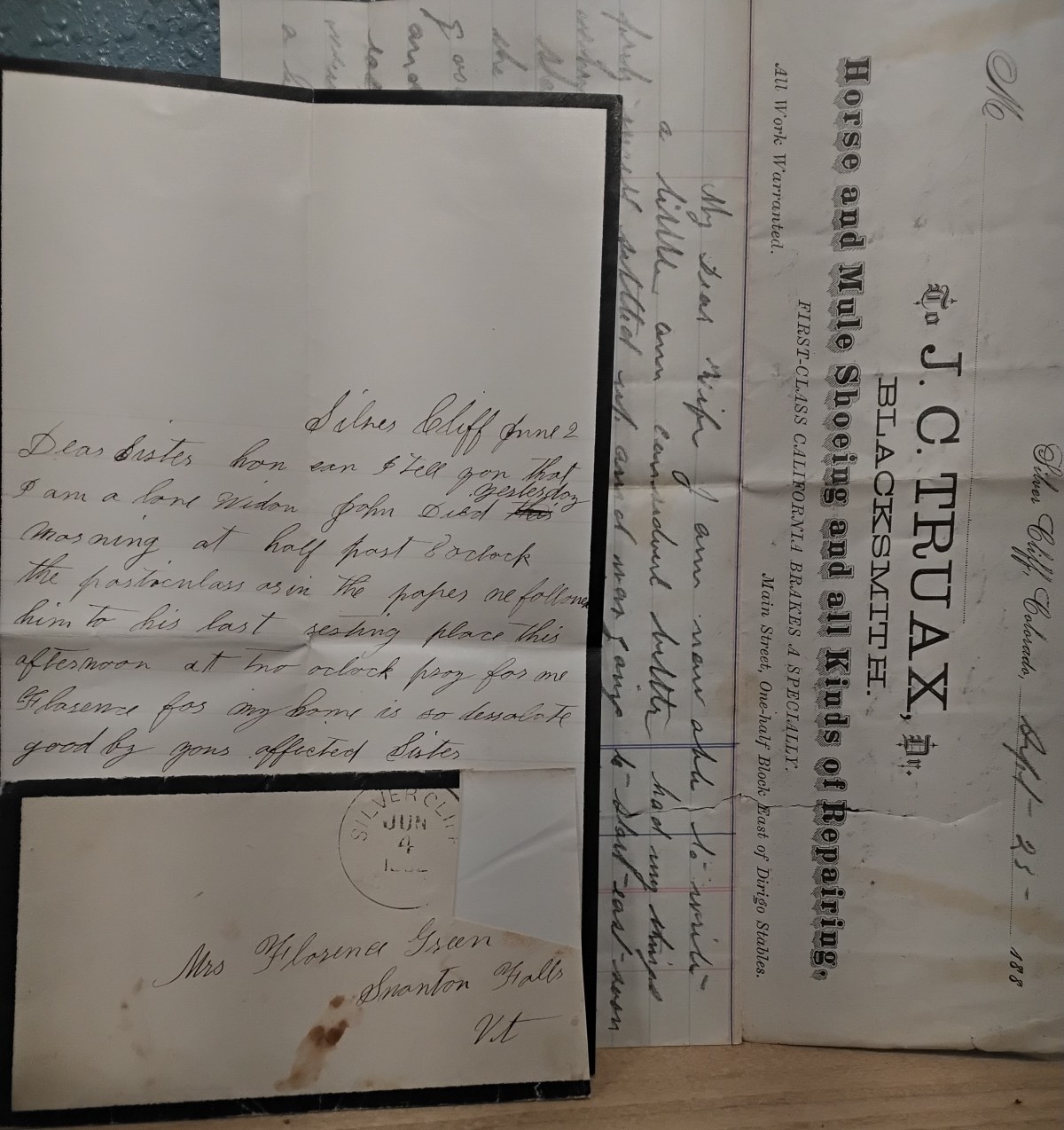
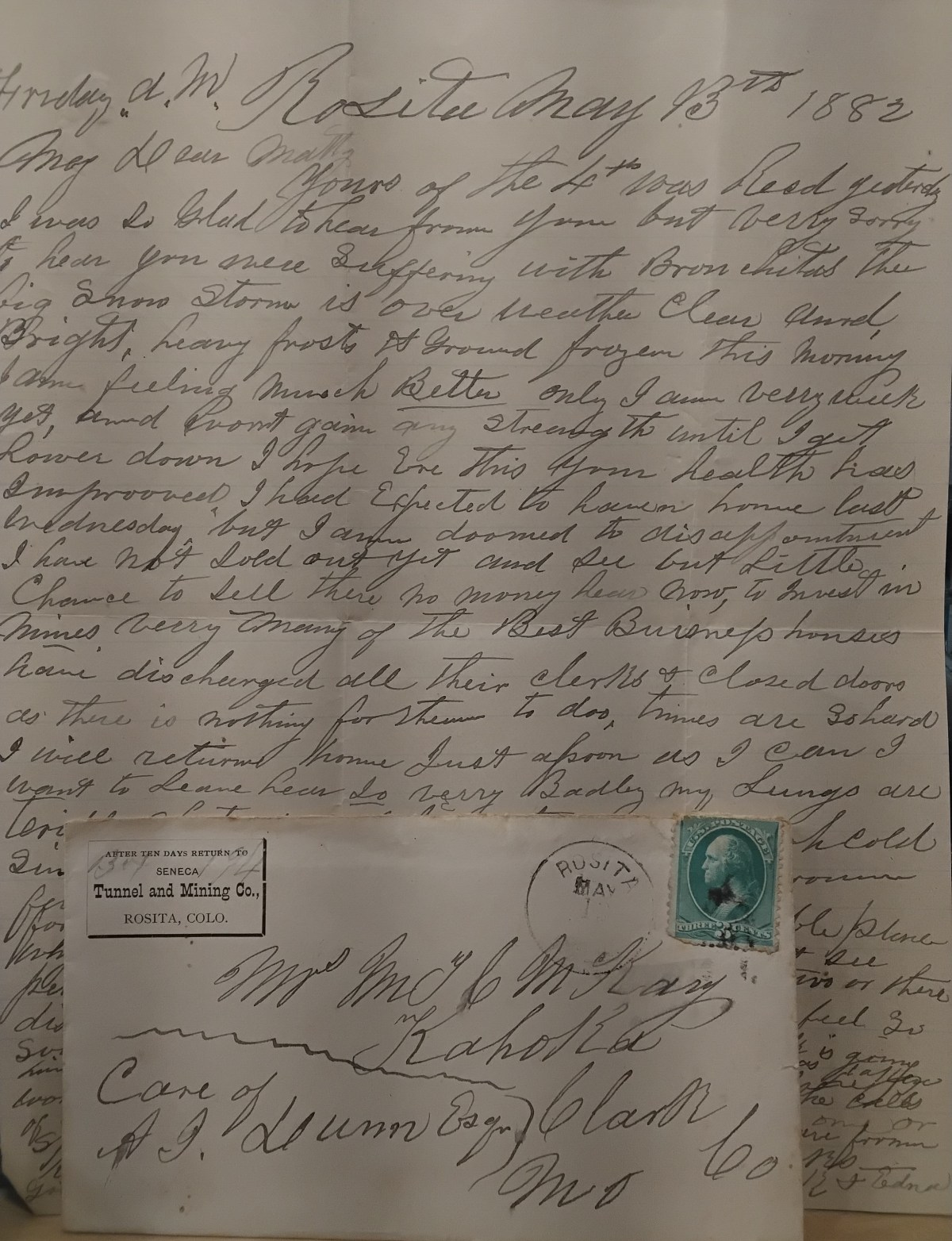
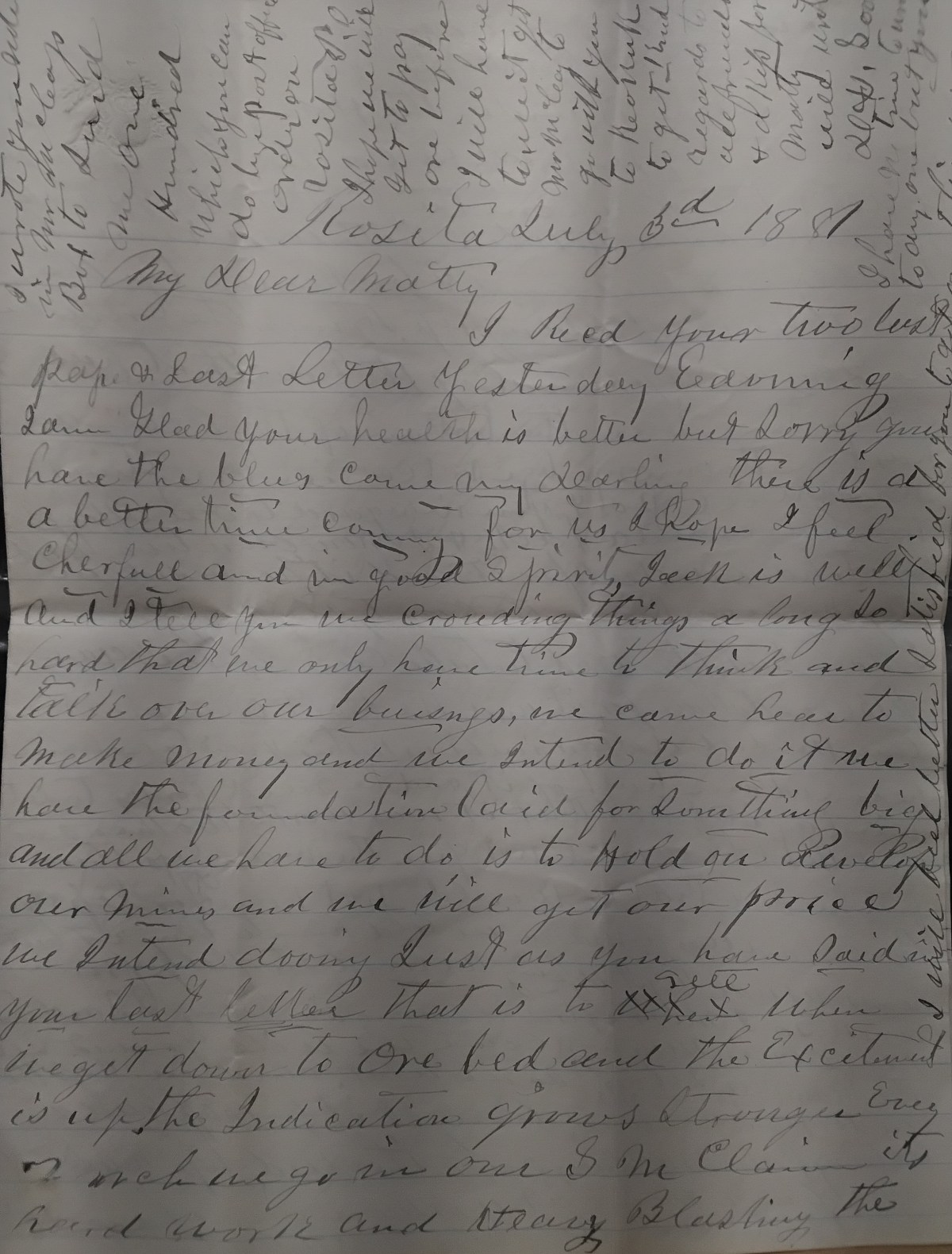
A transcription of an article from the June 1st, 1882 Weekly Herald, Silver Cliff, Colorado, and two handwritten letters, one from Mr. Truax to Mrs. Truax, and one From Mrs. Truax to her sister announcing the death.
Weekly Herald, June 1, 1882- This morning it was rumored that one of our citizens by the name of John C. Truax had died of an overdose of morphine, and a Herald reporter at once visited the home of the above named man, on first street below Hudson, and found the awful reality. There he lay on a bed in the back part of the house stiff and cold in death. On making inquiry of some of the neighbors that lived in that vicinity, we found that Mr. Truax has been in poor health and had taken that morphine to soothe his pain which had caused his end about nine o’clock this morning.
The deceased had been in the habit of taking chloroform for some time past, and the evidence was to the effect that he had taken it last fall and occasionally since. G.A. Truax stated that at that time she took part of a bottle from him while he was under its influence, and also he did the same thing several times since.
Mrs. Ada Truax, wife of deceased, stated that at times while in pain, as he suffered from rheumatism, he would saturate his pocket handkerchief with chloroform and lay down and go to sleep. He worked hard and was out late at nights and thought he used it to produce sleep. Had noticed how it worked on him and began to be alarmed, and had forbidden the druggists to sell it to him, but by some means or other he had it and she believes got it from other parties whom he would furnish money to bring it to him. Mrs. Truax said he has taken as high as six grains of morphine before.
As to the cause of his immediate death and the manner we only know that Tuesday night he went to the city drug store with a prescription for his wife, given by Dr. Shoemaker, and while their[sic] asked for some chloroform, and received it on the strength of his wife’s sickness and on stating it was for her. He kept this quiet at home and on the sly -as he knew she would object- took part and slept some. When he awoke yesterday, he asked his wife and another lady to go the store for morphine, but both positively refused. When in this semi-crazy state he would get angry, so much so that Mrs. Truax, being ill herself went to another house for a time, and afterwards sent a note by a boy for 2 grain powders of morphine. Mrs. Truax said she made a mistake and should have asked for half grain powders. A note was returned with the drug cautioning her on the size.
Mr. Truax, last night took half a powder and went to bed. Mrs. Truax also talking about one-half the balance of the same powder and also went to bed sleeping at the front side so as to be sure as to watch him. However in the night, she awoke and saw him up at the stand, by the bedside and spoke to him, asking him what he was doing. He got into bed again and about five o’clock this morning and he was there the second time taking something. She (Mrs. T) said, “John, what are you taking? be careful and not take too much.” Deceased laughed and replied “if he took too much she had money enough to bury him” and went to bed.
Mrs. Truax was awakened shortly after by hearing his heart beating loudly, and the dreadful thought then broke upon her. She immediately got up and gave him some liquor and aroused the neighbors, and Dr. Shoemaker was sent for, but at his arriving there about 6:30, there was no hope. He was in too weak a state to take an emetic and consequently breathed his last a few moments before nine this morning. The coroner empaneled a jury of six men and an inquest was held at 11:30 today. Several witnesses were examined and from the evidence that was there brought out, the only verdict that could be given was that death was caused by his own hands and mistaken judgment.
The deceased has been a citizen of Silver Cliff for some time, and at one time was in business as a blacksmith on Main street, near Dirigo stables, but of late has been working at his trade for Mr. Stewart. He leaves a wife and one little child to mourn his loss.
Letter from Mr. Truax to Mrs. Truax, Sept. 25, 188(1?), Written on His Business Letterhead-
My dear Wife I am now able to write a little am considered better had my things fairly well settled up and was going to-start-east-soon when I was taken very sick the fact is I cannot stand this climate Mrs Fay wrote to you she lived close to wheir[sic] I was sick I ____ good care and shall from now on pain in strength and just as soon as ____ able to travel well go east I have been all day writing this and will write you in a day as soon ____ I would like a letter so well think of ____ J.C. Truax
Letter from Mrs. Truax to Florence Green, Swanton Falls, Vermont, June 2, 1882-
Dear Sister ____ I tell you that I am a lone widow John died yesterday morning at half past 8 oclock the ____ followed him to his last resting place this afternoon at two oclock pray for me Florence for my home is so dessolate[sic] good by your afflicted Sister AE Truax
The Observer as Light Origin: Individual and Perceptual Dimensions
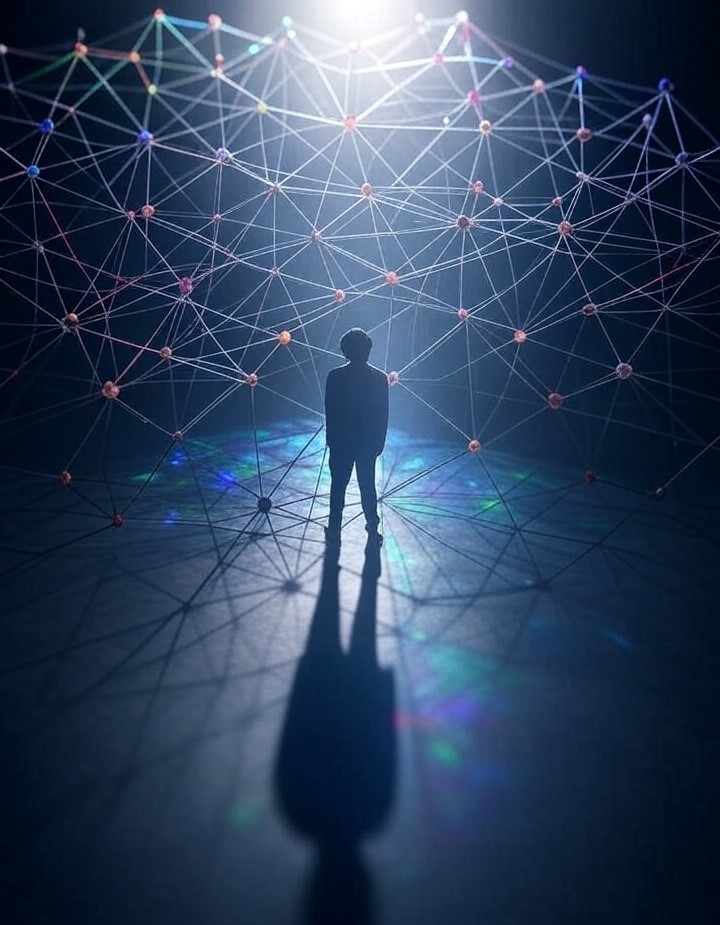
At the heart of this metaphor is the point of origin for the tomographic light stream, which symbolizes my standpoint as the observer. This origin represents not only a spatial or vectorial position, aligned for instance with the network’s time axis, but also my perceptual state, encompassing cognitive frameworks, prior assumptions, and interpretive lenses. In phenomenology, I do not merely record data; I co-create the observed world through my situated awareness. Similarly, in Affinity Time, the light’s origin embodies this duality: as the individual historian or analyst, I direct the inquiry, casting illumination that “brings into being” patterns of affinity and compression.
For example, when projecting through a network of ghost town artifacts, my perceptual state influences how affinities (e.g., between cartridge casings and conflict activities) are highlighted. The light stream travels as a field of awareness, interacting with the network’s nodes and edges to reveal temporal dynamics. This underscores a key philosophical insight: temporal foldings, where affinities fold and compress time, are perceptual artifacts. The framework invites humility, recognizing that what I perceive as compressed time is shaped by my light, much like how context folds historical interpretations into subjective narratives.
To clarify the process, I define light tomography in this context as a simulated ray-tracing technique adapted from network tomography principles in graph theory. Network tomography traditionally involves inferring internal characteristics of a graph such as densities or flows from endpoint measurements, often applied in communication or social networks to estimate hidden parameters without direct access to the interior. In Affinity Time, I extend this metaphorically: the “light” consists of virtual rays originating from my position as observer, traversing the 3D-embedded network structure. The network itself is a graph where nodes represent artifact categories (e.g., ‘suspender clips’ as a node sized by frequency), and edges are weighted connections reflecting affinities (e.g., production-to-use flows, with thickness proportional to strength). These internal structures of clusters of densely connected nodes or high-weight edges obstruct the rays variably: rays passing through sparse areas continue unimpeded, while dense internals (e.g., overlapping affinities compressing time) attenuate or scatter the light, creating shadows. The resultant patterns on the projection surface visualize temporal dynamics directly tied to the network’s topology.
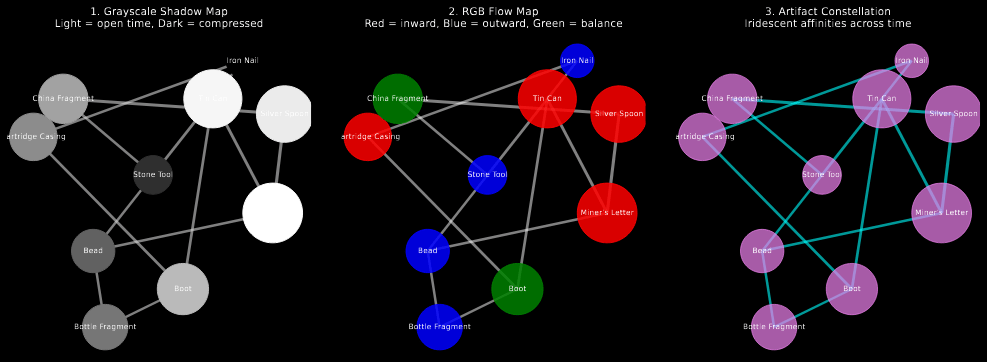
What is meant by “light tomography” in the Affinity Time framework borrows principles from medical CT scans and network tomography but applies them conceptually to perceptual analysis of historical or archaeological data. It involves imagining infinitesimal, parallel rays of perception originating from the observer’s vantage point (the origin) and traveling along a chosen vector through a 3D graph representation of affinities. During traversal, each ray interacts with the graph’s nodes and weighted edges. In a computational sense, this could be simulated by counting the graph elements within the ray’s path, but philosophically, it represents attenuation: denser, higher-weighted structures reduce the ray’s intensity, akin to how obstacles absorb or scatter light. On the opposite side of the network lies a projection plane, an abstract screen where the cumulative attenuation of all rays renders as a grayscale image: White (approximately 0% attenuation) indicates minimal internal structure, symbolizing open, uncompressed time. Mid-gray (1 to 49% attenuation) shows partial obstruction, representing zones where temporal layers stretch or decompress. Black (≥50% attenuation) denotes strong obstruction, visualizing temporal folds where affinities collapse elements together. Since the rays emanate from the observer’s position, the resulting shadow map is inherently calibrated to what can (and cannot) be perceived from that standpoint.
The network structure is a 3D-embedded graph that models artifact affinities. Nodes represent categories or subcategories of artifacts (e.g., suspender clips, tin cans, cartridge casings), with their radii scaled by observed frequency, with larger nodes for more common items, which cast broader shadows in the tomography. Edges connect nodes based on affinities, such as production-to-use relationships, spatial co-locations, or functional similarities. Edge weights quantify the strength of these affinities, acting like thickness or opacity in the ray model; higher weights indicate stronger attractions (or repulsions) derived from data analysis, such as correlation metrics or inferred links via graph neural networks. The graph is oriented with time along the Z-axis: elongated edges or tall nodes suggest extended chronological spans, while flattened clusters imply simultaneous or rapid depositions. Obstruction occurs when a ray passes through: high-frequency nodes (large cross-sections due to abundance), high-weight edges (thick connective elements), or overlapping subgraphs (convergent clusters of ties). The greater the material traversed, the darker the pixel on the projection screen, directly mapping network topology to visual patterns.
Why the observer must be the origin: Positioning the observer at the light’s origin is essential, as shifting it warps the entire pattern, dark zones shift, new gaps emerge, and others disappear. This renders the compression map explicitly perspectival. From a personal perspective, the observer’s prior assumptions direct the light vector, illuminating specific graph regions. Different interests would redirect the beam, altering visible compressions.
Collective Observation: Participatory Perception and Calibration
Extending beyond my individual perspective, I conceive of the observer in Affinity Time as potentially manifesting in a networked form, where a collective of participants contributes to the perceptual field through mechanisms like prediction market-style feedback. In this configuration, the “light origin” shifts from a singular point to a distributed network of observers, each illuminating aspects of the unknowns within the affinity structure. This collective perceptual field expands the scope of inquiry, allowing shared insights to refine edge weights and inferred elements, such as wagering on the probability of affinities between artifacts. The aggregation of these contributions generates a consensus that calibrates the network, transforming isolated perceptions into a broader, interconnected field of awareness.
This networked observation draws parallels to the quantum observer effect, where the act of measurement interferes with the system itself, collapsing probabilistic states into definite outcomes. In quantum mechanics, observation is not neutral; it disturbs the observed, introducing interference that alters wavefunctions and measurements. Similarly, when observers form a network in Affinity Time, their participatory inputs create feedback loops that can interfere with the data, potentially distorting inferences. For instance, as users’ bets converge on certain affinities, these loops may amplify prevailing assumptions, echoing how quantum interference patterns emerge from repeated interactions. This amplification risks bias: initial perceptions, if dominant, could cascade through the collective, skewing calibrations and compressing temporal interpretations toward consensus artifacts rather than objective dynamics.
The concept here centers on the observer’s expanded role: as a network, the perceptual field becomes a dynamic interplay of interferences, where each participant’s “measurement” influences the whole. This introduces potential distortions like feedback loops that reinforce biases, much like quantum decoherence where environmental interactions collapse possibilities. It also enriches the field, allowing unknowns to be probed through collective scrutiny. Perception remains active and constitutive: the networked observer does not merely reveal but shapes the temporal affinities, with interference serving as a reminder of the inherent uncertainties in data interpretation.
Collectively, when calibration involves a crowd such as through prediction-market betting on edge weights, the origin becomes the barycenter of participants’ expectations. This aggregated “light” uncovers compressions that individual views might miss, fostering a shared perceptual field.
Interpreting the Shadow Map: Shadows, Transitions, and Light
The tomographic projections offer a rich canvas for philosophical interpretation, where patterns of light, transition, and shadow symbolize the interplay of temporal certainty and flux. Shadows; areas of deepest darkness are defined as grayscale values exceeding 50% and represent calibrated compressions where affinities densely overlap to fold time. These black zones visualize regions of intense temporal density, such as clustered survival artifacts compressing daily existence into survival imperatives, as refined by collective calibration. The obstruction occurs when rays encounter internal structures: high-density node clusters or thick edges block or diffuse the light, manifesting as shadows that indicate where affinities are pulling elements together, effectively compressing the perceived flow of time.
Transition zones, rendered in gray values, embody consensus uncertainties: intermediate gradients where affinities decompress or expand, reflecting divergences in user perceptions (e.g., debated links that pull temporal layers apart). These grays signify the liminal spaces of interpretation, where perception negotiates ambiguity, neither fully illuminated nor obscured, but in flux. These zones, with partial obstructions allowing some light to pass, represent time decompressing, as affinities loosen and temporal layers spread out.
Light areas, appearing as white or near-white regions, denote openness and sparsity: uncompressed temporal expanses where affinities are minimal, inviting further inquiry. Rays pass freely through these sparse internals, resulting in bright projections that highlight where time flows without compression. Together, these elements form holistic ratios like shadow to transition to light that proxy perceptual balance, revealing how compressed versus expansive experiences dominate the inferred “frequencies of life.” The projections serve as perceptual mirrors, casting the network’s dynamics onto a surface where time’s folds become visible artifacts of observation.
Crucially, these patterns are only directly perceptible by positioning the individual or the individual as part of a network as the point of origin for the light stream or vector. From this vantage, the tomography aligns with their perceptual field: the rays emanate from their position, ensuring that obstructions and passages are experienced relative to their viewpoint. Any other angle would distort the patterns, losing the direct correspondence between perception and projection. This setup reinforces the phenomenological principle that reality unfolds through the observer’s embodied perspective, making the compressions and decompressions intimate revelations of my interpretive act.
The shadow map’s tones provide a visual grammar for temporal dynamics:
Tonal Band
Graphical Cause
Temporal Meaning
Black (≥50%)
Multiple dense nodes and heavy edges stacked along the ray path
Time is highly compressed or “folded”, activities overlap tightly, blurring distinctions (e.g., rapid cycles of conflict and reprisal).
Gray (10–49%)
Partial obstruction; a single dense node or moderate edge bundle
Transitional phases, time stretches or relaxes; rival interpretations coexist.
White (<10%)
Sparse topology; rays pass through empty graph space
Open or dilated time, activities were rare, peripheral, or poorly preserved.
Global ratios (black:gray:white) serve as a phenomenological proxy for the rhythms of daily life inferred from the artifact assemblage.
Enhancing the Shadow Map: From Grayscale to RGB Shift for Directional Insight
To further enrich the perceptual tomography in the Affinity Time framework, I propose extending the grayscale shadow map into an RGB color shift, introducing an iridescent visual effect that captures not only the density of temporal compressions but also the directional flows within the network. In this adaptation, the monochromatic scale—where black signifies profound obstruction (compressed time via stacked dense nodes and heavy edges), gray denotes transitional ambiguities, and white reveals sparse, dilated expanses, is supplanted by a trichromatic model. Red channels could encode inbound affinities like convergent flows toward a node, such as artifacts drawn into survival clusters during frontier crises, green for balanced or static interactions, and blue for outbound divergences such as radiating uses from a production node like tin cans dispersing into sustenance activities. As rays traverse the 3D graph, attenuation now modulates hue and saturation alongside intensity: high-density paths might shift toward crimson iridescence if directional vectors point inward, evoking the perceptual “pull” of historical pressures, while outward expansions shimmer in azure tones, symbolizing temporal diffusion. This iridescent overlay, akin to the play of light on opal surfaces, emerges from simulated interference patterns in the ray-tracing, where overlapping affinities create chromatic fringes that highlight movement directions, revealing for instance how cartridge casings “flow” toward conflict nodes rather than merely clustering statically.
The benefits of this RGB shift are manifold, offering heightened resolution and multidimensional data encoding that grayscale alone cannot achieve. By leveraging three color channels, the visualization accommodates richer perceptual constructs: colors dissect directional nuances that might otherwise blur into uniform shades, allowing observers to discern vectorial dynamics such as the asymmetric pull of episodic events compressing time unevenly across the network. This not only provides more data (quantifying flow asymmetry via color gradients) but enhances interpretive fidelity, as iridescence intuitively mirrors the fluid, multifaceted nature of human traces in archaeological records. It deepens the observer’s immersion, transforming the projection into a vibrant perceptual artifact where colors co-constitute temporal realities, inviting reflections on how directionality shapes our embodied understanding of the past’s malleable folds. In collective calibrations, participants could even wager on directional probabilities, further tinting the map with consensus hues and underscoring the active, interferential role of perception in unveiling hidden historical currents.
Folds and Waves: Dual Expressions of Affinity Time
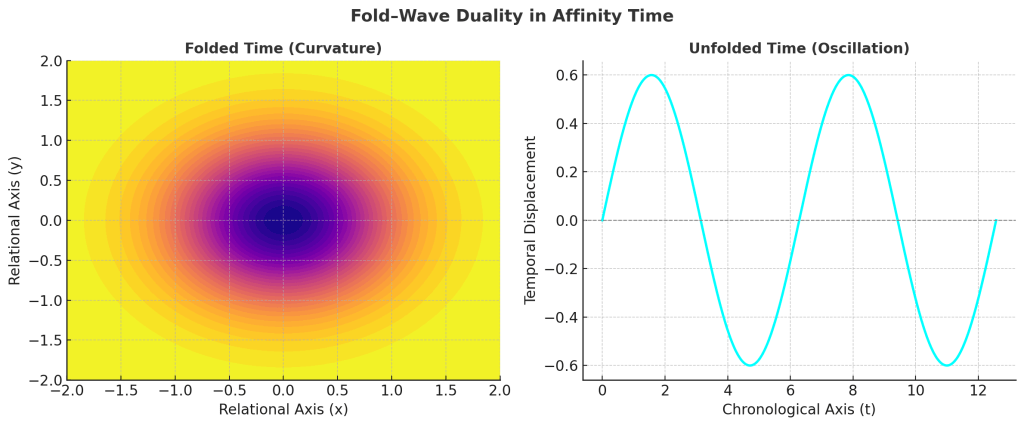
Within the Affinity Time framework, folds in temporality have thus far been modeled as compressions: dense affinity clusters bending the flow of time into depressions, like spherical curvatures in the temporal fabric. Yet observation of these folds reveals a deeper duality.
When the curvature of a fold is projected or unrolled onto a flat baseline, it does not disappear into uniformity. Instead, the curvature manifests as an oscillatory pattern, most naturally taking the form of a sinusoidal wave. The smooth efficiency of the sine function reflects the geometry of curvature distributed across a flat surface.
This suggests that Affinity Time is not only topological (folds and compressions) but also oscillatory (waves and ripples). The two are inseparable expressions of the same underlying phenomenon:
Inside the network, affinities pull time inward, generating folds and spherical depressions.
At the boundary and beyond, these folds unfold into sinusoidal waves, rippling outward as dilated temporal flows.
I propose a novel fold–wave duality within Affinity Time: compressions are experienced as curved surfaces of time, while decompressions appear as oscillatory undulations. This mirrors broader physical and phenomenological metaphors like Einstein’s spacetime curvature alongside Schrödinger’s wave mechanics; Husserl’s thickness of the present alongside Merleau-Ponty’s temporal rhythms.
Diagram: Fold–Wave Duality
This paper advances the Affinity Time framework by introducing the fold–wave duality, a novel principle in which temporal compressions (folds) are conceived as curvatures within affinity networks, and their subsequent unrolling manifests as oscillatory waveforms, thereby uniting topology and rhythm in the perception of time.
The implication is that Affinity Time should be modeled in both topological and waveform registers. Folds visualize the density of affinities within the network; waves visualize the release of those affinities once time dilates beyond the network’s edge. In this sense, the Affinity Time framework encodes not just the geometry of history but its rhythms: compressions become beats, decompressions become flows.
Resonance States and the Maybe Quandary
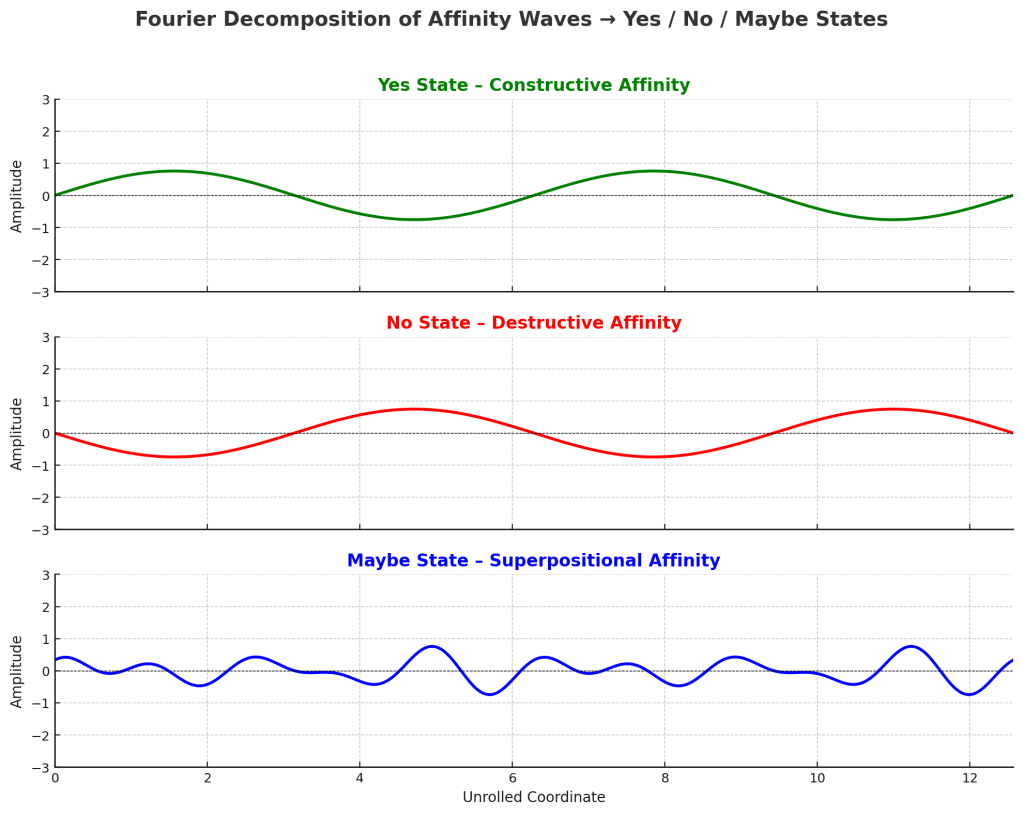
The unrolling of folds into sinusoidal waves reveals not only the rhythmic structure of time but also its ternary logic. When subjected to Fourier decomposition, these oscillations display three recurring resonance states: constructive alignment, destructive cancellation, and ambiguous superposition. These map directly onto what I have elsewhere called the Maybe Quandary or the philosophical problem of indeterminacy, where truth and decision are not binary (yes/no) but oscillatory (yes/no/maybe).
Within Affinity Time, this means that every fold of history does not simply dilate outward into smooth continuity; it resonates. The Yes state arises when affinities reinforce one another into coherent presence. The No state appears when affinities negate or cancel, producing troughs of absence. The Maybe state emerges when affinities partially overlap without resolution, producing ambiguity as a structural feature of time itself.
The implication is that uncertainty is not a flaw in perception but a fundamental rhythm of temporal unfolding. Affinity Time therefore encodes both the geometry of compressions and the logic of oscillations, uniting topology and ternary resonance in a single framework.
Fourier Decomposition and the Yes/No/Maybe States
In extending the fold–wave duality of Affinity Time, we observe that the unrolling of affinities into oscillatory patterns does not produce a single, uniform sine wave. Instead, Fourier-like decomposition reveals distinct repeating motifs that can be interpreted as temporal “states.”
Yes State (Constructive Affinity): Peaks align through reinforcement of multiple affinities, producing a clear, amplified waveform.
No State (Destructive Affinity): Affinities cancel each other, generating troughs or near-flat intervals where temporal resonance collapses.
Maybe State (Superpositional Affinity): Partial overlap of frequencies produces ambiguous, oscillatory motifs which are neither wholly reinforced nor wholly negated.
The Fourier spectrum of Affinity Time suggests that affirmation, negation, and indeterminacy are not merely logical categories but structural consequences of affinity interference. The “maybe” state, in particular, emerges as a natural mode of temporal flow, a ripple born of partial alignments across divergent folds.
Greater Implications
Through its tomographic metaphor, the Affinity Time framework invites broader reflections on perception and reality in archaeological and historical inquiry. By aligning the observer , whether individual or collective with the light origin, it underscores that temporal insights are perspectival, akin to observer effects in broader scientific paradigms where measurement shapes the measured. This avoids claims of absolute knowledge, instead embracing time as a perceptual construct: affinities fold and compress not in isolation, but through the illuminating act of observation.
The introduction of the fold–wave duality deepens this picture. Folds appear as curvatures in time, dense compressions within the network where affinities accumulate. Yet when these curvatures are unrolled, they reveal themselves as oscillatory waveforms, sinusoidal undulations that carry history outward as rhythm. Affinity Time therefore encodes both geometry and music: compressions become beats, decompressions become flows.
Conclusion: Shadows, Folds, Waves, and Resonance
Through its tomographic metaphor, my Affinity Time framework invites broader reflections on perception and reality in archaeological and historical inquiry. By aligning the observer as an individual or collective with the light origin, I underscore that temporal insights are perspectival, akin to observer effects in broader scientific paradigms where measurement shapes the measured. This avoids claims of absolute knowledge, instead embracing time as a perceptual construct: affinities fold and compress not in isolation, but through the illuminating act of observation. Such implications extend to existential questions about human traces across eras, where artifact networks become canvases for contemplating time’s malleability. Future explorations might integrate immersive technologies, allowing observers to “embody” the light origin and experience projections firsthand, further blurring the line between perceiver and perceived.
By constructing the graph, anchoring the observer (individual or collective) at the origin, and projecting this perceptual tomography, the framework yields a shadow map of history. It does not claim to reveal the “true” interior of the past but instead shows how the past compresses, stretches, or vanishes when illuminated from a specific stance. Affinity Time fulfills dual roles in this application: Analytical in that it distills vast artifact data into a single interpretable image, where darkness, gradients, and voids correspond to quantifiable network properties. It is reflective because it underscores that historical claims are angled by the chosen standpoint and the “light” questions, models, and expectations projected through the data.
To this foundation we now add resonance. The fold–wave duality reveals that compressed affinities, when unrolled, do not simply disperse — they oscillate. Fourier decomposition of these waves exposes a ternary rhythm: reinforcement (Yes), cancellation (No), and superposition (Maybe). This “Maybe Quandary” is not an external supplement but an intrinsic feature of Affinity Time: uncertainty itself is patterned, expressed as oscillatory ambiguity within the unfolding of history. Thus, Affinity Time models not only the geometry of folds and the rhythm of waves, but also the resonance states through which affirmation, negation, and indeterminacy co-constitute our experience of time.
Spelling and grammatical errors are retained, and illegible sections are indicated by _____. Clarifications are added in parentheses.
Friday A.M. Rosita May 13th 1882
My Dear Matty
Yours of the 4th was Recd yesterday I was so Glad to hear from you but verry sorry to hear you were Suffering with Bronchitis The big Snow Storm is over weather Clear and Bright, heavy frosts & Ground frozen this morning I am feeling much Better only I am verry week yet, and wont gain any strength until I get lower down I hope _____ this your health has Improved I had Expected to _____ home last Wednesday, but I am doomed to disappointment I have not sold out yet and see but Little Chance to sell there no money hear now, to invest in mines. verry Many of the Best Buisnefs houses have discharged all their clerks & closed doors as there is nothing for them to doo, times are So hard I will I will return home Just asoon as I can I want to Leave hear so verry Badly my Lungs are Teribly Shatered up I have taken so much cold since being sick verry many are Dying from fever & measles, in the mountains a Horrible place for one to spend their Last moments I dont see why you do not get my Letters I write you two or three per week I hope we will soon meet I feel so discouraged I can hardly write to you Jack is going South Soon in to a better climate _____ ______ ______ him up a ranch I hear and is planting potatoes wont do much as he is too Lazy to attend to the calls of nature (several lines of writing become smaller, more hastily rendered, and are illegible, letter resumes on back with legible script) All the Horses in this country are down with pink Eye & Lung feverI hope to bee with you soon Respects to Enquiring friends I have had a fearfull time of trying to hold on to Life I doo wish I could love these mountains I doo hate to see the coaches Leave Every day for the East, and not be able to go with them, write me often
Ever yours
H McKay
P.S. yours of the 13th was Recd Containing ten dollar Bill thank you Matty
Spelling and grammatical errors are retained, and illegible sections are indicated by _____. Clarifications are added in parentheses.
Rosita, July 2, 1881
My dear Matty,
I rec’d your last two papers & and last letter yesterday evening. I am glad your health is better but sorry you have the blues. Come my dearling, there is a better time coming for us, I hope I feel cheerful and in good spirits. Jack is well. I tell you, we crowding things along so hard that we only have time to think and talk about our business. We came here to make money and we intend to do it. We have the foundation laid for something big and all we have to do is hold on, develop our mine, and we will get our price. We intend dooing just as you have said in your last letter. That is to sell when I have got down to ore bed and the excitement is up. Indication grows stronger every inch we go in our SM (Seneca Mining) claim. It’s hard work and heavy blasting. The crevice is still five feet wide and pitching into the mountain. I can’t see Jack from the ____ as he is under the hanging wall. So far the upper wall is called the ____ Wall and the lower one the Foot Wall. Yesterday noon we came to where both walls were terribly cracked and broken up by the Great Heat passing up through the crevise in the general upheaval of the earth. It has at one time been the bottom of the ocean and has been thrown up by the volcanic eruptions. Now I will post you in regard to our affairs. The ____ Jack and I now own two thirds of it and it is recorded and my name and his in the county clerk’s office. I gave Jack the deed to take care of, we gave $150 dollars for it and the doet (debt) owed on it $100 dollars in work this years taxes before he could own half of it. And he said for us to let him buy it for us that it was worth $2000 for it and that he would not give the man less that $500. That he would not have it for less as Blanchard was a mason. We told him to buy it but he as usual kept assing around to keep from work. So I mistrusted a wrong in him I said to jack one morning, came we will go and see the man ourselves. So we went and in less than an hour we had bought it for 150$. Had a notary public making out the deed bye nine o clock. Was back home at work on our claim so you see, if the doc does not work out, the $100 dollars taxes Jack and I will, and we will, then own it all. As I made the trade to that affect and have it in writing. I feel sorry for the honery devil and we wont be hard on him. We will doo just right, and nothing more. He came back late last Sunday, starved out and brought a ____ along to live off of. Jack and I was very liberal when he came back. He bought an old flye blown beef shank & $25 cents of last years potatoes & $25 cents worth of onions and went to making soop & eating old beef sinews and gristle. After eating all the good meat we had on hand when he came back we thought we could stand it as long as he could but he beat us out when it came to dinner yesterday. There was nothing to eat but some old bones and soop two days old. No coffee poor Jack took a little soop, I eat nothing. I said to Jack let us go and get something to eat and buy a pair of nippers so we can pull the gristle and sinews out of each other. As Tilden’s pills won’t moove them so we went bought a nice lot of something to eat brought it home got supper and you ought to have seen him eat last night at supper. The first one at the table, so to make the story short, he is the most unprincipled, meanyest, creature I ever saw in all my life. We keep an account of everything in the final settlement he will have to come to time so last Thursday we got the country surveyor and has the SM Claim run off. Corners and sidelines all permanently made. The surveyor made out his certificate and we had it recorded, two thirds of it to Jack and I so you see, that I am dooing is done right. So if anything happens to me you will have no trouble in seeing just how everyhting stands, no one can beat you out of it. And today I ____ my interest would sell for ten thousand dollars you can always just put the upmost confidence in Jack, he will never wrong order you wronged out of one cent. So as fast as we open up the claims, everything will be recorded and done right. It costs something it will all come back the name of the SM is changed too Cerargyte. And so recorded on account of it’s showing so much chlorides and horn silver rock. My advice to you Matty is to sell off all stock that will give trouble and work and take good care of yourself so that if I am permitted to return, we can enjoy our selves what little time we have left to live on this earth. And for the by all means, if you can get a good woman to live with you, do so, do it bye all means. It is horrible for me to think how lonely you are. Thanks for the stamps and papers. Jack is going to write you on the piece you sent. I don’t think hard of you for not writing. Oftener I know you doo the best you can, do not send anything to eat by express, it costs too high. I send Mr McCay and Lapoteys boxes of specimens on 28th June by express. Yours are in Mr McCay’s box they are all fine, your name was written on yours, wraped in paper. Don;t give any away. I send you something fine today, it is from Leadville, in cedar box. I will do my best to come see you this winter if I possibly can get away. It cost now from hear to Keokuk $37.50 by railroad. The rainy season is on hand and must have a dry warm house. Postscript on the back page- ____ Theirin we can buy ____ also a shaft house to be working this winter. Postscript on the front page- I wrote you note and Mr McCay’s box to send me $100 which you can do by post office order on Rosita PO I hope we will get to pay one before I will have to use it get Mr McCay to go with you to Keokuk to get. Send regards to all friends and a kiss for Matty. Will write soon, I have no time to write today one but you, I will feel better satisfied for you to get one to live with you.
In the enclaves and eddies and in between the homes of Rosita are the remains of implements of everyday life from the people who have passed through here for the past 13,000 years. Fragments of projectile points and other stone tools are occasionally revealed in a dirt driveway, or hiding in a gopher mound under a rabbitbrush which is behind a workshop or garage. The flotsam of the mining town is dispersed everywhere. Tin cans, iron cut nails, and shattered pieces of Ironstone china tableware are prolific in the old town site. The current visitors and residents all share the same space with the spirits of the past, but not exactly the same place in time. We share the same soil and the same vista.
I am proposing a new multidimensional framework for perceiving and understanding time for an observer who is relating to human events of the past. ‘Affinity Time’ redefines temporal proximity not by calendars or clocks, but through experiential, material, and perceptual axes. Drawing from phenomenology, historical materialism, and archaeological models, Affinity Time proposes additional coordinates such as memory intensity (m) and constellational linkage (c) to quantify how artifacts collapse centuries into shared moments. In applying this philosophy to the millennia of human history represented in the fields of the town, I explore how visitors can perceive prehistoric artisans and silver miners as “neighbors” in spacetime; fostering a deeper, more immersive engagement with history. This concept not only enriches museum narratives but also invites broader academic discourse on non-linear temporality, establishing a foundational claim for Affinity Time as a novel interpretive tool.
The Tyranny of the Clock and Linear Time
The ticking of clocks and the linear march of calendars reveal profound limitations. Traditional timekeeping pins events to distant points on a timeline thousands of years for ancient stone tools, a mere 150 for a discarded tin can, yet it fails to convey the intimate proximity we feel to these long-gone neighbors. Enter Affinity Time, a revolutionary concept that reorients our understanding of temporal distance. Rather than measuring separation by years or centuries, Affinity Time gauges “closeness” through the strength of experiential and material bonds. Affinity Time compresses eras into a shared human moment acknowledging the quiet resonance of holding a bone bead that once adorned a prehistoric hunter or the excited vibrations of holding a fragment of an arrowhead. In this framework, history isn’t a faded echo but a vibrant, proximate presence, alive in the artifacts that connect us, inviting us to perceive the past not as “then,” but as an enduring “here and now.”
This shift to Affinity Time opens the door to a multidimensional approach, drawing inspiration from Einstein’s spacetime continuum, where time intertwines with spatial dimensions, yet extending it to encompass the subjective layers of human experience. Influenced by phenomenological thinkers like Husserl and Merleau-Ponty, who emphasize time as a lived retention of the past in the present, and archaeological notions of palimpsests where multiple historical strata overlap in a single site. I propose additional axes to map these affinities. Imagine coordinates beyond the familiar (x, y, z, t): a memory axis quantifying the emotional vividness of an artifact’s echo, or a constellational axis linking disparate eras through shared objects, much like Walter Benjamin’s vision of history as a constellation of charged moments. These dimensions tease a richer temporal landscape, one where our ghost town’s layered artifacts fold time itself, transforming museum visits into portals of profound connection and challenging us to rethink how we navigate the intricate web of history.
Defining Affinity Time: From Linear to Multidimensional
Affinity Time emerges as a perceptual and experiential metric that fundamentally reimagines how we gauge closeness to the past, compressing temporal distance through the interplay of shared space, artifacts, and human connections. In the Rosita Museum, where the same patch of earth has borne witness to prehistoric tool-makers, 1870s silver miners, and contemporary residents, this concept transcends the cold arithmetic of dates and durations. Instead, it prioritizes the subjective bonds forged by material remnants: a discarded tin can doesn’t merely mark a meal from 140 years ago but actively draws that moment into our present, evoking universal experiences. Through these connections, Affinity Time transforms history from a remote chronicle into a living dialogue, where the emotional and sensory resonances of artifacts compress centuries into intimate proximity, allowing us to feel the pulse of bygone lives intertwined with our own.
This approach stands in stark contrast to Einstein’s spacetime framework, which merges three spatial dimensions (x, y, z) with a single temporal dimension (t) to describe the physical universe as a four-dimensional continuum. While relativity revolutionized our understanding of time as relative and bendable under gravity or velocity, it remains a linear construct that doesn’t account for the subjective overlays of human history and memory. In a site like Rosita, where prehistoric projectile points and historic bottles mingle in the soil, such a model falls short; it can’t capture the “historical overlap” where eras feel superimposed through personal encounters. Affinity Time argues for an expansion of this system, incorporating additional axes to infuse spacetime with phenomenological depth and cultural nuance, enabling a more holistic representation of how time warps not just in physics, but in the human experience of layered pasts.
At its core, Affinity Time proposes a multidimensional coordinate system (x, y, z, t, m, c) that builds on spacetime while bridging scientific and philosophical realms. Here, t serves as the conventional time axis, anchoring events to a linear baseline like 1000 BC for prehistoric artifacts, 1885 AD for miners’ relics, or 2025 AD for our present. The m axis, or memory axis, draws from phenomenological retention to measure how vividly an artifact summons the past: a miner’s personal letter might score high due to its tactile script and emotional immediacy, pulling the writer’s voice across the temporal divide, whereas an abstract stone tool could rank lower, its context more elusive. Complementing this, the c axis inspired by Walter Benjamin’s “now-time” quantifies constellational linkages, assessing how artifacts weave eras into a network; for instance, it rates high in our areas overlapping stratigraphic layers, where a prehistoric bead and a historic bottle binds disparate periods through shared materiality.
Beyond this foundation, Affinity Time invites further axes to enrich its flexibility, each tailored to different facets of temporal affinity. The p axis, for perceptual proximity, channels Maurice Merleau-Ponty’s embodied perception by factoring in sensory engagement, such as how grasping an artifact through touch diminishes temporal gaps, making the ancient artisan’s intent feel palpably near. An h axis, rooted in archaeology, could track historical density via material continuity, amplifying affinity in zones of high artifact concentration where dense overlaps signal enduring human presence. More speculatively, an e axis borrows from quantum mechanics’ entanglement, positing how objects like a shared-utility coin “entangle” modern users with their creators, fostering instantaneous connections across time through common purpose and handling. Together, these axes render time “foldable,” like origami creases in the fabric of history, converting the Rosita Museum from a static repository into a dynamic portal where visitors encounter the past as co-present companions rather than distant shadows, inviting profound, multisensory immersion in the continuum of lives that echo through our shared soil and experiences.
Affinity Time in Perception and Experience of History
Delving into the phenomenological roots of Affinity Time reveals a profound alignment with thinkers like Edmund Husserl and Martin Heidegger, who reframe time not as an abstract sequence but as a lived, experiential continuum. Husserl’s concept of temporal consciousness emphasizes “retention,” where the present moment actively holds onto the immediate past, allowing it to linger and influence our now. In the context of the Rosita Museum, artifacts embody this retention: a prehistoric stone tool unearthed from the backyard doesn’t merely represent a distant era but retains the essence of its creator’s gestures, intentions, and existence, drawing that ancient being into our perceptual field. Heidegger extends this in “Being and Time,” portraying time as existential and tied to our “thrownness” into historical contexts, our shared space with past inhabitants makes us co-dwellers in a temporal horizon. Through Affinity Time, these ideas manifest as artifacts that “retain” past beings in the present, compressing millennia into a felt immediacy where the miner’s 1870s letter whispers directly to us, unbound by chronological barriers.
This phenomenological foundation seamlessly links to Walter Benjamin’s historical materialism, where artifacts serve as dialectical images that shatter the illusion of linear progress. Benjamin, in his “Theses on the Philosophy of History,” envisions history as a constellation of moments charged flashes where the past erupts into the present, disrupting continuity and revealing hidden truths. In the museum, a tin can from a miner’s supper or a bone bead from prehistoric adornment becomes such an image: it dialectically juxtaposes eras, creating a network of temporal sparks that illuminate shared human experience. Affinity Time adopts Benjamin’s “now-time” (Jetztzeit) to quantify these constellations, positioning artifacts as portals that forge unexpected alliances across time, like a historic bottle alongside a prehistoric tool forms a material dialogue, reminding us that history isn’t a straight path but a web of interconnected instants.
Applying Affinity Time to everyday museum experiences brings these abstract ideas to life, illustrating how simple acts like digging a hole in the field at the crossroads in Rosita can unveil profound affinities. Imagine breaking ground and revealing a prehistoric tool: despite its ancient origins (t=1000 BC), its high m-value stemming from the tactile immediacy of its craftsmanship makes it feel closer than a contemporary event unfolding miles away, such as a news headline from another continent. The shared spatial coordinates (x, y, z) amplify this, as the tool’s emergence from the same earth we stand on compresses temporal distance, fostering a sense of co-presence with its maker. Similarly, unearthing a 1870s coin or cutlery fragment links us through constellational ties (c-axis), where the artifact’s utility echoes our own daily rituals, turning excavation into a revelation of temporal folds that prioritize experiential bonds over mere chronology.
The implications for visitors are transformative, elevating museum encounters from passive observation to active temporal dialogue that enhances empathy and immersion. By engaging with Affinity Time, guests are invited to “feel the miner’s struggle through this worn out boot,” sensing the artifact’s retained wear and context as if sharing a walk across centuries, or to trace the prehistoric artisan’s touch in a hand forged iron tool, bridging emotional gaps through embodied perception. This shifts history from a detached narrative to a participatory experience, where high perceptual proximity (p-axis) via sensory handling; touching, holding, or seeing deepens connections, fostering compassion for lives long past. For the Rosita Museum, this approach turns visitors into temporal explorers, co-creating meaning and leaving with a heightened awareness of history’s living pulse.
Affinity Time is not without challenges, particularly the inherent subjectivity of its axes, which rely on personal interpretations of memory (m) and constellational links (c). What evokes vivid retention for one visitor such as a miner’s photograph stirring emotional echoes but it might resonate less for another, highlighting the need for empirical calibration through tools like visitor surveys to average scores or refine metrics. Archaeological input could help standardize historical density (h-axis) based on site data, while phenomenological insights guide perceptual assessments. Importantly, Affinity Time complements rather than replaces scientific dating methods, such as carbon-14 analysis or stratigraphic sequencing; it enriches these objective tools with subjective layers, offering a fuller spectrum of temporal understanding that honors both fact and feeling in our exploration of the past.
Applications to the Rosita Museum
To illustrate Affinity Time in action, let’s turn to case studies from the Rosita Museum’s collection, assigning coordinates to key artifacts within the proposed multidimensional system (x, y, z, t, m, c). Consider the humble tin can, a relic from an 1870s miner’s supper unearthed in the backyard at spatial coordinates roughly (10, 5, 0) a spot shared with modern life. Its values might be t=1885 (conventional time), m=0.9 (high memory axis due to the vivid evocation of a specific, relatable meal through its preserved label and dents), and c=0.8 (strong constellational axis, as it links the mining era to present-day food rituals in a shared context of daily survival). In contrast, a prehistoric bead, found at similar spatial coordinates (10, 5, -1) to reflect its deeper stratigraphic layer, could be assigned t=1000 BCE, m=0.5 (moderate memory retention, as its abstract form offers less immediate emotional context than a personal item), and c=0.7 (solid linkage to other prehistoric artifacts, forming a network of ancient adornment and craftsmanship). These assignments aren’t arbitrary; they’re derived from phenomenological assessments of sensory and emotional impact, archaeological context, and Benjaminian connections, demonstrating how Affinity Time quantifies why the tin can feels “closer” while the bead’s deeper temporal roots are bridged by shared space.
Visualizing these coordinates brings the abstract to life through our 3D Temporal Constellation Diagram, a conceptual model that maps affinity networks in an intuitive, immersive way. In a conceptual diagram, artifacts might appear as glowing nodes plotted across spatial (x, y, z) and temporal (t) axes, with node sizes scaled by the m (memory) value to emphasize evocative power larger spheres for high-retention items like an ancient structure, smaller for subtler ones like a rusted nail. Lines connecting nodes represent the c (constellational) axis, their thickness proportional to linkage strength, creating a web that highlights temporal folds: the tin can’s thick ties to present-day and thinner threads to prehistoric beads illustrate overlapping eras in the Rosita soil. This visualization for 3D rendering, transforms static data into a dynamic constellation, allowing viewers to rotate perspectives and trace how artifacts collapse time, much like stars in Benjamin’s historical sky forming unexpected patterns.
Affinity Time offers innovative ways to reimagine museum exhibits and visitor interactions, moving beyond traditional chronological displays to ones organized by affinity scores. Instead of sequencing artifacts from oldest to newest; prehistoric tools first, then mining relics, we could cluster them by grouping high-affinity items. The broader impact of Affinity Time extends far beyond Rosita, inspiring a paradigm shift in how other historical sites engage visitors with layered pasts. At ancient ruins like Pompeii or Mesa Verde, where volcanic ash or cliff dwellings preserve multiple eras in one locale, curators could adopt multidimensional coordinates to highlight affinity over linearity, fostering empathy by emphasizing shared human experiences like daily meals or craftsmanship. In urban settings, such as Rome’s palimpsest of Roman forums atop medieval streets, or New York’s indigenous sites beneath skyscrapers, Affinity Time could guide exhibits that map historical density (h-axis) and perceptual proximity (p-axis), allowing city dwellers to “feel” entangled with buried histories. By rethinking visitor engagement this way and prioritizing experiential closeness over distant timelines, Affinity Time could democratize history, making it more emotionally resonant, ultimately transforming global heritage sites into vibrant portals where the past actively converses with the present.
Conclusion: Inviting Dialogue
In concluding this exploration, I assert Affinity Time as an original framework, meticulously crafted from the unique temporal tapestry of Rosita, a site where prehistoric echoes, 1870s mining relics, and modern life converge in the same soil. Grounded in the tangible artifacts unearthed and the visceral experiences they evoke, this concept emerges not from abstract theory alone but from the lived reality of digging up an old beer bottle that bridges 140 years or holding a stone tool that spans millennia. This framework invites scholars and enthusiasts alike to recognize its potential as a bridge between phenomenology, historical materialism, and scientific models, all tailored to sites of profound historical overlap like Rosita.
As a seeker of truth and the impartial curator of the Rosita Museum I ride the waves of history where they take me. I usually do not impose any expectations on my explorations, except to hope to better understand the history of the town, and maybe discover interesting specimens for exhibit. There is one specimen which eludes my pursuit. I know it exists, but I have never seen one in person…
Sometime around 1879 a token was used by the Rosita Brewery in at least two denominations, one token marked for 5 cents and one marked for 10 cents.The tokens were produced on the same planchet as a short lived and early token from nearby Silver Cliff, Colorado, from the Horn Silver saloon, and I suspect they were produced by a local or semi-local brass or novelty works. At least two have been discovered previously in Rosita, but I cannot find an example for the museum despite thousands of hours searching, and many excavations of various sizes.
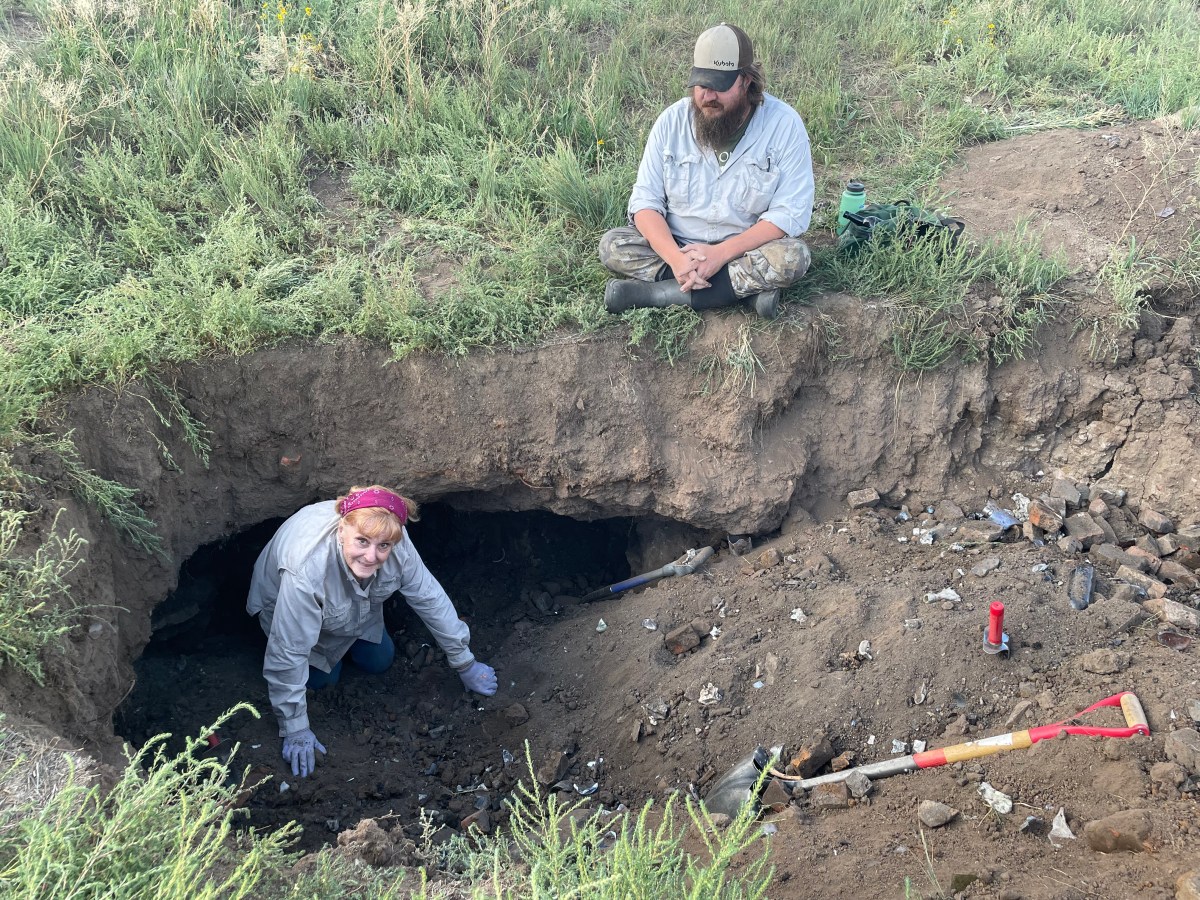
Here is a picture of me after another long day of sailing the high seas of history in Rosita, screaming into the howling wind and sea spray, plunging with reckless abandon towards the horizon beyond which I might find that which has always eluded me; a specimen of the Rosita Brewery token. Where do you think it is? How many years more do you think it will take me to discover an example?
Initial test holes on a site in the business district revealed the cellar of a saloon which has lain undisturbed since it burned down in the great fire of 1881. The original inventory contents of the cellar are still present, along with rubble and charred lumber from the fire. Exavations should be complete by the end of summer, 2025, and photos of artifacts and the excavation will be available for view. This is a rare opportunity to better understand the day to day life of a business in Rosita during the silver mining era.
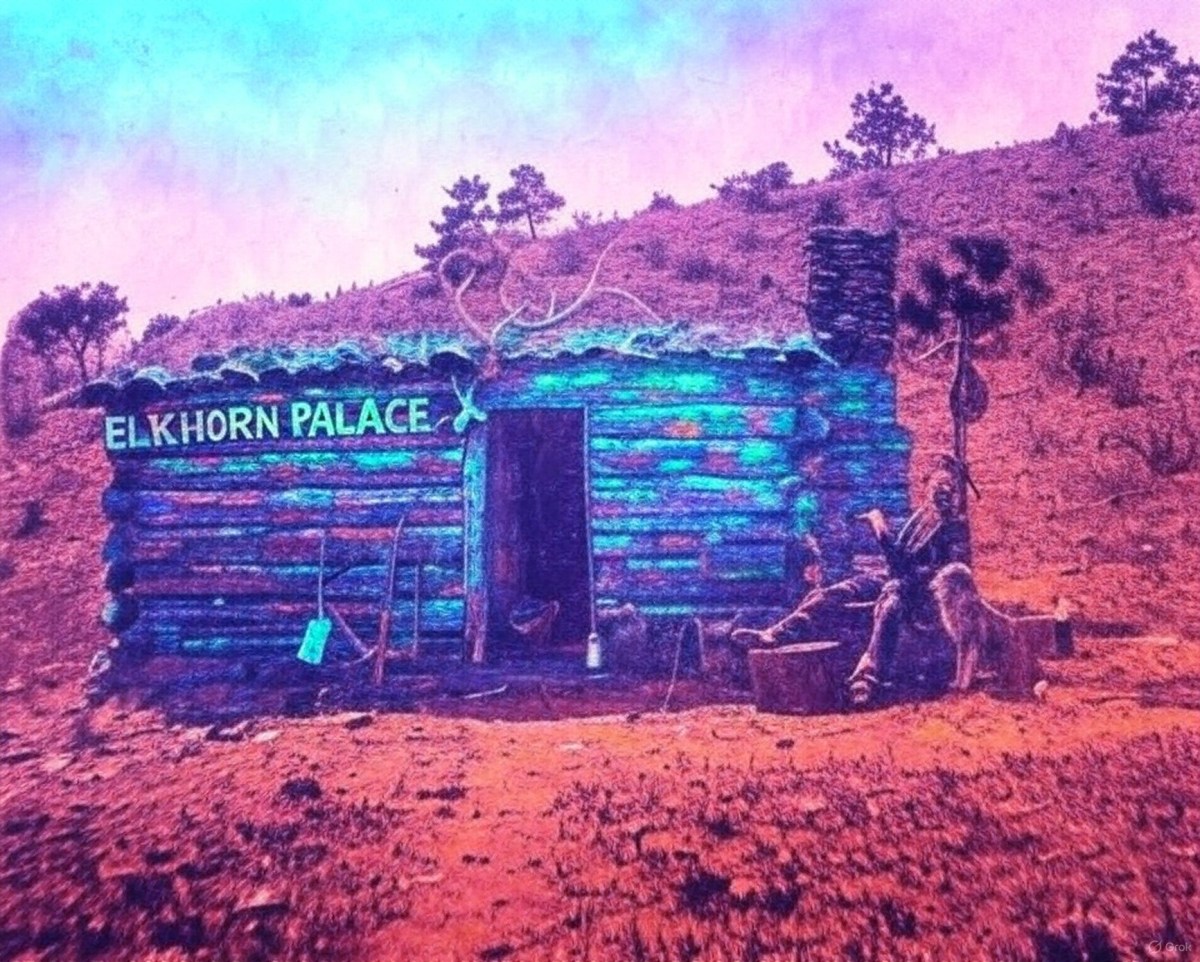
In the summer of 1980 I was 3 years old, and my aunt and uncle were building an off grid cabin in an eddy along Hungry Gulch in Rosita. The cabin was only a floor on pilings at that point, and the first night we camped there on the platform, playing Uno by lantern light and I ate Oreo cookies with a glass of powdered milk. It was Heaven. I stayed up all night in my sleeping bag breathing mountain air, watching shooting stars, and eager to explore when the sun rose.
The first morning I left at sunrise to go look for arrowheads. I was already obsessed with prehistory and arrowheads. I did not find arrowheads, but there was a lost mining town out in the rabbitbrush. It was magical. There was a cabin site near where my relatives were building which I found immediately. In those days there were still abundant and interesting artifacts on the surface of the ground. That morning I found a number of curios which interested me, to include a couple of old suspender ends, a porcelain doll head, the tip of a mining pick, a tinware spoon, and an interesting mineral specimen. I returned to the cabin for breakfast with a handful of neat stuff. They fed me eggs and bacon from Jenning’s Market. My aunt went back to the cabin site with me and we spent some time looking for additional artifacts. We found a few more items, and they are still displayed in the little rock garden alongside the cabin 45 years later.
Over the years I always explored around the ephemeral ruins of Rosita when I came up, and when I was 12 years old I purchased a metal detector with money I earned from selling candy at school at a 400% markup. Candy was forbidden at school, and so I took advantage of the black market premium. The metal detector I wanted was $650.00 in 1990. That was a lot of money to earn. I started with $10.00 in assorted candy I bought from Walgreens in bulk bags, and I worked my way up to a White’s Eagle 2 metal detector. It was the first metal detector with an LCD screen instead of an analog needle and dial meter. It had a big American flag sticker on the battery hatch. I loved it dearly.
When I brought my metal detector to Rosita for the first time I thought I was really going to hit it big. I decided there was a tin can full of silver dollars hidden in the saddle about halfway up the side of Pringle Hill, and I went up there at first dawn. There was nothing there except natural beauty. I returned down into the town site of Rosita with my metal detector and began the first day of my new adventure in life- being completely overwhelmed by tin cans, fragments of tin cans, and sheet tin from roofs and flashing .
The metal detector is almost unusable, and almost every find is tin. But it works once in awhile, and so I swing it around and dig up my tin cans, and I enjoy the process and the eternal joke. I always laugh when I dig up a can, so that the universe can see that I am trying to be a good sport about it. I find many laughs and almost no “treasure” which is fine.
The story of the town that came to life as I saw it thorough old spoons, broken bottles, cartridge casings, tin cans, and the passage of my own life was the story of us. It was full of poignancy and terror and desperation. It was full of deep and high religion and earnest hope. They had churches and they had brothels. Some of those miners had to use narcotics to overcome their fear at placing their feet into a small bucket, grabbing on to a rope, and having a mule hoist them 700 feet down into a totally dark and vertical shaft. There were horse races and balls. They had no electricity, no railroads, limited access to goods, no labor laws, and yet they built roads, banks, hotels, saloons, mines, and steeples.
I even encountered some of the Indians who passed through Rosita for at least the last 13,000 years. Lots of different people and tribes came through the area over the years, but I am not sure that anyone really ever stayed for long and in large numbers. They hunted deer and processed pinon nuts on every little hill overlooking the courses of the arroyos. The first people in Rosita probably saw the last of the Pleistocene megafauna. The last Indians in Rosita were still using little stone arrowheads on the tips of their arrows, but also used little metal arrowheads , and muskets from the fur traders. Perhaps the very last one knapped a cutting/scraping tool out of the deep aqua glass from the broken base of a Carl Conrad and Company Original Budweiser bottle, ca. 1881, before discarding it alongside Euclid Street as it runs through the bottom of Poverty Gulch next to where my mama lives now.
I am as interested in the fields and artifacts of Rosita as ever. Now I am well into middle age and I like digging holes more than I like filling them in. I am currently digging into the cellar of a saloon which burned in the great fire of 1881 and was the end of the original town. Down in the cellar it still smells like charred lumber and smoke. It is just like 1881. The fire boiled the bottles of Rosita Brewing Company beer and popped the tops off in a very precise way. It is amazing and I am grateful to sit in my hole in the field at the intersection of the roads and come to know the passing of time by artifacts in layers of soil, light and dark, and the seasons.

 The Rosita Museum