
Context, Lineage, and Novelty — a Synopsis
This synopsis situates Affinity Time alongside landmark contributions in three fields: archaeology, philosophy of time, and phenomenology, demonstrating both its intellectual lineage and its novelty. With the recent expansion of its conceptual apparatus, Affinity Time now stands as both a synthesis and an extension, combining inherited insights with new axes, dualities, and computational metaphors.
Field Comparisons
Archaeology
| Contribution | Parallel | Divergence |
|---|---|---|
| Processual (Binford, 1960s) | Systematic framework across artifacts | Phenomenological, adds axes (m, c, p, h, e) |
| Post-Processual (Hodder, 1980s) | Shares interpretive focus on meaning & perception | Formalizes interpretation into coordinates + tomography |
| Assemblage Theory (DeLanda, 2006) | Constellational axis (c) resonates | Adds quantitative visualization, folds + waves |
| Time Perspectivism (Lucas, 2005) | Affirms non-linear, layered temporality | Adds measurement + visualization toolkit |
Philosophy of Time
| Contribution | Parallel | Divergence |
|---|---|---|
| Augustine | Memory axis (m) echoes memory/attention/expectation | Adds spatial + network dimensions |
| Kant | Time constituted by perception | Extends into artifacts & networks |
| Bergson | Critiques clock time, aligns with durée | Quantifies lived time via axes |
| McTaggart | Multiple temporalities (A & B series) | Expands with c, h, e axes |
Phenomenology
| Contribution | Parallel | Divergence |
|---|---|---|
| Husserl | Memory axis (m) parallels retention–protention | Extends into material world |
| Heidegger | Ties time to existence & context | Adds tomography to visualize folds |
| Merleau-Ponty | Perceptual axis (p) echoes embodied time | Adds computational metaphors (light rays, calibration) |
| Ricoeur | Artifacts as narrative connectors | Extends to visual & mathematical models (Fourier/Maybe) |
Expanded Contributions
Taken together, these comparisons show that Affinity Time stands on the shoulders of giants: Augustine’s memory, Bergson’s durée, Husserl’s retention, Heidegger’s thrownness, and archaeology’s assemblages and multiple temporalities. Yet it does not merely echo them. Its novelty lies in:
- Coordinate system with expanded axes — t (chronological), m (memory intensity), c (constellational linkage), p (perceptual proximity), h (horizon density), e (entanglement/emergence).
- Fold–Wave Duality — time can appear as compressed folds (shadow maps, attenuations) or oscillatory fields (waves, Fourier states of “yes/no/maybe”).
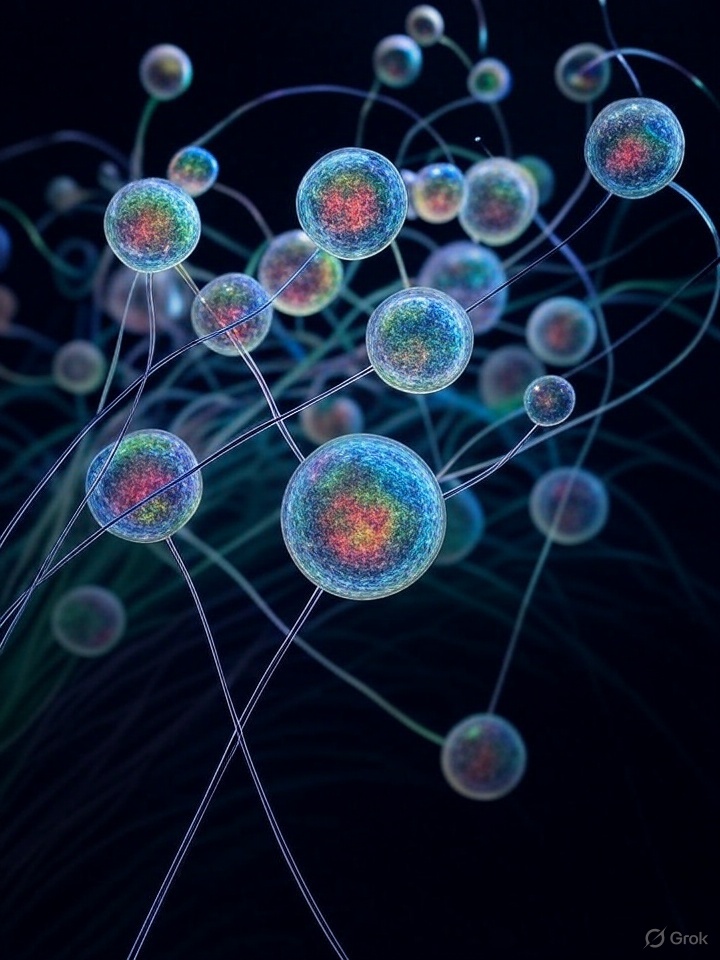
- Visualizable models — tomographic projections, shadow maps with threshold bands, and iridescent RGB overlays for simultaneous dimensional expression.
- Observer as origin — the observer’s standpoint acts as the barycenter or light source, with calibration possible across individuals and networks.
- Application beyond archaeology — climate debates, social media networks, policy response timelines, and memory studies.
- Handling indeterminacy — the Maybe Quandary and Fourier decomposition model how uncertainty itself leaves a temporal signature.
Conclusion
If archaeology and philosophy have long struggled with how to articulate non-linear time, Affinity Time offers one possible synthesis: a multidimensional, perceptual, and computationally suggestive model. It transforms artifacts from inert remnants into active coordinates of temporal affinity, and it reframes the observer not as detached analyst but as the very source of illumination that reveals folds, waves, compressions, and constellations.
Whether in a museum, a dataset, or a network of social relations, Affinity Time invites us to perceive history as a living present, a shimmering field where memory, perception, and connection overlap ; a space where all things relate to all other things.
 The Rosita Museum