
by Colin Joseph
Abstract
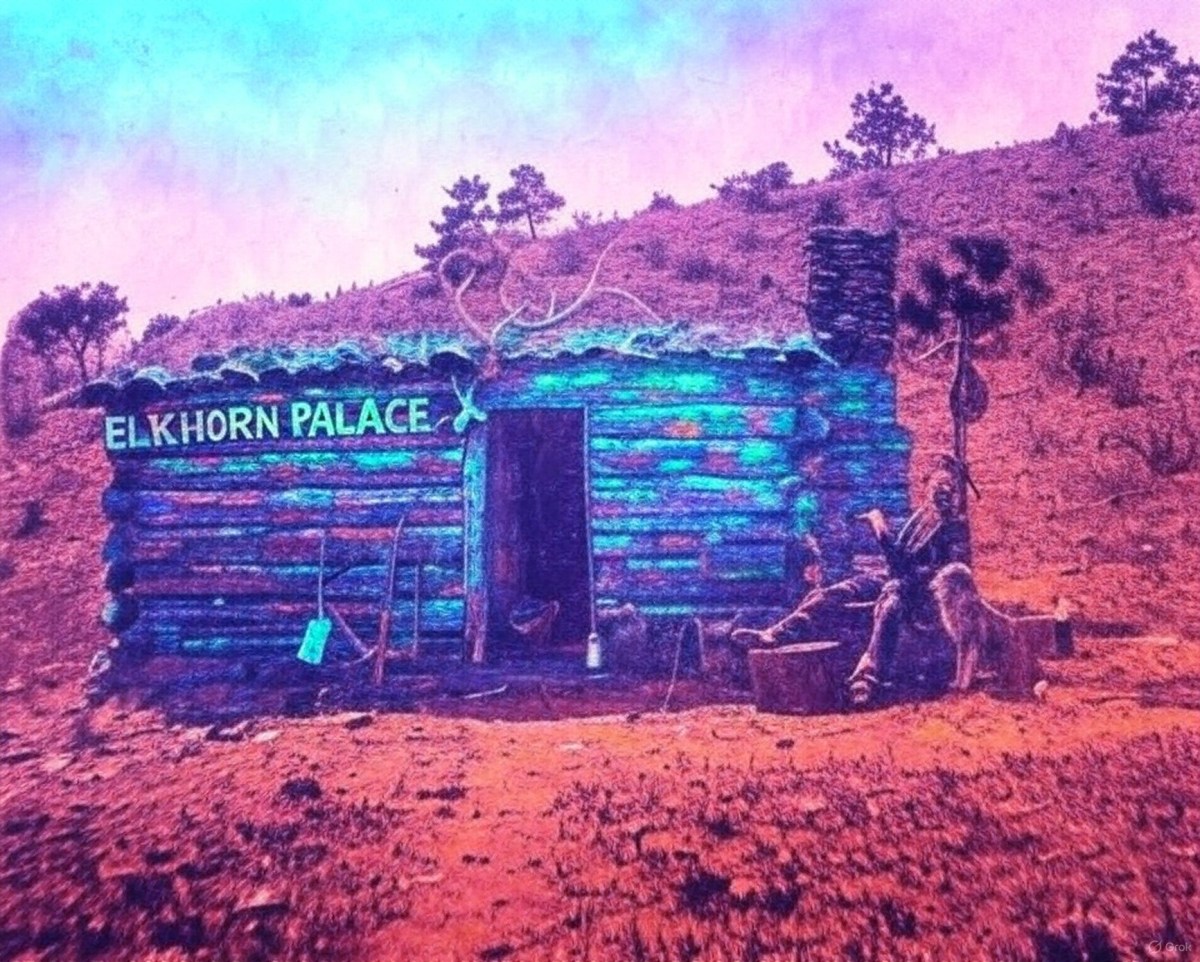
In the enclaves and eddies and in between the homes of Rosita are the remains of implements of everyday life from the people who have passed through here for the past 13,000 years. Fragments of projectile points and other stone tools are occasionally revealed in a dirt driveway, or hiding in a gopher mound under a rabbitbrush which is behind a workshop or garage. The flotsam of the mining town is dispersed everywhere. Tin cans, iron cut nails, and shattered pieces of Ironstone china tableware are prolific in the old town site. The current visitors and residents all share the same space with the spirits of the past, but not exactly the same place in time. We share the same soil and the same vista.
I am proposing a new multidimensional framework for perceiving and understanding time for an observer who is relating to human events of the past. ‘Affinity Time’ redefines temporal proximity not by calendars or clocks, but through experiential, material, and perceptual axes. Drawing from phenomenology, historical materialism, and archaeological models, Affinity Time proposes additional coordinates such as memory intensity (m) and constellational linkage (c) to quantify how artifacts collapse centuries into shared moments. In applying this philosophy to the millennia of human history represented in the fields of the town, I explore how visitors can perceive prehistoric artisans and silver miners as “neighbors” in spacetime; fostering a deeper, more immersive engagement with history. This concept not only enriches museum narratives but also invites broader academic discourse on non-linear temporality, establishing a foundational claim for Affinity Time as a novel interpretive tool.
The Tyranny of the Clock and Linear Time
The ticking of clocks and the linear march of calendars reveal profound limitations. Traditional timekeeping pins events to distant points on a timeline thousands of years for ancient stone tools, a mere 150 for a discarded tin can, yet it fails to convey the intimate proximity we feel to these long-gone neighbors. Enter Affinity Time, a revolutionary concept that reorients our understanding of temporal distance. Rather than measuring separation by years or centuries, Affinity Time gauges “closeness” through the strength of experiential and material bonds. Affinity Time compresses eras into a shared human moment acknowledging the quiet resonance of holding a bone bead that once adorned a prehistoric hunter or the excited vibrations of holding a fragment of an arrowhead. In this framework, history isn’t a faded echo but a vibrant, proximate presence, alive in the artifacts that connect us, inviting us to perceive the past not as “then,” but as an enduring “here and now.”
This shift to Affinity Time opens the door to a multidimensional approach, drawing inspiration from Einstein’s spacetime continuum, where time intertwines with spatial dimensions, yet extending it to encompass the subjective layers of human experience. Influenced by phenomenological thinkers like Husserl and Merleau-Ponty, who emphasize time as a lived retention of the past in the present, and archaeological notions of palimpsests where multiple historical strata overlap in a single site. I propose additional axes to map these affinities. Imagine coordinates beyond the familiar (x, y, z, t): a memory axis quantifying the emotional vividness of an artifact’s echo, or a constellational axis linking disparate eras through shared objects, much like Walter Benjamin’s vision of history as a constellation of charged moments. These dimensions tease a richer temporal landscape, one where our ghost town’s layered artifacts fold time itself, transforming museum visits into portals of profound connection and challenging us to rethink how we navigate the intricate web of history.
Defining Affinity Time: From Linear to Multidimensional
Affinity Time emerges as a perceptual and experiential metric that fundamentally reimagines how we gauge closeness to the past, compressing temporal distance through the interplay of shared space, artifacts, and human connections. In the Rosita Museum, where the same patch of earth has borne witness to prehistoric tool-makers, 1870s silver miners, and contemporary residents, this concept transcends the cold arithmetic of dates and durations. Instead, it prioritizes the subjective bonds forged by material remnants: a discarded tin can doesn’t merely mark a meal from 140 years ago but actively draws that moment into our present, evoking universal experiences. Through these connections, Affinity Time transforms history from a remote chronicle into a living dialogue, where the emotional and sensory resonances of artifacts compress centuries into intimate proximity, allowing us to feel the pulse of bygone lives intertwined with our own.
This approach stands in stark contrast to Einstein’s spacetime framework, which merges three spatial dimensions (x, y, z) with a single temporal dimension (t) to describe the physical universe as a four-dimensional continuum. While relativity revolutionized our understanding of time as relative and bendable under gravity or velocity, it remains a linear construct that doesn’t account for the subjective overlays of human history and memory. In a site like Rosita, where prehistoric projectile points and historic bottles mingle in the soil, such a model falls short; it can’t capture the “historical overlap” where eras feel superimposed through personal encounters. Affinity Time argues for an expansion of this system, incorporating additional axes to infuse spacetime with phenomenological depth and cultural nuance, enabling a more holistic representation of how time warps not just in physics, but in the human experience of layered pasts.
At its core, Affinity Time proposes a multidimensional coordinate system (x, y, z, t, m, c) that builds on spacetime while bridging scientific and philosophical realms. Here, t serves as the conventional time axis, anchoring events to a linear baseline like 1000 BC for prehistoric artifacts, 1885 AD for miners’ relics, or 2025 AD for our present. The m axis, or memory axis, draws from phenomenological retention to measure how vividly an artifact summons the past: a miner’s personal letter might score high due to its tactile script and emotional immediacy, pulling the writer’s voice across the temporal divide, whereas an abstract stone tool could rank lower, its context more elusive. Complementing this, the c axis inspired by Walter Benjamin’s “now-time” quantifies constellational linkages, assessing how artifacts weave eras into a network; for instance, it rates high in our areas overlapping stratigraphic layers, where a prehistoric bead and a historic bottle binds disparate periods through shared materiality.
Beyond this foundation, Affinity Time invites further axes to enrich its flexibility, each tailored to different facets of temporal affinity. The p axis, for perceptual proximity, channels Maurice Merleau-Ponty’s embodied perception by factoring in sensory engagement, such as how grasping an artifact through touch diminishes temporal gaps, making the ancient artisan’s intent feel palpably near. An h axis, rooted in archaeology, could track historical density via material continuity, amplifying affinity in zones of high artifact concentration where dense overlaps signal enduring human presence. More speculatively, an e axis borrows from quantum mechanics’ entanglement, positing how objects like a shared-utility coin “entangle” modern users with their creators, fostering instantaneous connections across time through common purpose and handling. Together, these axes render time “foldable,” like origami creases in the fabric of history, converting the Rosita Museum from a static repository into a dynamic portal where visitors encounter the past as co-present companions rather than distant shadows, inviting profound, multisensory immersion in the continuum of lives that echo through our shared soil and experiences.
Affinity Time in Perception and Experience of History
Delving into the phenomenological roots of Affinity Time reveals a profound alignment with thinkers like Edmund Husserl and Martin Heidegger, who reframe time not as an abstract sequence but as a lived, experiential continuum. Husserl’s concept of temporal consciousness emphasizes “retention,” where the present moment actively holds onto the immediate past, allowing it to linger and influence our now. In the context of the Rosita Museum, artifacts embody this retention: a prehistoric stone tool unearthed from the backyard doesn’t merely represent a distant era but retains the essence of its creator’s gestures, intentions, and existence, drawing that ancient being into our perceptual field. Heidegger extends this in “Being and Time,” portraying time as existential and tied to our “thrownness” into historical contexts, our shared space with past inhabitants makes us co-dwellers in a temporal horizon. Through Affinity Time, these ideas manifest as artifacts that “retain” past beings in the present, compressing millennia into a felt immediacy where the miner’s 1870s letter whispers directly to us, unbound by chronological barriers.
This phenomenological foundation seamlessly links to Walter Benjamin’s historical materialism, where artifacts serve as dialectical images that shatter the illusion of linear progress. Benjamin, in his “Theses on the Philosophy of History,” envisions history as a constellation of moments charged flashes where the past erupts into the present, disrupting continuity and revealing hidden truths. In the museum, a tin can from a miner’s supper or a bone bead from prehistoric adornment becomes such an image: it dialectically juxtaposes eras, creating a network of temporal sparks that illuminate shared human experience. Affinity Time adopts Benjamin’s “now-time” (Jetztzeit) to quantify these constellations, positioning artifacts as portals that forge unexpected alliances across time, like a historic bottle alongside a prehistoric tool forms a material dialogue, reminding us that history isn’t a straight path but a web of interconnected instants.
Applying Affinity Time to everyday museum experiences brings these abstract ideas to life, illustrating how simple acts like digging a hole in the field at the crossroads in Rosita can unveil profound affinities. Imagine breaking ground and revealing a prehistoric tool: despite its ancient origins (t=1000 BC), its high m-value stemming from the tactile immediacy of its craftsmanship makes it feel closer than a contemporary event unfolding miles away, such as a news headline from another continent. The shared spatial coordinates (x, y, z) amplify this, as the tool’s emergence from the same earth we stand on compresses temporal distance, fostering a sense of co-presence with its maker. Similarly, unearthing a 1870s coin or cutlery fragment links us through constellational ties (c-axis), where the artifact’s utility echoes our own daily rituals, turning excavation into a revelation of temporal folds that prioritize experiential bonds over mere chronology.
The implications for visitors are transformative, elevating museum encounters from passive observation to active temporal dialogue that enhances empathy and immersion. By engaging with Affinity Time, guests are invited to “feel the miner’s struggle through this worn out boot,” sensing the artifact’s retained wear and context as if sharing a walk across centuries, or to trace the prehistoric artisan’s touch in a hand forged iron tool, bridging emotional gaps through embodied perception. This shifts history from a detached narrative to a participatory experience, where high perceptual proximity (p-axis) via sensory handling; touching, holding, or seeing deepens connections, fostering compassion for lives long past. For the Rosita Museum, this approach turns visitors into temporal explorers, co-creating meaning and leaving with a heightened awareness of history’s living pulse.
Affinity Time is not without challenges, particularly the inherent subjectivity of its axes, which rely on personal interpretations of memory (m) and constellational links (c). What evokes vivid retention for one visitor such as a miner’s photograph stirring emotional echoes but it might resonate less for another, highlighting the need for empirical calibration through tools like visitor surveys to average scores or refine metrics. Archaeological input could help standardize historical density (h-axis) based on site data, while phenomenological insights guide perceptual assessments. Importantly, Affinity Time complements rather than replaces scientific dating methods, such as carbon-14 analysis or stratigraphic sequencing; it enriches these objective tools with subjective layers, offering a fuller spectrum of temporal understanding that honors both fact and feeling in our exploration of the past.
Applications to the Rosita Museum
To illustrate Affinity Time in action, let’s turn to case studies from the Rosita Museum’s collection, assigning coordinates to key artifacts within the proposed multidimensional system (x, y, z, t, m, c). Consider the humble tin can, a relic from an 1870s miner’s supper unearthed in the backyard at spatial coordinates roughly (10, 5, 0) a spot shared with modern life. Its values might be t=1885 (conventional time), m=0.9 (high memory axis due to the vivid evocation of a specific, relatable meal through its preserved label and dents), and c=0.8 (strong constellational axis, as it links the mining era to present-day food rituals in a shared context of daily survival). In contrast, a prehistoric bead, found at similar spatial coordinates (10, 5, -1) to reflect its deeper stratigraphic layer, could be assigned t=1000 BCE, m=0.5 (moderate memory retention, as its abstract form offers less immediate emotional context than a personal item), and c=0.7 (solid linkage to other prehistoric artifacts, forming a network of ancient adornment and craftsmanship). These assignments aren’t arbitrary; they’re derived from phenomenological assessments of sensory and emotional impact, archaeological context, and Benjaminian connections, demonstrating how Affinity Time quantifies why the tin can feels “closer” while the bead’s deeper temporal roots are bridged by shared space.
Visualizing these coordinates brings the abstract to life through our 3D Temporal Constellation Diagram, a conceptual model that maps affinity networks in an intuitive, immersive way. In a conceptual diagram, artifacts might appear as glowing nodes plotted across spatial (x, y, z) and temporal (t) axes, with node sizes scaled by the m (memory) value to emphasize evocative power larger spheres for high-retention items like an ancient structure, smaller for subtler ones like a rusted nail. Lines connecting nodes represent the c (constellational) axis, their thickness proportional to linkage strength, creating a web that highlights temporal folds: the tin can’s thick ties to present-day and thinner threads to prehistoric beads illustrate overlapping eras in the Rosita soil. This visualization for 3D rendering, transforms static data into a dynamic constellation, allowing viewers to rotate perspectives and trace how artifacts collapse time, much like stars in Benjamin’s historical sky forming unexpected patterns.
Affinity Time offers innovative ways to reimagine museum exhibits and visitor interactions, moving beyond traditional chronological displays to ones organized by affinity scores. Instead of sequencing artifacts from oldest to newest; prehistoric tools first, then mining relics, we could cluster them by grouping high-affinity items. The broader impact of Affinity Time extends far beyond Rosita, inspiring a paradigm shift in how other historical sites engage visitors with layered pasts. At ancient ruins like Pompeii or Mesa Verde, where volcanic ash or cliff dwellings preserve multiple eras in one locale, curators could adopt multidimensional coordinates to highlight affinity over linearity, fostering empathy by emphasizing shared human experiences like daily meals or craftsmanship. In urban settings, such as Rome’s palimpsest of Roman forums atop medieval streets, or New York’s indigenous sites beneath skyscrapers, Affinity Time could guide exhibits that map historical density (h-axis) and perceptual proximity (p-axis), allowing city dwellers to “feel” entangled with buried histories. By rethinking visitor engagement this way and prioritizing experiential closeness over distant timelines, Affinity Time could democratize history, making it more emotionally resonant, ultimately transforming global heritage sites into vibrant portals where the past actively converses with the present.
Conclusion: Inviting Dialogue
In concluding this exploration, I assert Affinity Time as an original framework, meticulously crafted from the unique temporal tapestry of Rosita, a site where prehistoric echoes, 1870s mining relics, and modern life converge in the same soil. Grounded in the tangible artifacts unearthed and the visceral experiences they evoke, this concept emerges not from abstract theory alone but from the lived reality of digging up an old beer bottle that bridges 140 years or holding a stone tool that spans millennia. This framework invites scholars and enthusiasts alike to recognize its potential as a bridge between phenomenology, historical materialism, and scientific models, all tailored to sites of profound historical overlap like Rosita.
 The Rosita Museum